
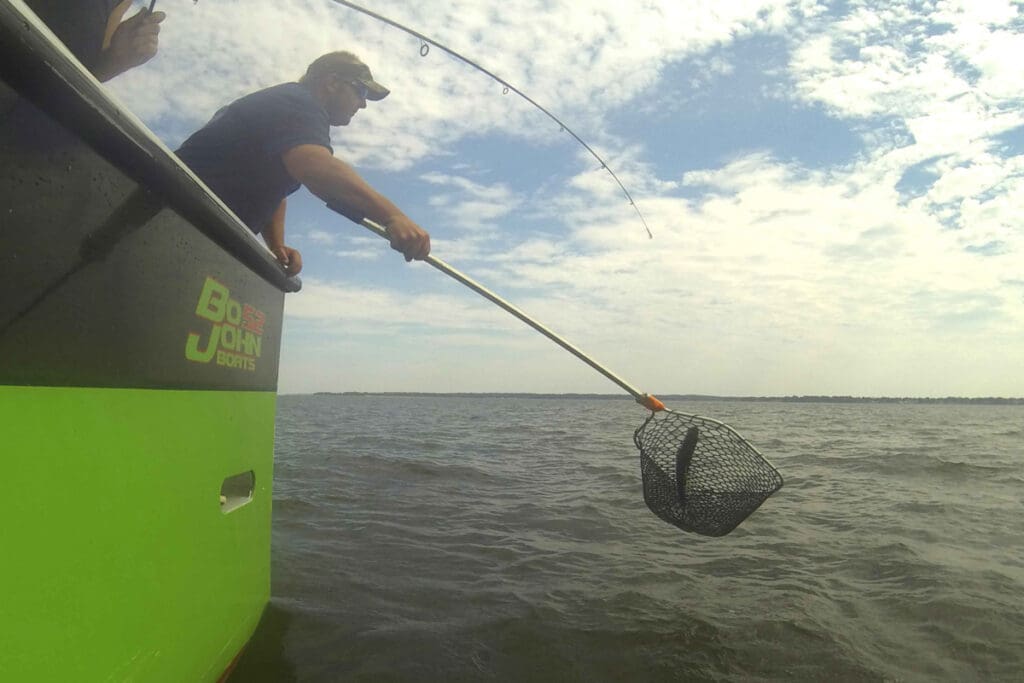
Recently, my landing net was turned into a tangled mess of bent aluminum and shredded mesh by a very angry 47-inch cobia that maybe, just maybe, we should have played out a bit longer before landing. Then a week later, my backup net broke on a 10-pound striped bass. As you might guess, a net-buying trip to the tackle shop soon followed. And as I gazed at all of the landing nets lined up in the isle, more than half of which I’d call completely sub-par, it reminded me that all landing nets are not created equal. Not by a longshot. So the next time you go net shopping, remember:
- You’ll need to choose one with a handle long enough to reach the water from your boat, but longer isn’t always better. Longer handles are tougher to stow, and can be unwieldy on small boats. To use an extreme example, nets used by kayak anglers can’t have a handle much longer than a foot.
- Extendable or telescopic handles are great for extending your reach while minimizing stowage space, but remember that they also introduce a potential point of failure to your net. Some will telescope right into two pieces, and those little spring-loaded locking buttons have a habit of failing after a few seasons of use.
- Mesh choice is very important. Most of the nets you see have regular knotted nylon, which serious anglers should consider unacceptable. The knots rub the slime off of fish, and can cause injury or even death. If you want the fish you release to live, choose a net with knotless or rubberized mesh, which doesn’t harm the fish (you’ll often see them billed as “release” nets). Added bonus: rubberized mesh almost never gets snagged or tangles with your hooks.
- Make sure you choose a hoop size large enough for your ambitions, not your average catch. Yes, larger hoops are harder to stow. But choose one too small and you’ll be sorely disappointed when you reel your PB up next to the boat and don’t have a good way of landing it.
- Those fancy collapsing and folding hoops are great for stowing, but they also introduce yet another potential failure point.
- Having one net aboard is not enough. No matter how good a net you get, there’s always the chance it could break or get dropped overboard—having a backup net is a must.
And remember, the next time a 47-inch cobia swims right up to the boat, DON’T SCOOP! Let it run a few times and play it out, or that fish could go berserk when it hits the deck.
Lenny Rudow