
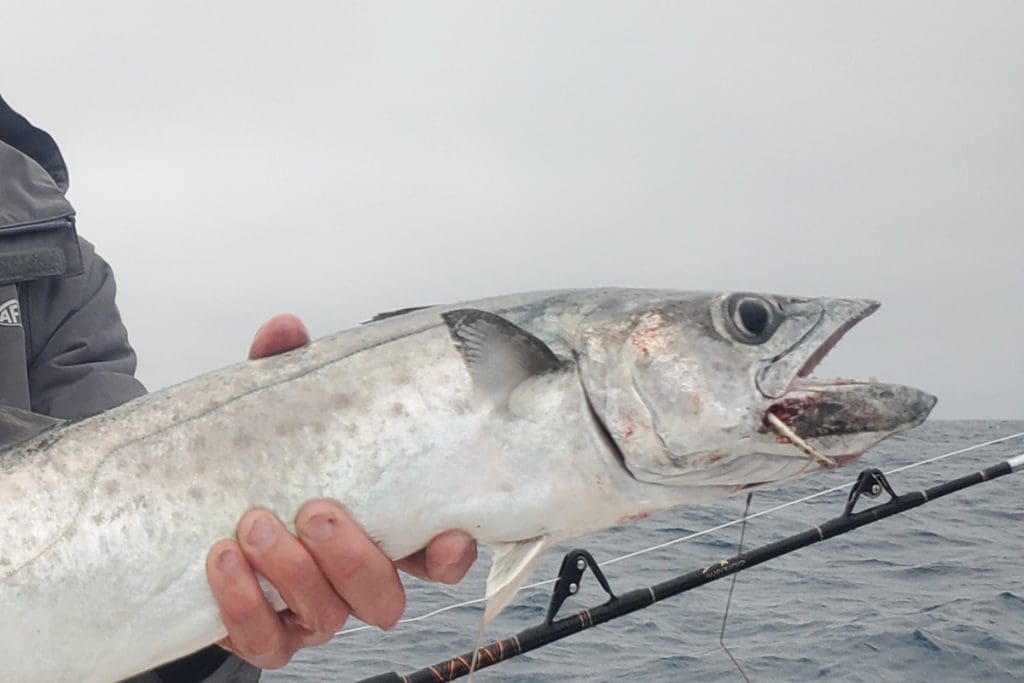
No one will deny the effectiveness of running a planer rod for kingfish. But sometimes you need to get exceedingly deep, and who wants to deal with all the hassle of using #4 or larger inline planers? And, who wants to deal with those clunky planer rods that go along with them? Just about no one. Enter: the cleat rig.
The cleat rig is a pain in the keister to deal with, but once a fish is on the line, it’s eliminated from the equation. To use it you’ll want to rig a planer to 50 feet of 200-pound test line, with a large loop crimped to the end. When you start trolling, put the loop around a stern cleat and deploy the planer. Then take your fishing line, toss the spoon or lure over the side, and let 25 or 30 feet of line out. Place the rod in a holder, bend a rubber band around it, then bend the swivel-end of a snap swivel onto the rubber band. Next, open up the snap and clip it around the cleat rig’s line. Now pick the rod up and put it into freespool. Water tension created by the spoon or lure will drag the snap swivel down the cleat rig line. Keep letting it back until the snap swivel hits the planer (you’ll know because the mainline will begin bowing back due to water resistance if you keep letting line out), then put the rod into a holder and set the reel to strike.
When you get a hit the fish will snap off the rubber band, and you can then fight it up to the boat unencumbered. After catching a fish simply reach for a new rubber band and snap swivel, and redeploy it in the same manner. At the end of a good day of fishing, you’ll have five or six snap swivels siting on the cleat rig line when you finally decide to stop the boat and haul back the planer.