
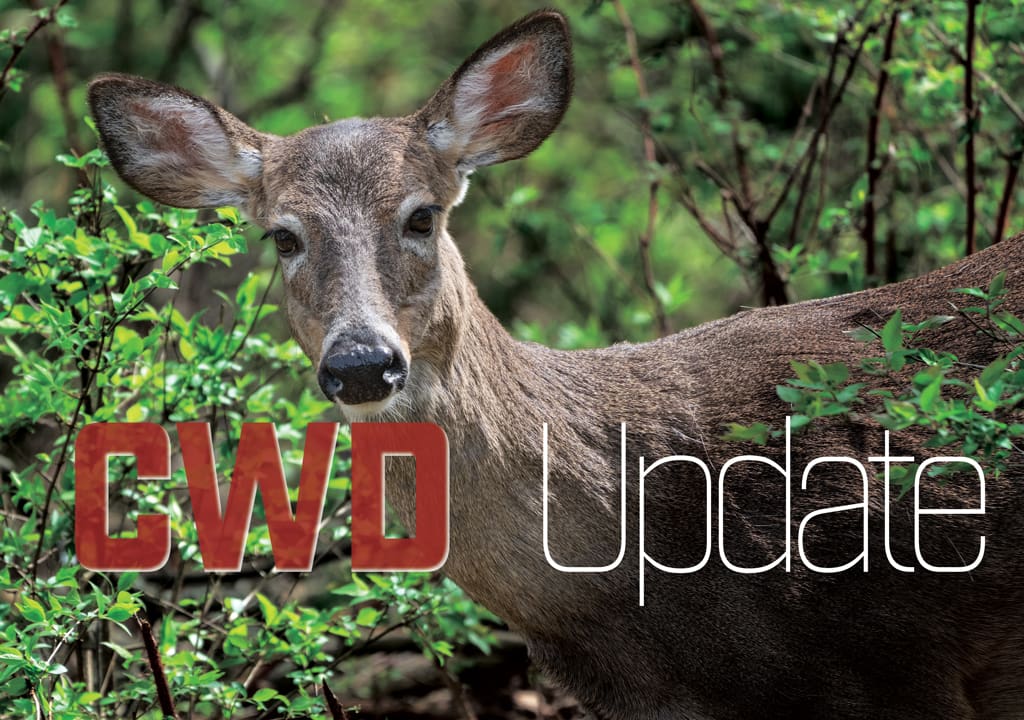
New Carcass Disposal Rules Plus… Venison-to-Human Transmission?
Feature Story by TF&G STAFF
LISTEN: (6 minutes, 25 seconds)
OFFICIALS WITH THE NATIONAL DEER ASSOCIATION are urging caution about a report from the University of Texas Health Science Center published in the journal Neurology.
The article suggested chronic wasting disease (CWD) could have been transmitted from deer to humans through the eating of venison.
“Caution and accuracy are critical when examining the question of CWD and human health. Until more information about this report becomes available, we urge deer hunters to consider this new report cautiously.”
“First, we emphasize: Nothing about this new report changes current knowledge or guidance on CWD in deer. The evidence remains strong that CWD in deer and elk is not causing disease among hunters who consume infected animals. Because scientific certainty is not 100 percent, and prion diseases are still not fully understood, experts continue to recommend CWD testing of all deer harvested in known CWD areas and avoiding consumption of CWD-positive venison to minimize risk.”
NDA officials reported the brief report focuses on a 72-year-old man who died in 2022 of Creutzfeldt-Jakob Disease (CJD), a human disease that is similar to CWD in deer but never definitively connected through causation. We aren’t told where he lived.
“The man reportedly had a friend who also died “recently” of CJD. We are given scant details about any of this, but according to the report, both men had “…a history of consuming meat from a CWD-infected deer population.”
NDA officials pointed out this is not the same as eating meat from a CWD-infected animal.

“Just because CWD is in the population does not mean the patient ate a sick deer. In many CWD zones, prevalence rates are low and the vast majority of deer are healthy. If either of these patients in fact consumed CWD-positive venison, the evidence for this is not presented or even hinted at in the paper.”
“CJD, which affects about one in every 1 million Americans annually and is most common in people over age 55, is known to be sporadic and to appear in localized clusters. No previously investigated cluster has been found to have links to CWD in deer. In fact, experts have looked for patterns or clusters among hunters in the oldest CWD zones without finding any. While the odds of two acquaintances both having CJD are slim, it is not impossible. Just because it is unlikely does not prove a connection to CWD, especially with no supporting evidence for that conclusion other than circumstance.”
“Any assertion that CWD has spilled over into humans needs a full and comprehensive diagnostic investigation,” said Dr. Krysten Schuler, wildlife disease ecologist with the Cornell Wildlife Health Lab in a press release published by NDA.
“The implications of such a finding would have huge implications for wildlife and the hunting community.”
You can read more about this issue at deerassociation.com
• • •
By the time you read this story Texas Parks & Wildlife Department officials will have likely made a decision on deer carcass disposal rules in relation to CWD.
According to TPWD currently, hunters who harvest deer within a Chronic Wasting Disease (CWD)
zone must comply with carcass movement restrictions, which require quartering a hunter-harvested animal and leaving the most infectious parts of the animal (i.e., brain and spinal cord) within the zone.
“This approach helps mitigate the risk of CWD transmission. Current carcass movement restrictions, however, present an inconvenience for those hunters and landowners who have difficulty quartering or deboning deer and/or do not have access to a locker plant or deer processor within a zone. One proposed change would allow them the flexibility to travel to a processor and then have all unused carcass parts disposed of correctly.”
“For most hunters, this proposal does not change how they currently care for their deer after harvest, since many hunters take the carcass to a commercial processor who properly disposes unused parts for them,” said Blaise Korzekwa, TPWD White-tailed Deer Program Leader.
“Hunters that process deer at home should dispose of the unused parts in their commercial trash service. Hunters who prefer to quarter or debone their deer at the property where it was harvested only need to leave the remaining parts at that location to follow this new proposed rule.”
TPWD asserts proper disposal of all potentially infectious material is critically important for reducing the risk of disease transmission. If CWD is not contained and managed, the implications of the disease for Texas and its multibillion-dollar ranching, hunting, wildlife management and real estate economies could be significant.
TPWD is proposing statewide carcass disposal measures only for unused carcass parts from native deer (i.e. white-tailed deer and mule deer) harvested in Texas that are being transported from the property of harvest. If carcass parts from native deer species are not being transported from the property of harvest, these carcass disposal rules would not apply.
Acceptable disposal options include:
• Directly or indirectly disposing of the remains at a landfill permitted by the Texas Commission on Environmental Quality to receive such wastes,
• Burying the carcass at a depth of no less than three feet below the natural surface of the ground and covered with at least three feet of earthen material, or
• Returned to the property where the animal was harvested.
TPWD is also proposing to allow hunters to debone a carcass at the site of harvest provided proof of sex and tags are maintained until the hunter reaches the final destination. Meat from each deboned carcass must remain in whole muscle groups and maintained in a separate bag, package or container until reaching the final destination.
What are your thoughts on carcass disposal? Have you ever heard of an issue with law enforcement over deer carcass disposal? Email us at cmoore@fishgame.com with your thoughts.
[photo_box title=”DIGITAL BONUS” image=”” align=”” link=”” target=”_blank” greyscale=”0″ animate=””]
[heading tag=”h2″ align=”center” color=”#0153a5″ style=”lines” color2=”# 0153a5″]Chronic Wasting Disease[/heading]
[heading tag=”h4″ align=”left” color=”#0153a5″ style=”lines” color2=”# 0153a5″]This short video from TPWD explains that Chronic Wasting Disease (CWD) is a fatal neurological disease affecting members of the deer family. If left unmanaged, CWD can have catastrophic, long-term impacts on Texas deer. If you’re deer hunting in Texas, test your harvest for CWD. It’s mandatory in CWD zones and voluntary elsewhere. With your participation, biologists can gather statewide data to aid in CWD management strategies to reduce the risk of CWD spread.[/heading]
[/photo_box]
—report by TF&G STAFF
[button title=”Return to CONTENTS Page” link=”https://fishgame.com/2407-july-august-2024-issue/” target=”” align=”” icon=”” icon_position=”” color=”” font_color=”” size=”2″ full_width=”” class=”” download=”” rel=”” onclick=””]