
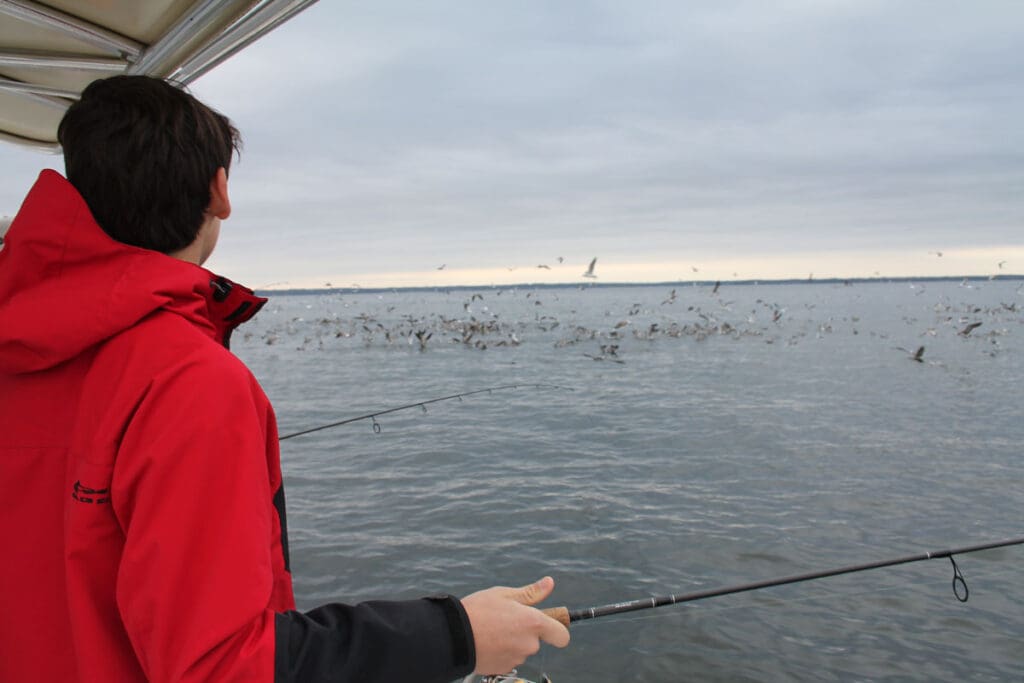
Few situations are more fun than encountering a school of Spanish mackerel or bluefish that are churning the water, busting through hapless bait-balls. One that is even more fun, however, is finding a mixed school that includes both species tearing through the bait.
Many anglers don’t realize it, but the mixing of these species sets up a slightly different dynamic than finding one or the other. Generally speaking, the mass of fish will be more broken up and scattered over a wider area, with wolfpacks of predators slashing this way and that among many multiple schools of bait as opposed to one large, concentrated school. When you see this happening, remember:
- In this sort of frenzy there’s a lot more bait being ripped up and falling through the water column. As a result, you’ll find larger fish and often different species, like cobia or kingfish, cruising beneath the fray. After you’ve caught your fill of Spanish and blues try tying on a heavy jigging spoon or troll weighted lines down deep and you may have a very, very nice surprise.
- Just about anything you toss into the water is likely to be struck in the chaos. This is a time to leave the popping corks and small flashy teasers in the box. Deploy them, and there’s a good chance they’ll be chomped off.
- Leave the lures with treble hooks in the box. You’re likely to get many multiple strikes on a single retrieve so there’s absolutely no reason to use them. Meanwhile, it often takes longer to un-hook a fish on a treble which means you lose time and efficiency during what could be a very short window of opportunity. On top of all that, with blues and mackerel flipping around those treble hooks become a danger – get one in your hand and the day of fishing just came to an abrupt end.
- Keep everything moving rapidly – retrieve speeds, topwater cadence, trolling speeds, whatever. The baitfish won’t exactly be sitting around and the best (sometimes the only!) way to not get hit is to let your offering sit still.