

A Fish with Many Aliases
LISTEN: (4 Min, 23 Sec)
COBIA (also referred to as ling, crabeater, or lemonfish) are a welcomed sight for any angler on the Texas coast this time of year. Known for their drag smoking battles and tasty table fare, cobia are a fun fish to go out and target and luckily for us, these predators can be found swimming around inlets, buoys, oil rigs and underwater structures.
Once spotted, cobia are often mistaken for sharks, but are in no way related to them. Cobia are a part of the Rachycentridae family and are built with a stream-lined and powerful body with brown and white lateral stripes, a distinctive long dorsal fin, a forked tail, and have both a wide head and mouth. Their mouth and jaw is lined with villiform teeth designed to prevent prey escape. Although not related, cobia do not have a swim bladder just like sharks, mackerel and flounder. This means they can only maintain their position in the water column by actively swimming.
All types of fish and fishing are great, but the visual stimulation of seeing a snook hit a topwater or watching a tarpon roll is what really exhilarates me. That’s why fishing for cobia is one of the top on my list. Cobia are not bashful by any means. In fact, they are curious and inquisitive. Capt. Brian Barrera and myself like to fish a few nearshore underwater shipwrecks for ling and I’ve learned to be ready to cast for these fish as soon as we start approaching the spot. Cobia congregate around these structures and as soon as they hear our motor, they start making their way to the surface and surrounding the boat.
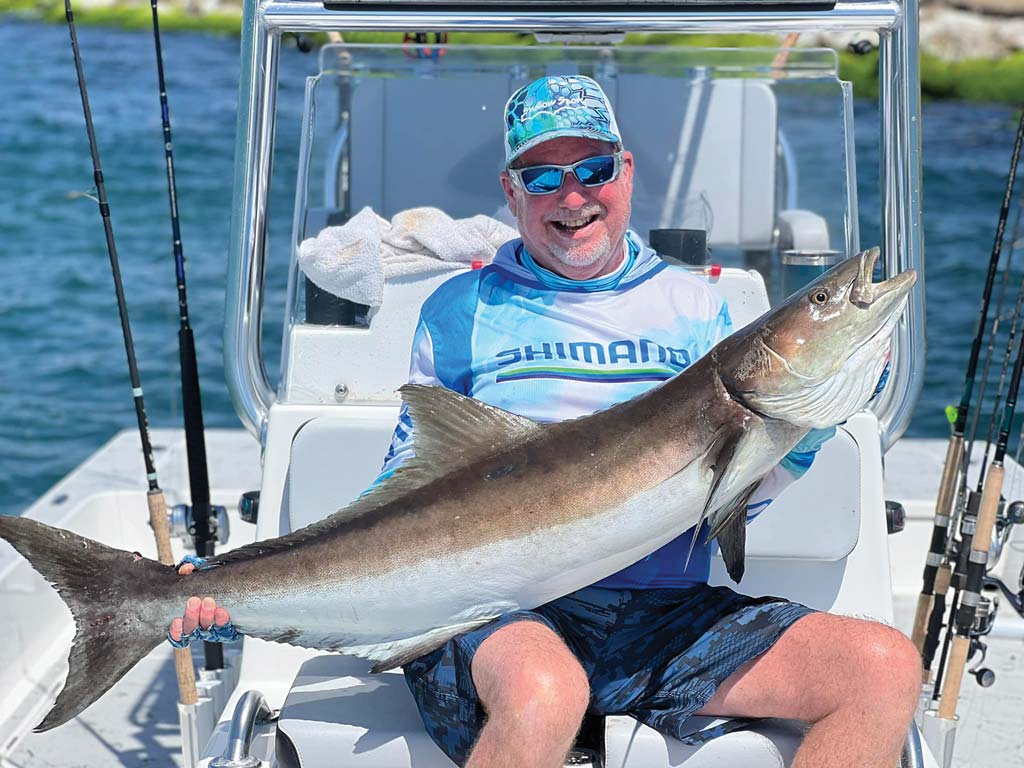 Skip Crosby is all smiles with a 51 pound cobia he caught at the South Padre Island jetties with Capt. Brian Barrera. These fish put up a fun and rewarding battle, leaving anglers wanting more.
(Photo: Kelly Groce)
Cobia will eat both real and artificial baits, but they can be picky choosers. Depending on their mood, a ling will come right by the boat and inhale your lure or literally put their nose on it and reject it. I highly suggest having both lures and live or dead bait ready to offer them. Swimbaits and topwaters are popular artificials to use and live mullet or crabs are a cobia’s favorite. On my last outing for ling I had a D.O.A. Baitbuster (mullet imitation) with 40 lb. leader ready to serve them. I cast my lure by the school and with a constant retrieve worked the lure right under the water’s surface. Four or five ling were fighting over my lure and trying to eat it at the same time. I hooked up to one and Capt. Brian Barrera cast a large topwater into the commotion and got one too. After we landed those, the school disappeared. We were Spot-Locked on top of a sunken ship in about 60’ of water using the Minn Kota Riptide Instinct trolling motor and with the detailed Down and Side Imaging of the Humminbird Solix 12, we could see that the school had gone down into the wreckage. Using a Shimano Teramar 8’ Extra Heavy rod with a 6000 Spheros reel we threw out a live mullet rigged on a bottom weight down below. It didn’t take long for one of those ling to sniff out that bait and we hooked up. It is important to have a rod with some backbone and proper leader line to effectively pull them out of the structure, especially since cobia can reach upwards of 100 lbs. Fighting these powerful predators in deeper water is a fun and rewarding battle.
Growing up, I remember the pure excitement on my dad and his fishing buddies faces when they would spot a school of ling while offshore fishing. Madness would ensue as they cast any and everything they had onboard at these fish. I understand the thrill as catching one is an achievement and the meal around the dinner afterwards is exceptional. Cobia meat is white, firm and has a delicious buttery ocean taste to it thanks to their high protein diet made up of mostly crab. Once cooked, the fillets are perfectly flaky, and don’t fall apart like some other fish fillets do. A simple pan sear or blackening on these fillets is all you need. I guarantee you will have no problem finding a few friends or family members to join you for dinner if this is what’s on the menu. Good luck in your pursuit of this magnificent and interesting species this fall.
Email Kelly Groce at ContactUs@fishgame.com
