

The Nilgai Antelope is one of the most sought-after exotic species in Texas. According to the Texas Parks & Wildlife Department, nilgai are native to Pakistan and India, and they are truly unique animals.
“Male nilgai stand between 48 to 60 inches tall at the shoulder and weigh between 480 and 540 pounds,” officials state. “The male, often called a blue bull, is typically about one-fifth larger and heavier than the female. Their hair is short and wiry. Both males and females have a mane on their necks, but only the males develop a tuft of hair on the throat.”
Free-Ranging Nilgai
Nilgai are difficult to contain within fences, but none of the thousands of free-ranging nilgai have migrated out of South Texas.
“The upper parts of males are generally iron gray, while the lower surface of the tail, the insides of the ears, fetlock rings, and underparts are white,” officials continue.
“The head and limbs are tawny, and both the throat tuft and tip of the tail are black. Females are more lightly colored. Both sexes have longer forelegs than hind legs, and the head is long and pointed. Only males carry short horns.”
According to the Texas State Historical Association, nilgai were brought to the United States from India as zoo animals before the mid-1920s and were released in South Texas around 1930.
Introduction to Texas
“The King Ranch led the way in introducing nilgai to Texas,” according to the Association.
“Between about 1930 and 1941, the ranch acquired several nilgai from zoo stock and released them in Kennedy County. With limited hunting, protection, and favorable habitat, the nilgai adapted well. Their primary range now extends from Baffin Bay south to near Harlingen.”
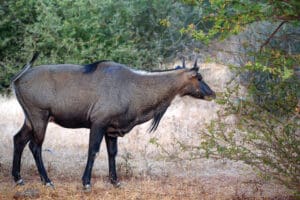
These nilgai are free-ranging and difficult to contain—not because they jump over fences but because they can destroy them.
I’ve often wondered why nilgai, having been present in South Texas for nearly 100 years and being free-ranging, have not migrated farther north.
The Texas State Historical Association suggests it’s due to the cold.
“Approximately 15,000 nilgai are now on Texas rangelands,” they report. “However, nilgai will likely not become widespread because they suffer in extreme cold. Even in temperate South Texas, they may die during unusually cold winters when food is scarce.”
I have seen nilgai on high-fenced ranches in Central Texas where they receive supplemental feed, but I’ve also heard of them dying off in temperatures that have little impact on other exotic species. The freeze of 2021 saw that happen in their South Texas range and on high-fenced ranches farther north.
Chester Moore