

Interstate 10 in its Prime: Waterfowl Super Highway
LISTEN: (4 min, 26 sec)
FORGIVE ME FOR BELABORING a disheartening point, but I miss the Texas coastal prairie in its waterfowl-attracting prime.
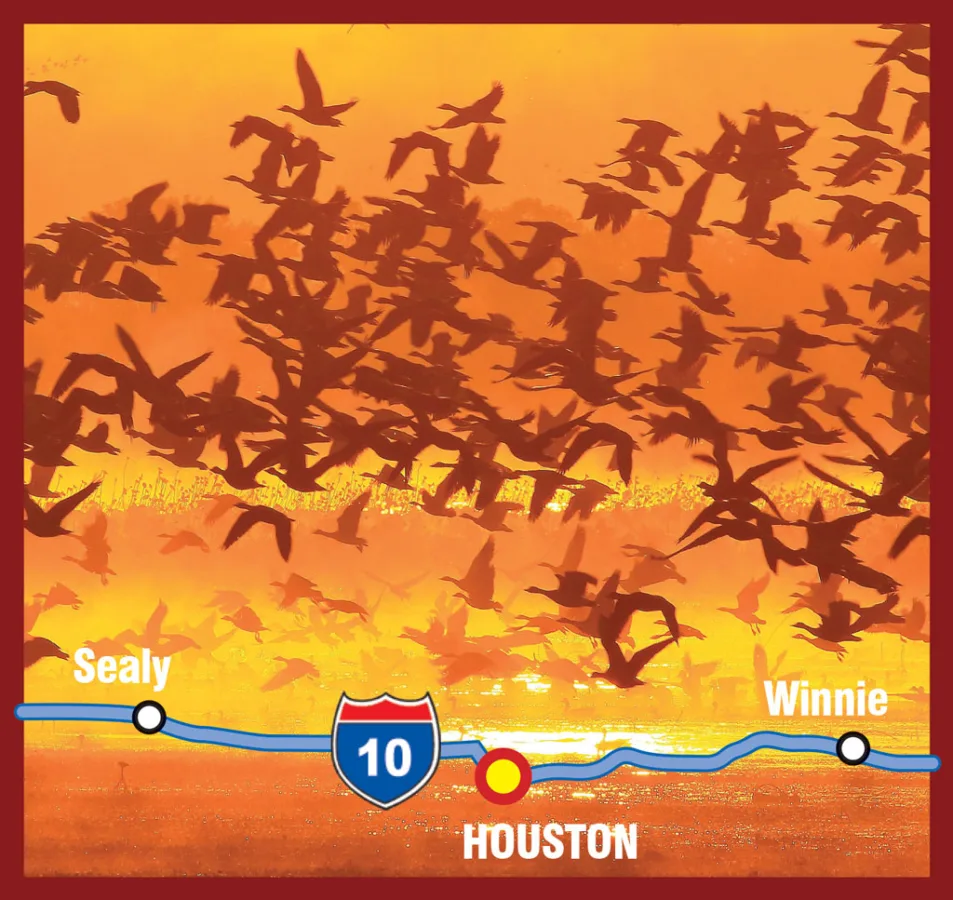
Its peak of staggering spectacle spanned some 40 years, a rock-solid run starting roughly in the late 1960s and continuing through the turn of the century. It encompassed a huge chunk of Texas along I-10 roughly between Sealy and Winnie for 20 miles north and about as far south. Houston interrupted it almost in the middle, and on any winter night, city people could hear geese trading between the two vast expanses of farmland.
Beginning late each fall, that ground wintered more than a million waterfowl and as many or more non-waterfowl migratory birds, including everything from tiny songbirds running from the cold to bald eagles feasting on weary or wounded geese.
As a waterfowl hunter and guide during three quarters of that span, I and my peers saw things few other people on the planet would believe possible. We all had our home turf, intricate checkerboards of leased land, and we knew every inch of ground behind those gates. Every rice field and bean field and corn field and peanut field, every stock tank and irrigation canal and cattle guard and locked gate and muddy farm road. And as personal and productive as we believed those parcels were, truth was that every field on both prairies wound up blanketed in ducks or geese or both at some point during a long winter.
Our relationships with the prairie were personal, something among guides and outfitters akin to dozens of men being in love with the same woman. And every one of us fought for her, fought to keep that prairie healthy so that it could keep us giddily happy ‘til death do us part.
Only the prairie ran into poor health not long into this century, something of a cancer in the form of reduced agriculture and increased development. Farming was the backbone of that prairie, and in a relative blink, maybe 15 years or so, it weakened and snapped. Families that had generational ties to that ground let it go, and the prairie – as a winter home to waterfowl – saw it’s pulse weaken and ultimately stop.
 ADVERTISEMENT
I can’t blame the children of those farmers for abandoning the combines and tractors. Farm life is hard. City life, by comparison, is a cakewalk. Slowly but inevitably, the heirs of passing farmers divvied up the family land and sold it, each making more money with a single signature than their parents made in a decade.
The change was certain, but that doesn’t make it any less disappointing to those of us who most enjoyed the ride. Places I hunted then are monstrous warehouses now, or neighborhoods that at least carry recognizable family names, although that’s of no value to anyone outside those families.
The first time I accepted that the prairie on which I spent so much time wallowing in cold mud and blowing bird calls and watching a great dog save me thousands of steps was on a brief tour with my son, in the December after he turned seven, 2014. It was hard to convince him that the ground on either side of the winding, two-lane asphalt road once was covered in rice or soybeans or corn or peanuts as far as he could see. There was no agriculture then but for a random 10 or 20 acres, which by the prairie’s former identity wouldn’t be enough room to park a pickup.
Bothersome as it was to know he’d never get to see what I saw, the experience instilled in me a desire to share that prairie’s history with anyone who’d listen or read.
Recalling the Texas coastal prairie comes easily for those of us who were there in its heyday. Memories aren’t much compared to those firsthand experiences, but they are a source of quiet comfort.
For younger hunters, those of you who’ve found productive waterfowl spots where you can share sunrises and great times with friends and family, know that those places someday also will be threatened.
Fight like it matters to keep them as they are. Because it does matter.
Email Doug Pike at ContactUs@fishgame.com
