

Last Chance
LISTEN: (5 min, 1 sec)
IT HAPPENED LAST JANUARY, after I had spent several days at the 2024 DSC Convention visiting with hunters who, like me, were headed to their deer camps as soon as the festivities completed to finish out their deer season on properties under Texas’ Manage Land Deer Permits. Lands under those approved wildlife management programs can hunt whitetails until the end of February. On our lease in Sterling County out west of San Angelo, I still had buck and doe permits assigned to me that remained to be filled.
I invited Luke Clayton, with whom I have been doing a weekly radio show since 2007 (“Catfish Radio with Luke Clayton and Friends”, now also a weekly podcast like my “DSC’s Campfires with Larry Weishuhn” on www.outdooraction.com and many other places) and Jeff Rice. Jeff, Luke and I do a weekly television series on CarbonTV.com, “A Sportsman’s Life.” I hoped to take a couple of bucks and had asked Jeff and Luke to help me with my doe quota. We also hoped to get footage to use in our show.
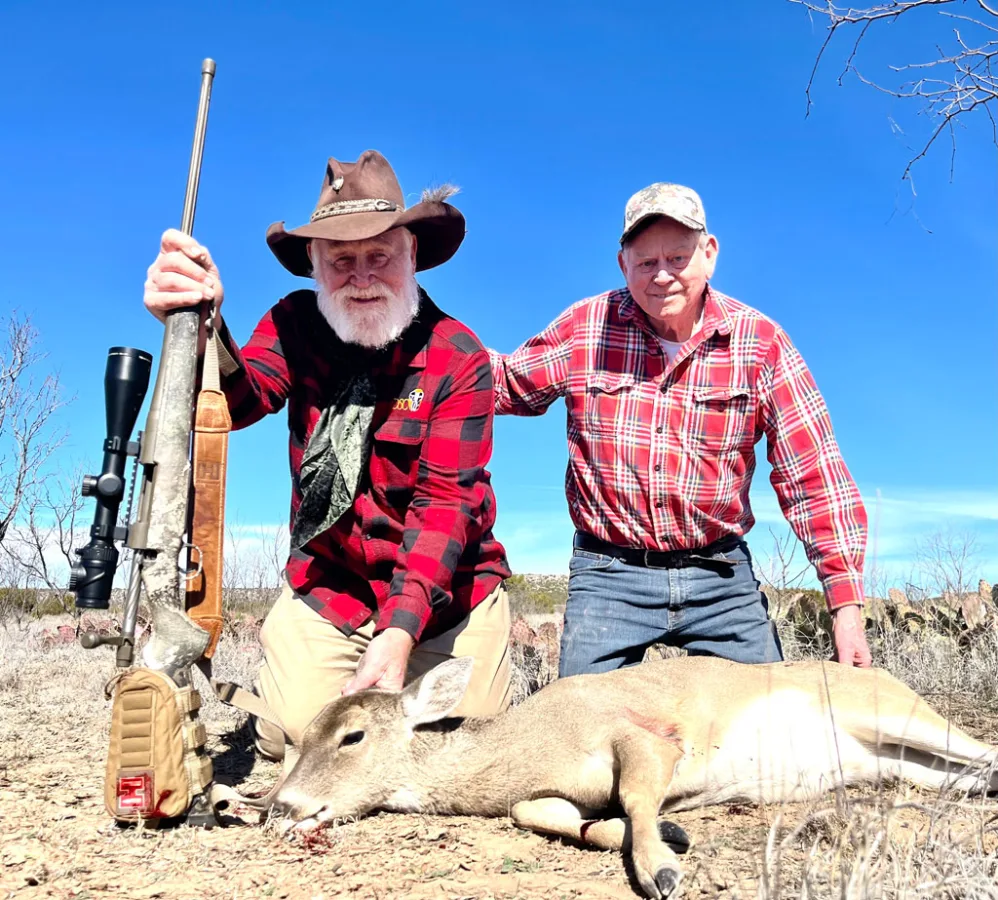 Larry and Luke Clayton with Larry’s late season doe.
(Photo: Larry Weishuhn)
Upon arrival we headed to the range to make certain our rifles were properly sighted-in. I was using two Rossi lever actions (.44 Mag and .30-30 Win), and a new Mossberg Patriot in 7mm PRC topped with a Stealth Vision scope (www.stealthvision.com), shooting appropriate Hornady ammo.
After dropping off Luke and Jeff I headed to a blind on the back side of a long stretch of “low country.” I had scarcely sat down when I spotted three nice, young bucks. Moments later a short-tined, ancient buck stepped out; one to remove. Not because of genetics, but because the forage he would consume if I passed him, could be eaten by one of the younger bucks that had just walked by. I raised my rifle and shot him. Then settled back to wait to see what else I might see, hoping for a doe or two.
More bucks showed up at the feeder. Even though the rut was waning, bucks were still dominant. Does, having been bred wanted nothing to do with “pesky” bucks.
Way off in the distance I saw more movement which quickly turned into a huge herd of deer. In near awe I watched seventy-two deer stream by. The closest was unfortunately over 500-yards away. The herd included bucks of all sizes including six of the best bucks I had ever seen on the property, does and fawns. I watched as they ran to the head of the long draw I was on.
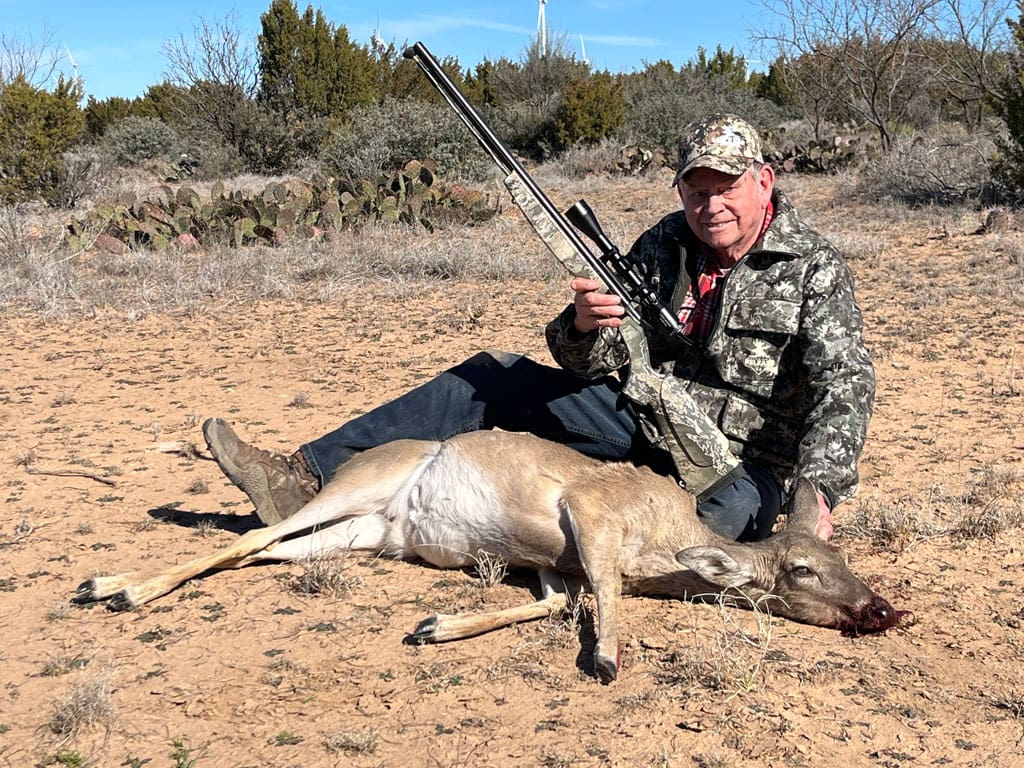 Luke Clayton with his late season whitetail.
(Photo: Larry Weishuhn)
I still have no idea what spooked the deer or how they had become such a large herd. I knew western Texas whitetails, typical of the plains, tended to be herd animal. But never outside of several years earlier on the historic Rocker B Ranch in Irion County had I seen such large number of whitetails together in one herd.
I hope such a large herd might again form on our lease this January and February.
I related what I saw to Luke and Jeff when I picked them up. Both had seen numerous deer, all bucks! The feeders where I had put them were apparently too, dominated by bucks.
Why so many bucks? Interestingly for the prior three years the property we lease had experienced a high fawn survival rate near 80%, as opposed to surrounding ranches where they had raised very few fawns (around a 10% fawn survival rate) those same past three years. What is interesting about the lease and a few other places I hunt and manage is I kept record of the sex of 6-month old fawns I observed while hunting. On the lease during the past few years approaching 70% of the fawns I counted during the fall were bucks!
This interestingly goes back to research done years ago on red deer in Europe. It was determined if a hind (doe) goes into the fall breeding season in less than good body condition she tended to produce male offspring. Whereas, if she was in top body condition going into the fall she tended to produce female offspring. In doing observations on numerous ranches I manage as wildlife biologist or where I hunted, this research seems to have validity in whitetails as well.
We did finally shoot the number of does I needed to take. We put out Vineyard Max (www.vineyardmax.com) at least a hundred yards from where the corn feeders were. Initially does could come there to feed, while bucks congregated and dominated the feeders. This worked for about three days before bucks took over the Vineyard Max feeding places as well. Thankfully during the interim we were able to harvest the remaining number of does on quota.
By the time you read this I’ll be hunting my lease once again to see if the deer there during January and February are herding up! Surely hope one of those biggest bucks I saw last January puts in an appearance!
Email Larry Weishuhn at ContactUs@fishgame.com
