
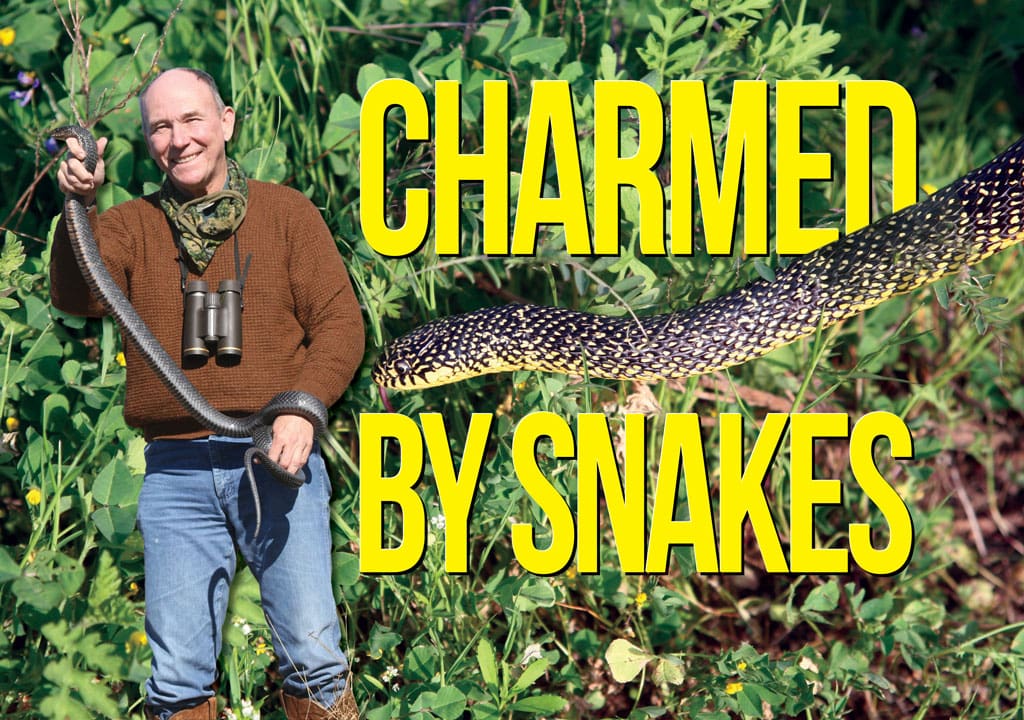
Doggett’s Texas Snake Adventures
Feature Article by JOE DOGGETT
LISTEN: (10 min, 49 sec)
A WATER SNAKE WAS BETTER than a ribbon snake, and a hog-nosed snake was better than a water snake, and a rat snake was twice as good as the whole passel in a sack.
That was our standard of measure during junior-high snake collecting days along the banks of Houston’s Brays Bayou. Back in the late ‘50s and early ‘60s, that uncut and natural drainage was an amazing strip of wildness “snaking” through the southern tier of the growing urban sprawl.
Our bounty represented a microcosm. Texas boasts at least 72 snake species, by far the most of any state (if various subspecies and intergrades are included the count is more than 100).
The Lone Star State’s size is not the whole story; it has 10 ecological regions (or six biotic provinces). Regardless of how the vastness is environmentally sliced and diced it provides an unmatched variety of habitat. And generally temperate conditions encourage prosperity among cold-blooded reptiles.
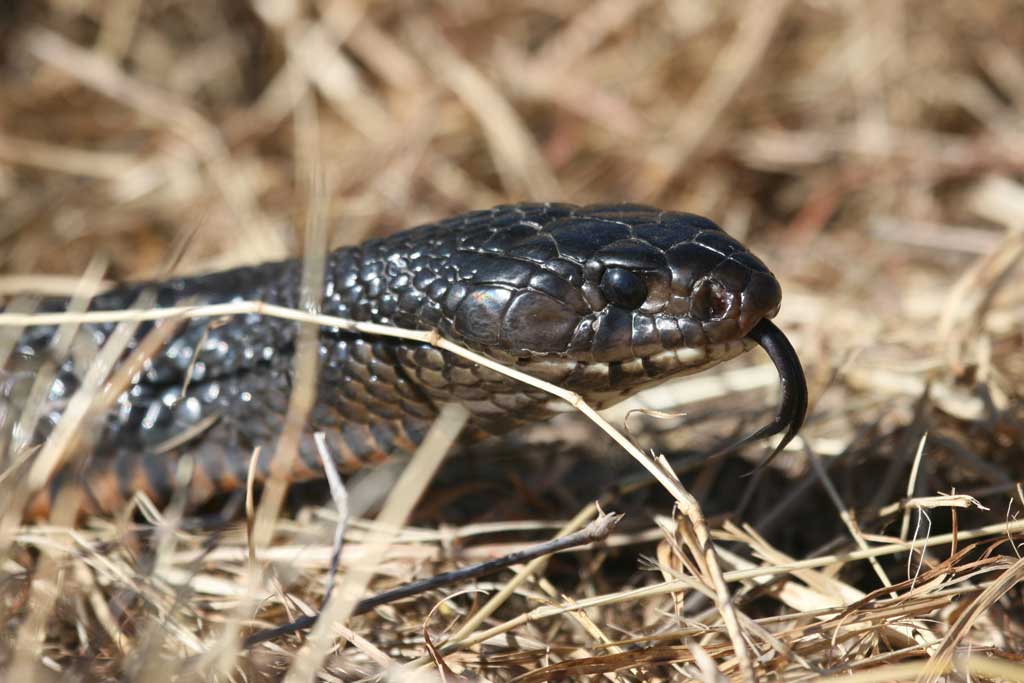 Closeup of an indigo snake in Webb County.
(Photo: Joe Doggett)
I can document 10 species and subspecies in the two-to three-mile stretch of urban bayou within reach of our long-ago forays with angle-iron snake sticks, muslin collecting bags and knee-high rubber boots. Several were scarce and others common, but all were native.
The confirmed Brays Bayou denizens: Texas rat snake, eastern yellow-bellied racer, rough earth snake, Texas ground snake (Dekay’s snake), western ribbon snake, eastern garter snake, rough (keeled) green snake, yellow-bellied water snake, diamond-backed water snake, eastern hog-nosed snake, speckled king snake, southern copperhead, and Texas coral snake.
For several friends, snake collecting was a passing fancy, a way to tap into the wildness of the bayou, along with trapping the odd possum or fishing for short-nosed gar or plinking with BB rifles.
But I was serious about the study of reptiles—herpetology. I had a growing collection of books. Classics were North American Snakes (1939) and Thrills of a Naturalist’s Quest (1947), Raymond Ditmars; Adventures with Reptiles, the Story of Ross Allen (1951), C.J. Hylander; Snakes and Snake Hunting (1957), Carl Kauffeld; and A Field Guide to Reptiles and Amphibians (1958), Roger Conant.
Those authors were among my childhood idols, and they were not side-show hucksters. Ditmars was curator of the prestigious Bronx Zoo; Allen was founder of the Reptile Institute in Silver Springs, FL; Kauffeld was director of the Staten Island Zoo; and Conant was curator of reptiles at the Philadelphia Zoo.
Our real-life herpetological hero was John Werler, curator of reptiles at the nearby Houston Zoo in Hermann Park. He was tolerant of star-struck kids and went on to become curator of the entire zoo. But he remained a “snake man.” He co-authored with James Dixon in 2000 the monumental 437-page text, Texas Snakes, Identification, Distribution, and Natural History.
Back in the Brays Bayou days, I would have been stunned, utterly blown away by such a comprehensive book defining local snakes.
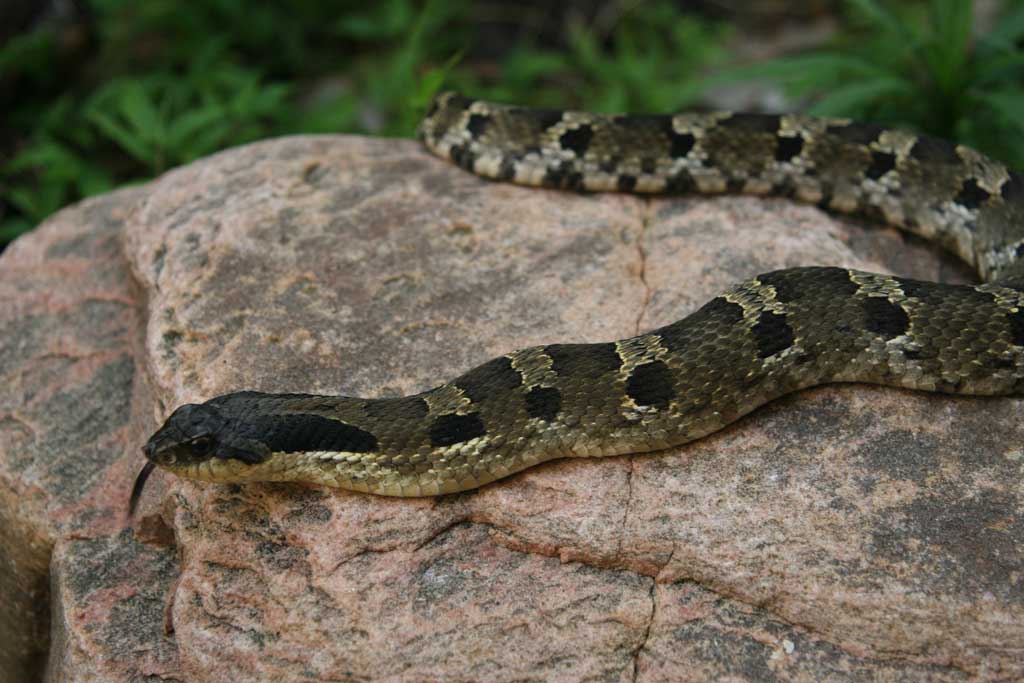 A hognose photographed by the author in Houston’s Memorial Park.
(Photo: Joe Doggett)
I was an only child of loving parents, neither of whom had any particular interest in the outdoors. Being often alone, I found solace and satisfaction in wandering the banks of the old bayou—a fledgling “Naturalist’s Quest.”
My collecting perimeter expanded, adding green water snakes, broad-banded water snakes, and salt marsh snakes from Sheldon Reservoir to the southeast, and western pigmy rattlesnakes and western cottonmouths from the Memorial area on the west side (oddly, while cottonmouths were semi-common
around certain Houston-area drainages, we never found one along our stretch of Brays Bayou).
The big prize, literally, was the Lindheimer’s rat snake. Most of our catches were less than three feet in length, but a mature rat snake might measure five to six feet—a double handful of serious snake. One spring morning, on the south bank of Brays Bayou near Scott Street Bridge, I caught one that taped 6-feet, 9-inches. The fact that such a creature thrived between North and South MacGregor streets only confirmed the rightness of the old bayou.
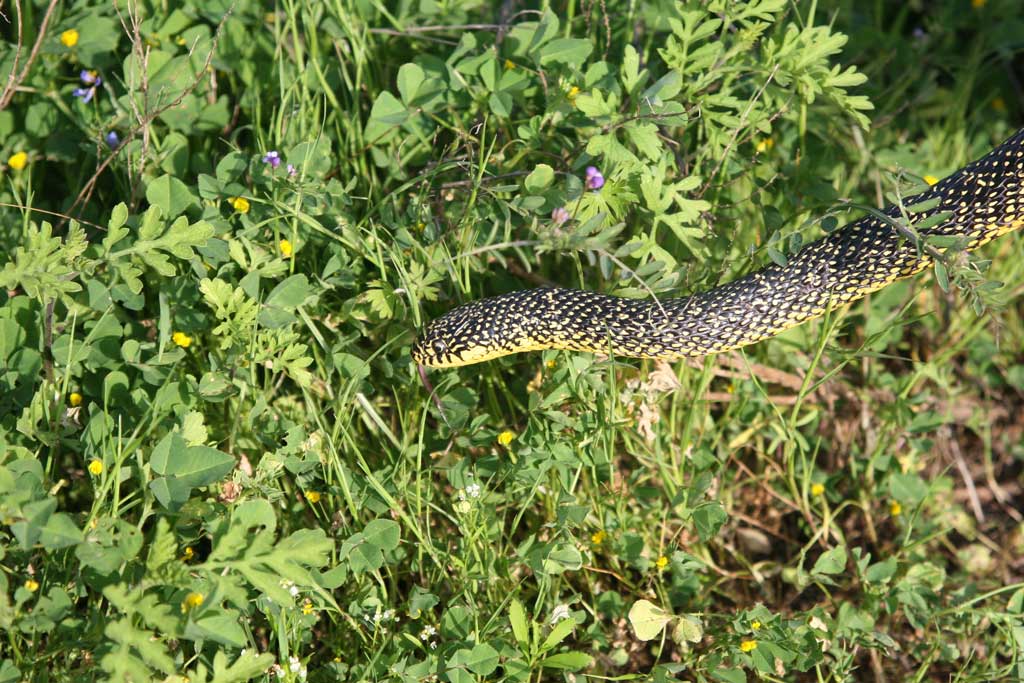 A speckled king snake at Quintana Beach in Freeport.
(Photo: Joe Doggett)
Elaphe obsoleta lindheimeri was named after Ferdinand Jacob Lindheimer, a 19th Century naturalist acknowledged as the father of Texas botany. Shortly after the Alamo fell, he presumably was poking around the Hill Country looking for a morning glory (Ipomoea lindheimeri) and bumbled onto and catalogued the writhing coils of a fine rat snake specimen.
Why subsequent experts saw fit to dismiss Lindheimier and change the name to Texas rat snake or, worse, western rat snake is a mystery. To old-timer snake collectors the undeniable pedigree still stands (“Wow! A big Lindheimer’s!”), and I grudgingly concede only because Werler used “Texas rat snake.”
My first exposure to native snakes outside the Gulf Prairies and Piney Woods ecoregions occurred during the early ‘60s. My father was an English professor at the University of Houston and two of his colleagues, Wilson Hudson and Francis Abernethy, were long-standing members of the Texas Folklore Society.
They encouraged our family to join them at the annual April meeting. That year, the site was in West Texas—Midland, with a side trip to Monahans Sandhills State Park. The arid terrain below the visitors’ center at the massive Monahans dunes was spiked with thornbrush and sagebrush, a panorama right out of Walt Disney’s The Living Desert movie, and spring is prime snake season—dear old dad!
Rather than listening to the readings and lectures from folklore luminaries such as J. Frank Dobie and Mody Boatright, I bailed to the beckon of the desert. I had no collecting equipment other than a semi-straight stick but was thrilled to wander and look.
The morning was clear and mild, favorable for snake movement, and I caught and released a new species—a bull snake. The impressive snake was about four feet in length. Like the rat snake it was a constrictor, but with thicker girth and an irritable attitude. A crescent of bleeding toothmarks across the right wrist attested to the fact that outdrawing a jacked-up snake is difficult; however, a non-venomous bite comes under the heading of no big drama.
The superficial scratches from the tiny teeth are like raking a vine of briar thorns. During those early years I was bitten dozens of times—ribbon snakes, water snakes, rat snakes—and never had a complication.
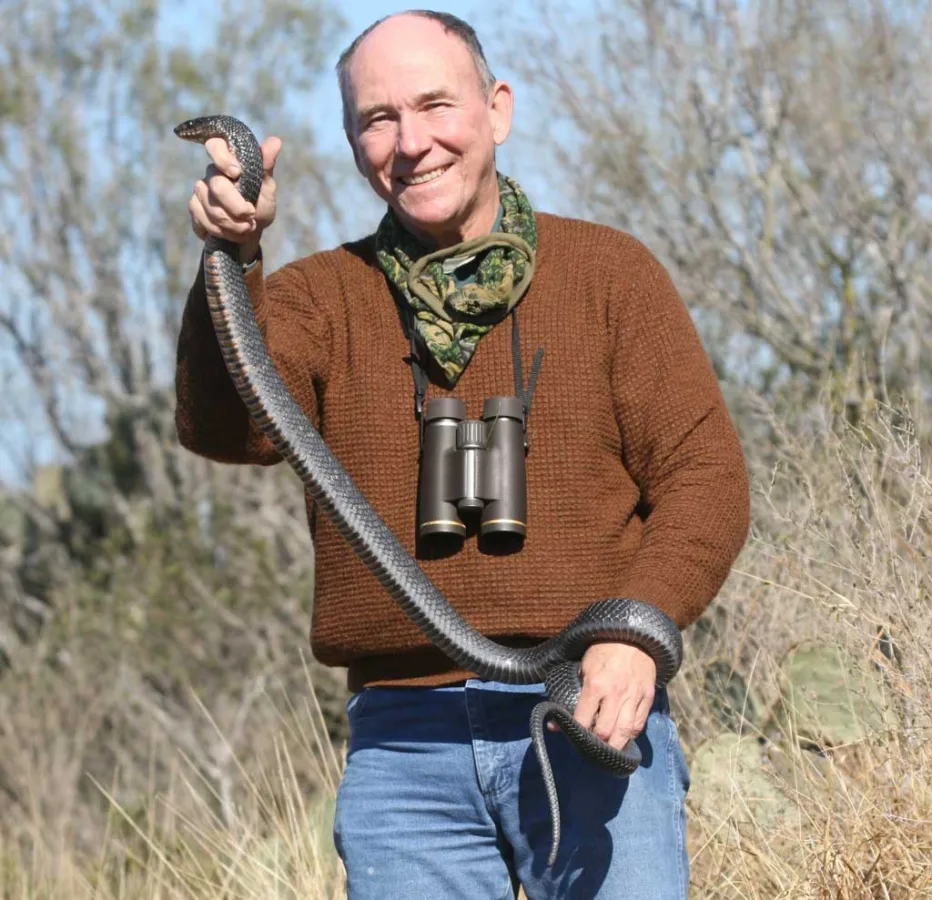 Doggett with a catch-and-release indigo on a Webb County deer hunt.(Photo: Joe Doggett)
Thirty minutes later I stirred up a major first—a western diamond-backed rattlesnake. It was coiled near a thick motte of brush and prickly pear. The alarmed rattler was mature, about the length of the bull snake but heavier and buzzing with an undeniable aura. William Blake’s “tiger, tiger burning bright” is not the only creature with “fearful symmetry.”
The diamondback bowed up in an awesome display as I feinted with the stick. The bulbous head and sifting coils and furious tail radiated danger. I was stunned. Whoa—Ross Allen and Carl Kauffeld and John Werler might hand-grab that thing, but no way I’m getting near it!
My few piddly copperheads and an aptly named 16-inch pigmy rattlesnake were not remotely in the same league.
Kauffeld proudly wrote in Snakes and Snake Hunting, “If we be permitted to verge on the sensational, our own diamondback rattlesnakes are among the world’s first four largest and most deadly snakes: the king cobra, the bushmaster, and the fer-de-lance are its only rivals.”
He was mainly referring to Crotalus adamanteus, the eastern diamondback of the southeastern coastal states. This formidable pit viper has been documented at more than eight feet in length, with a few sketchy reports of 9 footers. The western diamondback comes in about a foot shorter on an honest tape (snake stories like fish stories tend to grow, and snake skins or mounts can be stretched). But a live five- or six-footer of either issue is a huge thick snake with large venom sacks and long fangs.
Our C. atrox might be a tad shy against its eastern counterpart, but it is far more plentiful over a greater range. And it is more aggressive when cornered—not that any logical individual could blame a snake on its own turf for firing back when harassed.
For better or worse, Texas has another first—the mother lode of these world-class pit vipers. The diamondback rattler is common across the Hill Country and South Texas, and downright plentiful along the salt grass regions of the middle and lower coast.
Texas tallies between 1,000 and 1,500 venomous snake bites per year, and most are from diamondbacks and urban copperheads. The upside is that only one or two per year are fatal—copperheads are small snakes with weak venom and the diamondbacks usually are within an hour or two of emergency rooms and antivenin injections. A bad bite, of course, is a miserable and potentially life-threatening ordeal.
On the Christmas following the Folklore Society trip I received my most memorable gift. It was an impressive pyramid-type cabinet of dark varnished hardwood on a bench of short legs—three rectangular snake cages, two on the lower level and a larger one on top. Individual glass panes slid back and forth on aluminum runners, and each cage interior was painted flat white and sported a socket for a small lightbulb activated by an exterior toggle switch.
Werler, himself, would have nodded approval, and I was overwhelmed. The piece of furniture meant my mother had consented to allow several harmless snakes inside the house. The major move from rough cages of orange crates and hardware cloth on the back porch was an acknowledgment that I was focused, that herpetology represented a legitimate path forward.
The best part—my thoughtful father did not drive to the nearest “Snakes R Us” store and purchase the elaborate cage. He and a handy neighbor, Fred Wye, designed and constructed it in Fred’s garage. (“Oh, it’s nothing, son; I’m just helping Fred make a cabinet for his record album collection.”)
A parade of the usual Brays Bayou suspects passed through the sliding-glass portals, and several non-resident standouts were a four-foot corn snake, a five-foot Florida king snake, and a gorgeous six-foot eastern indigo snake. The Naturalist’s Quest was expanding, and herpetology was thriving.
It didn’t last.
—story by JOE DOGGETT
DIGITAL BONUS: Snake Safety Tips
