

Fawns and Velvet
LISTEN: (5 min, 28 sec)
FAWNS ARE HITTING THE GROUND and we’re starting to see them up and around with the does! From what I’ve seen so far, looks like we’re going to have a pretty good fawn crop this year. And, we should have pretty good herd recruitment as a result. “Looks like the predator control we did late winter is paying off” said David Cotton, whose property is not far from the Trinity River, east of Dallas. Before I could comment David added, “Not only that, but bucks are starting to get interesting again. Seeing what looks like the makings of a good antler year!”
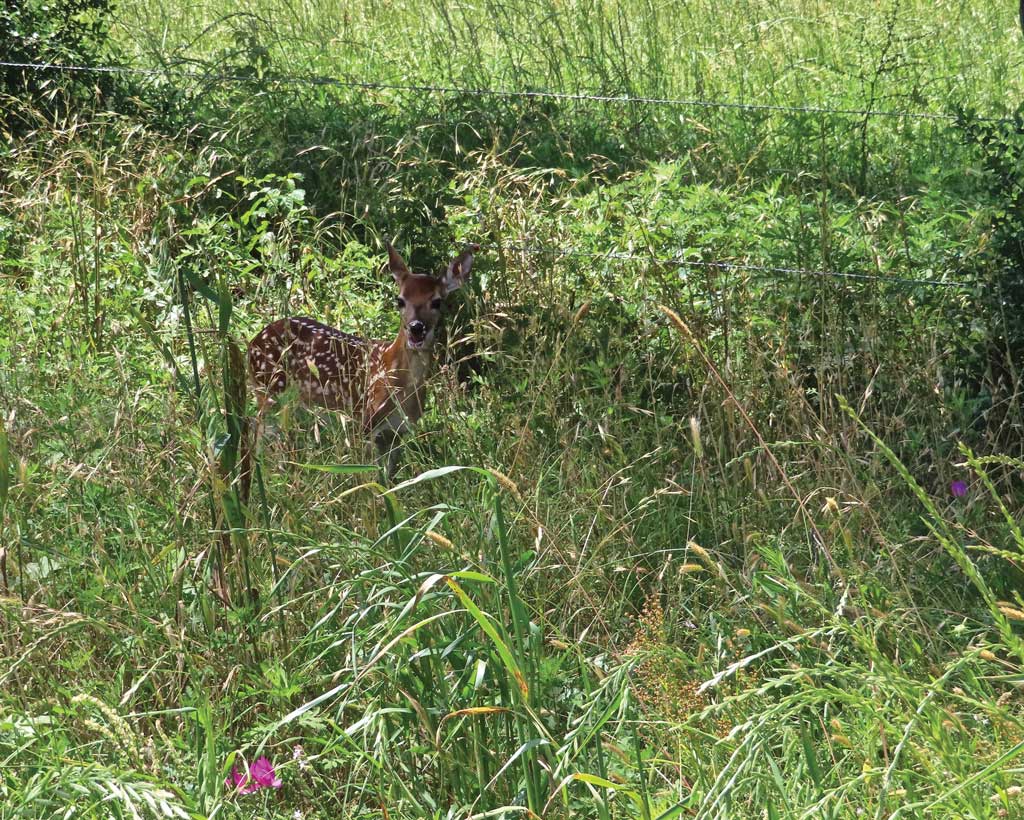 So far, evidence points to a pretty good fawn crop this year.
(Photo: Larry Weishuhn)
I was thrilled to hear what he had been seeing on all accounts. This mostly because of the habitat and herd management programs we established and started implementing four years ago. Efforts were most likely really going to start paying off in big way come the fall of 2025. Some of those steps included selective controlled burns to remove old bunch grass which when burned had been disked to encourage forb growth. In other areas selected trees where there was a dense canopy had been removed so all sunlight could reach the ground to encourage forb and woody browse growth. The ranch had also changed their supplemental feeding program to incorporate Double Down feed into a year round feeding program. The latter was suggested because sometimes we forget we do not feed deer, we feed the micro-flora in a deer’s digestive system which breaks down what the deer eat. Every time their diet changes, the exiting microbes die and have to start all over once again. Double Down feed also takes into consideration the deer’s energy needs. “Energy” is particularly important to a deer’s general health, including antler development and does producing healthy fawns.
We had also properly harvested both bucks and does. Having for the past three years primarily removed management bucks, those older aged bucks with less than desirable antlers. Not concerned about them passing on their genes, but they eat as much if not more than a younger buck with much better antler potential.
We also carried on a proper doe harvest, based on buck to doe ratio and deer density.
I mentioned both fawn crop and recruitment. The fawn crop is essentially the number of fawns born, and usually expressed in terms of a percentage by dividing the number of does into the fawns seen. These figures are based on incidental observations, which is something as a biologist I highly encourage. Starting as soon as bucks show sufficient antler growth where they can be easily distinguished, start keeping a running record of the number of bucks, does and fawns observed each time you go to “the field”, meaning your property or hunting lease. Makes no difference if you see the same deer again and again. Keeping record of what you see throughout the late spring, summer and even fall provides good data as to determining your buck to doe ratio, fawn crop and later in the fall, fawn recruitment.
“Recruitment” is best described as those fawns that live to become at least one and a half-year old deer; taking into account not all fawns born survive into the fall season when does start weaning their offspring. The better the day-to-day nutrition, and fewer numbers of predators, primarily coyotes and bobcats, the greater the herd recruitment.
By June bucks are starting to once again become “interesting.” Antler development is well on it’s way and you can at least start imagining what their racks will look like in two more months. It is truly amazing how rapidly antlers grow. You’ve heard me state this before, but it bears repeating. Texas bucks mature at 4-years of age. By then all their long bones are fully developed as are essentially their muscle systems. Up to the age of four, body development always takes precedence over antler development. After four years of age any daily nutrition not required for simple body maintenance can be channeled into antler development. This is why four-year and older deer generally have bigger antlers.
There is however “a kicker in the deal.” Much of the breeding is done by 2 to 4-year old bucks. If they get severely rundown because of the rut, their antlers may not be as big as one would imagine the following fall. I’ve seen some truly impressive 3-year old 10-point bucks get severely run down from the rut and revert to producing very mediocre 8-point racks as 4-year olds. Given a chance to reach 5-years old, that same buck will develop exceedingly impressive antlers. This is one of the reasons I caution hunters about shooting “management 8-points.” That 4-year old 8-point you shot, left to recover, might at 5-years of age have been that absolute monstrously antlered buck of your dreams.
May and June? Continue doing predator control and learn what you can about the property you hunt or plan to hunt this fall. Spend time shooting your rifle, handgun, muzzleloader, bow and/or crossbow. Learn your gun’s, bow’s or crossbow’s capabilities and yours’ with them. Doing so will pay off come this fall!
Email Larry Weishuhn at ContactUs@fishgame.com
