
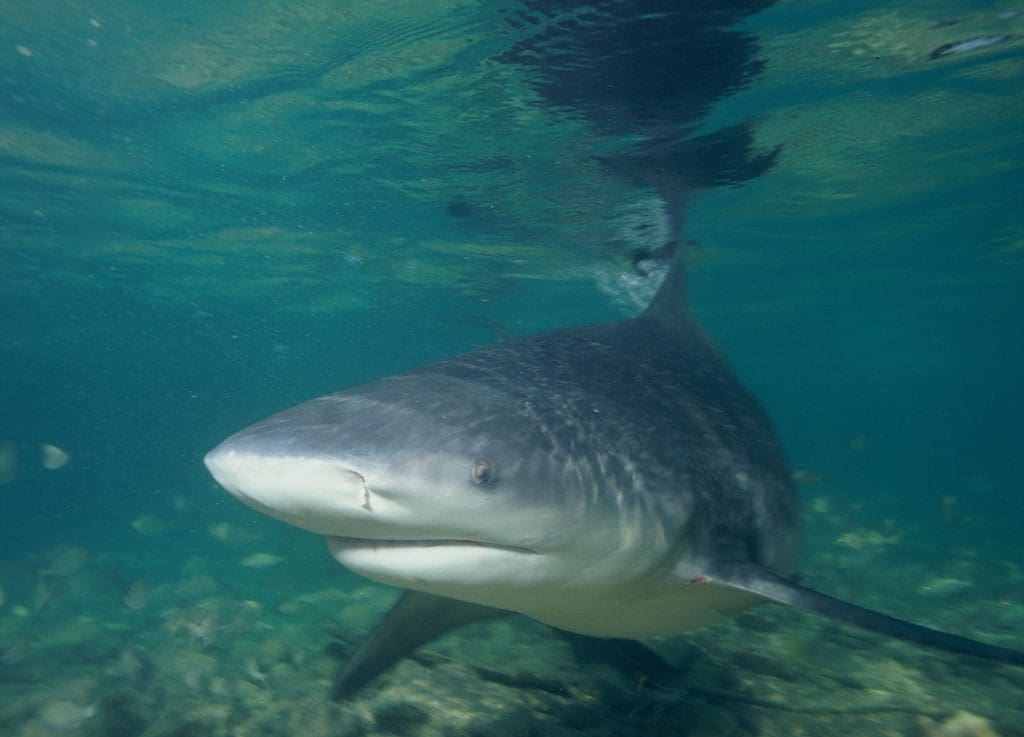
In the heat of July 1916, Americans fled the sweltering cities for the cool comfort of the New Jersey shore. What awaited them, however, was not relief—but terror and many believe it was the work of a bull shark.
On July 1st, 25-year-old Charles Vansant went for a swim off Beach Haven. Minutes later, he was pulled from the water, his leg shredded by a shark. He died shortly after on the floor of the Engleside Hotel. Five days later, Charles Bruder, a bellhop at a nearby resort, became the second victim. Witnesses watched in horror as he was pulled under near Spring Lake, leaving only a red bloom on the water.
Listen to an in-depth episode on this topic and more on sharks on Dark Outdoors® via the player below. Or listen and subscribe on Apple Podcasts, Sportify, IHeartradio & more here.
Despite the carnage, scientists at the time dismissed the idea of a shark attacking humans. Newspapers speculated everything from sea turtles to German U-boats. But the fear was growing—and it would soon reach its climax inland.
On July 12th, eleven miles from the sea in Matawan, a group of boys played in a brackish creek. One, Lester Stillwell, was dragged beneath the surface and vanished. Townspeople rushed to help. Watson Fisher, a local tailor, was mortally wounded trying to recover the boy’s body. And minutes later, 14-year-old Joseph Dunn was attacked nearby—he survived, but with severe injuries.
In just 12 days, four were dead, one maimed, and the nation was in panic.
President Woodrow Wilson called an emergency cabinet meeting. Nets were installed along beaches. Armed locals patrolled the surf with rifles. Eventually, a 7.5-foot great white shark was caught in Raritan Bay. Inside its stomach? Human remains.
The attacks stopped. But the questions didn’t.
Many experts today believe the real killer may not have been a great white at all—but a bull shark. These sharks are uniquely adapted to freshwater, can travel far upriver, and are notoriously aggressive. They’ve been found more than 1,100 miles up the Mississippi River, and they live full-time in freshwater lakes like Lake Nicaragua.
And their aggression isn’t a myth. In 2005, a bull shark attacked two teens in Australia’s Swan River in minutes. In Brazil, rivers near Recife have seen repeated fatal incidents. And just last year, on July 4, 2024, a single shark injured four swimmers in a span of two hours at South Padre Island, Texas.
Bull sharks are large—up to 11 feet—and possess the highest testosterone levels of any animal on Earth. They’re built for shallow water ambushes and unpredictable behavior, making them a far more likely suspect in the inland Matawan attacks than their deep-ocean cousins.
The true story of those 1916 attacks—what happened, why it happened, and how it changed America forever—would later inspire author Peter Benchley to write Jaws. Though he later regretted the fear the book caused, its legacy remains.
But the real monster wasn’t a shark—it was our fear of the unknown.
Sharks are not villains. The great white, so often misunderstood, is now a threatened species, vital to marine ecosystems. Peter Benchley spent his final years fighting for shark conservation, urging the public to see these creatures not as threats, but as essential guardians of the ocean.
Want the full story? The dark details, the modern parallels, and the science behind the shark that stalked New Jersey in 1916?
🎧 Listen to the latest episode of Dark Outdoors:
“Bull Shark: The True Story Behind Jaws”
Available now on all major podcast platforms. Listen and subscribe here.
Dark Outdoors® partners with Texas Fish & Game to raise awareness of missing people in the wild through the podcast.