
Doggett’s Texas Snake Adventures, Continued
Feature Article by JOE DOGGETT
LISTEN: (7 min, 4 sec)
DURING THE DECADE of the ‘60s, between years at Lamar High School and the University of Houston, my snake collecting was pushed aside in favor of fishing, hunting, falconry and, increasingly, surfing. Following higher education, in 1969 I had a two-year commissioned detour on an aircraft carrier through the South China Sea to the Gulf of Tonkin.
On return to Houston, I earned a respectable living for the next 50 years by writing about the outdoors—mainly the traditional sports of fishing and hunting. The profession of outdoor writing demanded extensive travel to the wild reaches of the state’s ecological regions, and old habits die hard. Whenever the terrain and weather favored “herptile” movement, I would cast a keen eye in the direction of the nearest “snaky” brush pile or stream bank and seldom missed the opportunity to flip a piece of discarded plywood or cardboard.
These opportunistic forays across snake-rich Texas yielded catch-and-release rewards—several grand indigos on deer and quail hunts in deep South Texas (the largest a stunning seven-footer from a deer lease near Carrizo Springs), as well as rat snakes, king snakes, bull snakes, hog-nosed snakes, rattlesnakes, copperheads, cottonmouths, coral snakes, and a slew of lesser species.
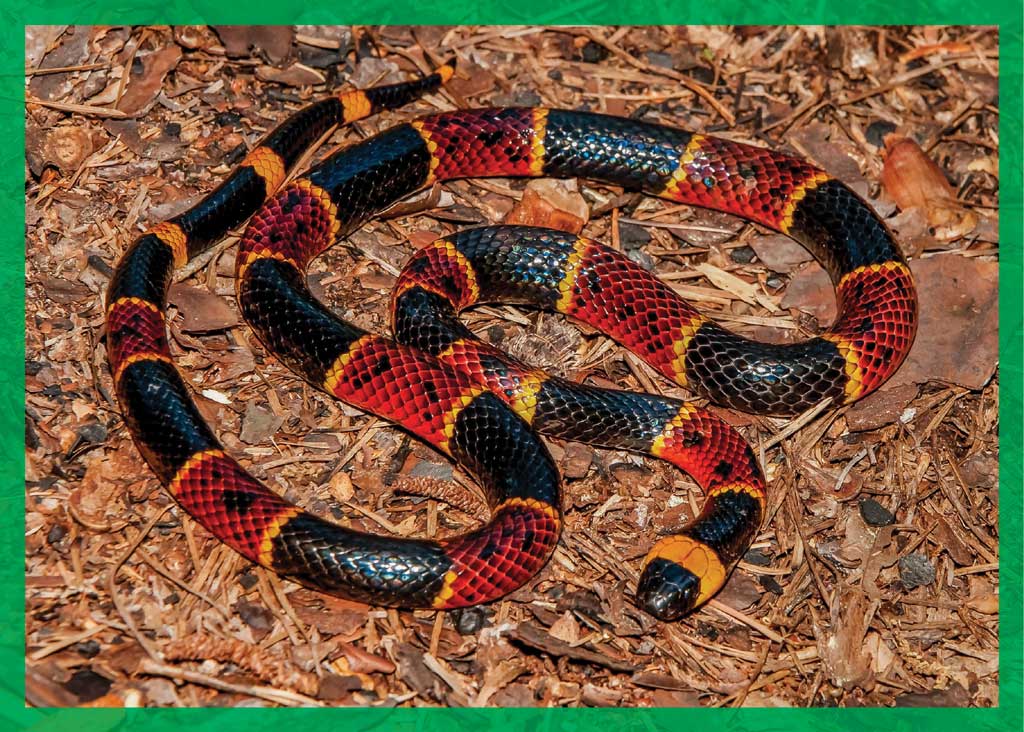 Coral snakes have deadly venom but they are extremely beautiful.
(Photo: ADOBE)
The sight of even a ribbon snake always brought a quick thrill, and the sight of a freshly killed non-venomous snake always brought a surge of sadness. The good in most snakes far outweighs the bad. For example, the numerous rodent-eating species are among nature’s perfect pest control agents, prowling 24/7 and capable of reaching tight places no trap or cat can touch. Many smaller species feed heavily on insects.
Regardless of value, the senseless killing of a non-venomous snake minding its own business is lame behavior in a culture increasingly concerned with the environment. The Texas Parks and Wildlife Department now protects various reptiles as threatened species, not the least of which are the indigo snake and the canebrake (timber) rattlesnake.
Prejudices aside, holding a docile snake is not all that appalling. Snakes are not slimy. The scales are firm and dry. Frogs are slimy and eels are slimy, and fish are slimy—snakes are reptiles.
And myths aside, the forked tongue of a snake does not sting or otherwise impart harm. If the flickering sensor of a serpent is dangerous, I would have surely suffered the excruciating agony of Death by a Thousand Tongues (rivaled only by the ancient Chinese torture of Death by a Thousand Cuts).
Native snakes are part of the chain of life, the natural order of things. Unless a confirmed pit viper or coral snake represents a clear and present danger to people or pets, the wise move is to leave any mysto-snake alone. Chances are, based on sheer numbers, it is non-venomous.
Honest mistakes can occur, as several non-venomous species resemble copperheads and cottonmouths (nobody can confuse a rattler, and coral snakes are rare and secretive). The most likely “counterfeit copperhead” in urban areas is the poor hognose, an ironic twist as pudgy little Heterodon with its clever upturned snout is singular in its refusal to bite when handled.
Several species of surly-looking water snakes can be mistaken for cottonmouths, and the broad-banded has the misfortune of resembling both the “water moccasin” and the copperhead.
Good advice for the outdoor-oriented individual is to obtain a field guide for Texas snakes and study the lookalikes. Even subtle differences quickly become obvious to a trained eye.
For example, as a comparison, two of the most popular full-sized SUVs are the Ford Expedition and the Chevrolet Tahoe. In boxy profile they are very similar. But put the two vehicles of the same color side-by-side and the experienced driver can promptly tell the difference. It’s the same with snakes.
Last fall, while on a surfing trip to Quintana Beach south of Freeport, I came across a large Lindhei—I mean, Texas rat snake. It was stretched out in a patch of low grass behind the primary dunes.
I hit the brakes on my ancient two-door Surf Tahoe and bailed from the driver’s door and ran into the field—Surf Fever literally taking a backseat to a serious dose of Snake Fever. The right hand snatched the startled snake behind the head. Mine! The old thrill of the Naturalist’s Quest was back!
It was an excellent specimen, at least five feet in length, with no visible scars or blemishes. It was of the light color phase, with a latticework pattern of yellow, orange, gray and brown. The snake had recently shed, and the keeled scales glowed with a velvety sheen.
I decided to temporarily keep it, the first in-house snake in years. The arboreal rat snake settled into a three-foot glass terrarium furnished with a heavy water bowl, a wooden hidey hole, and a gnarled limb with several branches for climbing and draping. Captive snakes do not require much space and this one adjusted well, never attempting to bite when handled and taking a pair of unlucky pet shop mice every two weeks.
Such a fine snake fueled the fire, and I spent hours re-reading the old books, pleased to find that they still resonated.
The rat snake was released in prime condition several months later.
I drove to Quintana Beach one morning and turned it free near an undulating expanse of brush and grass near the original capture. The snake recognized the wildness as I opened my hands, and it shot like a tight stream of flowing liquid through the weeds and briars.
Leaving the dunes, I drove through the low sandy country, the habitat of rattlesnakes, rat snakes and king snakes. Herpetology can be a rewarding exercise of prowling the native habitat, and the snake collector, unlike the bird watcher, has the option of holding a prized specimen, even keeping it—assuming the catch is legal, and the prospective handler is qualified.
The barrier island was vital, alive. A pair of native mottled ducks sprang from tall reeds along the roadside slough. Scattered mourning doves flushed from the sandy shoulders, corkscrewing up and away. A diminutive male kestrel perched atop a sagging telephone pole launched with sharp falcon wings, flashing slate blue and russet in the early light.
The birds I could see. Any snakes remained a mystery.
Up ahead, tangles of driftwood piled against a ridge of yellow weeds beckoned with the long-ago echo of the Naturalist’s Quest. Maybe next time a speckled king snake! Better yet, a beautiful little prairie king snake!
As a kid, I studied the books and walked the banks and prowled the fields and dreamed of becoming a real herpetologist. I would have been a good one.
—story by JOE DOGGETT
BONUS VIDEO: How to Identify a Cottonmouth
