
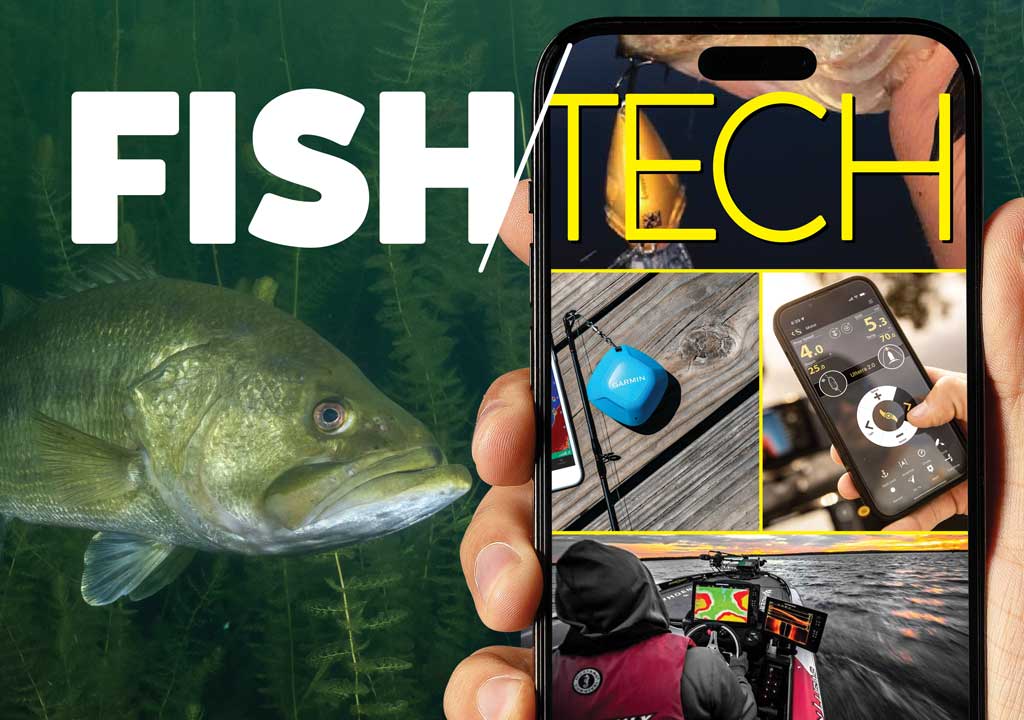
A Look at Smart Gadgets for Fishing
Feature Article by MATT WILLIAMS
LISTEN: (7 min, 31 sec)
LIKE IT OR NOT, technology is here to stay. Advancements continue to surface in the tools we use in virtually every aspect of life ranging from cutting the grass, to preparing meals, communicating and even vacuuming the floors of our homes. You just never know what might come down the pike next.
So it goes in the fishing world, too. In fact, high-tech goodies seem to be way more prevalent today in fishing than other popular sports and hobbies.
While many are linked to fishing electronics in one way or another, big tech is also making waves in battery power management and shallow anchor operation. It has also spurred new generations of artificial baits, digital scales, rods, reels, action cameras and specialty fishing lines among manufacturers determined to keep pace with changing times and the insatiable appetites of anglers who are always looking to gobble up the next best thing.
Though a few may seem more gimmicky than practical, there are some really useful tools out there that will help anglers to become more efficient at their game and ultimately catch more fish if they take the time learn them.
Here’s a random list:
FORWARD FACING SONAR: No single fishing tool has changed the face of bass and crappie fishing more in recent times than forward facing sonar has. It’s the biggest thing since the spot lock trolling motor, which relies on built-in GPS technology to tell the trolling motor to maintain its current position with the push of a button. Paired together the two are a deadly combination.
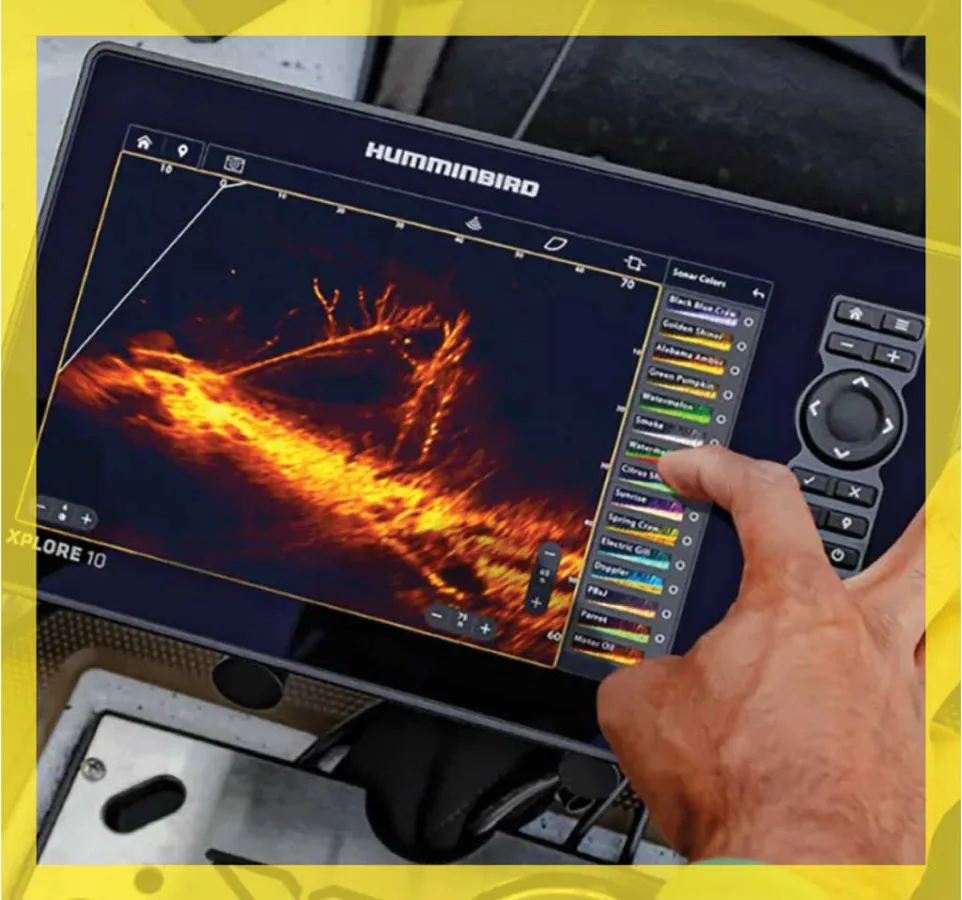 Forward facing sonar is a game changer in bass and crappie fishing.
(Photo: Humminbird)
FFS functions via a special transducer that mounts to the trolling motor shaft, some sort of independent pole or a motorized turret mount. The transducer sends real-time data to an electronics screen and helps anglers detect fish and cover from a considerable distance.
The technology allows for making precise bait presentations to fish and, more importantly, seeing how they react as a bait moves through the water column. Though not 100 percent fool proof, FFS usually leaves little question as to whether or not fish are present. If the fish move, anglers can quickly adjust. Sometimes it’s possible to hound an individual fish with different baits until it bites. Garmin, Lowrance and Humminbird are the leaders in FFS arenas.
PHONE APPS: I’ve never been one to put my fishing faith in Smartphone apps, but there are plenty of anglers who do. Most downloadable phone apps rely on Bluetooth or Wi-Fi connectivity for operation. Some are free, while others charge annual fees.
There are all sorts of phone apps that allow anglers to gather useful pre-fishing data like hotspots and waypoints on specific water bodies, gain map access, log private catch data, interact with other anglers, operate/manage fishing tournaments, check weather forecasts, select baits and much more.
Some of the apps are considered “all-in-one” apps, while others are dedicated strictly to bass fishing, fly fishing and saltwater fishing. Anglr.com provides great comprehensive review of fishing apps in multiple categories.
The list doesn’t end there, either. There are specialized apps that allow anglers to monitor and manage batteries, charging systems and shallow anchors including Power Pole (Power Pole C-Monster App) and Minn Kota (Raptor App).
Additionally, the Bubba Pro Series digital scale has an exclusive app that allows for logging catch data, GPS coordinates, competing in virtual tournaments, utilizing live map tracking features and sharing fish catches and other info on social media. Texas Parks and Wildlife’s Toyota ShareLunker also uses a special phone app that allows anglers to enter their catches year-round.
CASTABLE DEPTH FINDERS: Hmmm….While there may not be a place in everyone’s fishing arsenal (including mine) for one of these gadgets, a beginner or bank fisherman may find a castable depth finder like Garmin’s Striker Cast GPS ($179) to be somewhat useful.
Weighing 2.6 ounces, the floating device uses Bluetooth to turn a smartphone into a handheld depth finder. It is designed to be cast out (minimum of 20 pound test line is recommended) and reeled back to read bottom contours, find grass lines/under water structure and detect other areas that might be holding fish. Garmin says it features a 200 foot range, built-in GPS to provide the ability to create custom Quickdraw fishing maps with one foot contours, 2-D sonar and ice fishing flasher modes, and a rechargeable battery that lasts up to 10 hours between charges. To conserve battery life, unit automatically powers on when floating in water and turns off when it’s not.
Underwater Cameras: Ever spotted a group of fish on your depth finder and wondered about the species? Aqua-Vu’s Micro Revolution HD Underwater Camera will help eliminate the guesswork. Compact and portable, the nifty device supports HDMI and RCA output and allows for easy connectivity and crisp HD viewing on compatible screens like Garmin GPSMAP Series, Humminbird Apex, and Lowrance HDS PRO.
The unit comes with 50 feet of durable cable that connects to Aqua-Vu’s patented revolution cable management system for rapid deployment and easy retrieval. Bassmaster Elite Series pro Jeff Gustafson says it is a handy tool for checking out brush piles, rock piles and other potential sweet spots without the risk of burning a fish. It’s also a great tool to keep kids occupied if they lose interest in fishing. Sells for $499.99.
SEABRAKES 2.0: SeeBrakes are mini-trolling motors designed to mount on existing shallow anchors including Power Poles and Minn Kota Raptors. The motors act as brakes to help optimize boat control in deep water or in windy conditions and help prevent spooking fish when using forward-facing sonar. Sold in pairs, the motors are available in 30 or 40-pound thrust for $1,650-$1,800.
SMART LURES: The evolution of forward facing sonar has resulted in the creation of a number of bass baits and other products that are designed or modified to get at suspended fish and provide better returns, so they show up better on sonar screens. Ballhead jig/swim baits and hover rigs are among the hottest new items with FFS junkies. There are dozens to choose from.
Another is a product called Bait Pop Live Sonar Intensifier. Applied to hard baits, soft baits and fishing line near the connection point, the scented gel is advertised to make lures show up significantly better on the sonar screen than without and leave a definitive scent trail. A .5 ounce tube sells for about $10.
As “smart lures” go, the Livingston Lure family is arguably in a class all it of its own. The company makes a wide range of baits for fresh and saltwater species that feature the company’s patented EBS (Electronic Baitfish Sound) technology. The technology relies on an internal smart chip that emits natural recordings of bait fish and other prey that is advertised to call predators from a distance.
Check them out at livingstonlures.com.
—story by MATT WILLIAMS
DIGITAL BONUS: Humminbird/Minn Kota One Boat Network
