
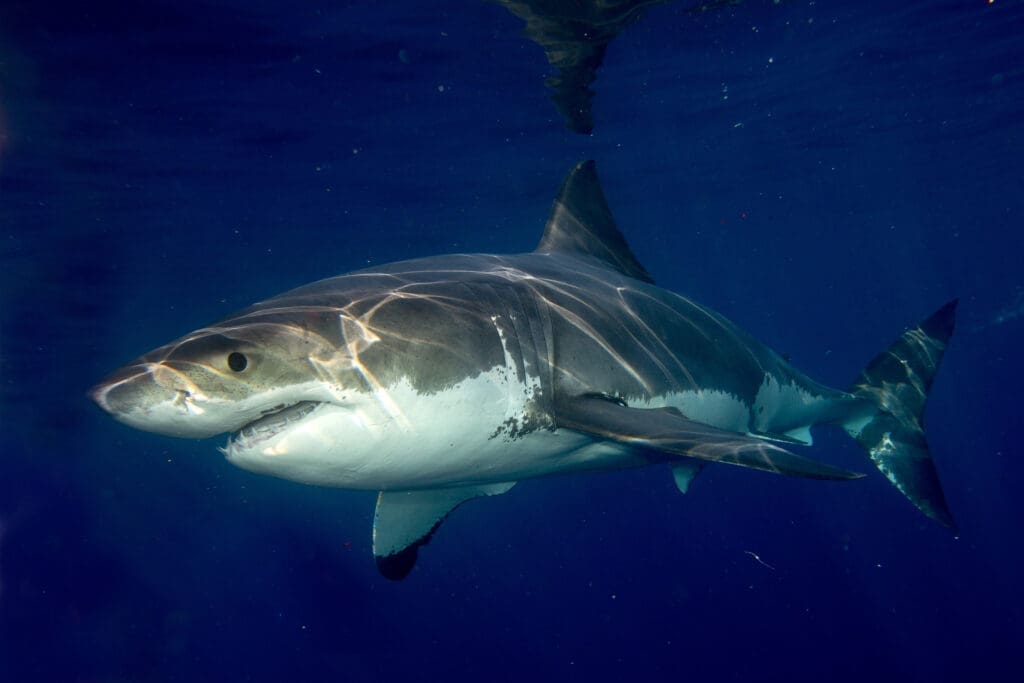
Fifty years ago, a 25-foot mechanical shark named Bruce forever changed the ocean. When Jaws hit theaters in June 1975, it became the first true summer blockbuster, grossing over $470 million worldwide—a staggering amount at the time—and turning beachgoers into reluctant swimmers overnight. More than just a thriller, Jaws left a complicated legacy: while it brought sharks into popular consciousness, it also sparked widespread fear and a surge in shark killings across the globe.
Yet from the panic emerged something more enduring—a generation of marine scientists inspired to study sharks. Researchers have long credited the film’s character of oceanographer Matt Hooper, played by Richard Dreyfuss, with motivating them to pursue careers in marine biology and conservation. Among them are now-leading figures in shark research and advocacy.
Today, as we mark the half-century milestone of Jaws, that legacy continues—but in a new form.
In the Gulf, sightings of great white sharks—once considered nearly mythic in these waters—are becoming more frequent. Divers, anglers, and researchers are documenting their presence along the coastlines of Louisiana, Florida, and even Texas. And one Texas-based initiative is turning the spotlight on this mysterious return, not with sensationalism, but with science and storytelling.
“Jaws scared some people, but it also inspired real scientific curiosity,” said Texas Fish & Game Editor-In-Chief and award-winning content creator and conservationist.
“Now we have a chance to use that spark to fuel a deeper understanding—one that’s rooted in facts, education, and conservation.
On June 21 Moore releases the documentary, Gulf Great White Sharks: Return of an Icon, Moore dives into the data, ecology, and personal stories behind the great whites’ return to Gulf waters.
The documentary, produced with cinematographer and TF&G contributor Paul Fuzinski, features marine researchers, Gulf anglers, and youth conservationists investigating this stunning resurgence. Far from fiction, the film presents real-life evidence and insights into the behavior, migration, and growing presence of great whites in Gulf ecosystems.
For Moore, the mission is deeply personal. Growing up on the Texas Coast in a lower-middle income family, sharks felt like something from another planet.
“To be able to study them, film them, and bring that story to people here at home, it’s more than a dream. It’s a way of aiding conservation awareness and hopefully inspiring people,” he said.
Together with his wife Lisa, Moore also leads Wild Wishes®, a nonprofit that grants wildlife encounters to children facing trauma, critical illness, or loss. So far, 260 wishes have been granted. The couple’s conservation mentoring initiative—an offshoot of Wild Wishes®—teaches young people to document wildlife stories using media tools. Several of these youth appear in the film, narrating parts of the story in their own voices.
“Kids bring a level of honesty and hope to wildlife issues that adults often forget,” Moore said.
“They’re not just watching this story. They’re part of it.”
Now, the Moores are inviting the public to experience this story firsthand.
Event Details:
Great White Sharks in the Gulf
Museum of the Gulf Coast, 700 Procter Street, Port Arthur, TX
*Saturday, June 21, 10 a.m. – 2 p.m.
*Screenings: 12:00 p.m. (Premiere), 1:00 p.m. (Encore)
*Free and open to the public
The event will feature two film showings, a shark education seminar, interactive exhibits, family-friendly activities, and conservation giveaways.
“It’s an honor to debut this project at the Museum of the Gulf Coast,” Moore said
“There’s no better place to connect our communities to the growing role the Gulf plays in global shark conservation.”
Learn more at the Facebook event page.
More on “Jaws”
When Jaws opened in June 1975:
-
It grossed over $7 million in its opening weekend—a record at the time—and went on to become the highest-grossing film in history until Star Wars surpassed it in 1977.
-
It played in over 450 theaters across the U.S., unprecedented distribution at the time, helping establish the summer blockbuster model still used today.
-
The film was based on Peter Benchley’s 1974 novel, which also became a bestseller and later sparked regret from Benchley, who spent his later years advocating for shark conservation.
-
Jaws led to a documented increase in shark killings, with sport fishermen and recreational hunters targeting sharks out of fear and fascination.
-
Yet paradoxically, it also inspired many. In a 2015 National Geographic article, shark researcher Dr. Greg Skomal noted, “Jaws terrified people—but it also sparked careers. A lot of today’s marine scientists grew up watching that movie.”