
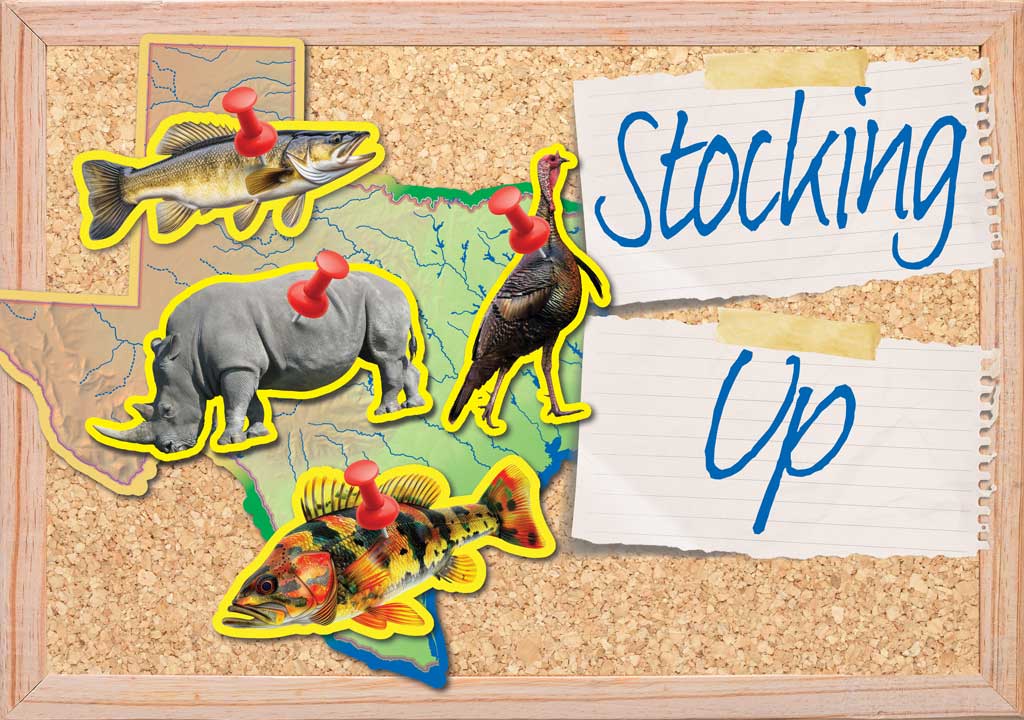
Texas Wildlife Stocking Efforts Include Everything from Peacock Bass and Turkeys to Walleye and Rhinos
Feature Article by CHESTER MOORE
LISTEN: (5 min, 56 sec)
WHEN IT COMES TO STOCKING animals, Texas doesn’t just think big. It thinks bold, wild, and sometimes just a little bit weird. From restoring Eastern wild turkeys in the Pineywoods to attempting to raise Nile perch in power plant lakes, the Lone Star State has a rich (and highly entertaining) history of putting critters back on the land and occasionally in the water.
Let’s start with the wins.
In East Texas, for example, Eastern turkeys had vanished from much of their historic habitat. Texas Parks & Wildlife Department (TPWD) initially tried pen-raised birds, but those turkeys didn’t take to the woods like their wild cousins. The early releases were a bust as pen-reared birds simply lacked the survival instincts and smarts of their wild brethren.
So, the department changed tactics. TPWD started importing Eastern wild turkeys from other states. And it has been highly successful with around 10,000 Eastern turkeys in the Pineywoods and that number is on the rise.
But not every stocking story in Texas has been quite so successful or quite so, shall we say, terrestrial.
Enter the Fish Oddities
Texas hatcheries are a cornerstone of the state’s inland fisheries. Thanks to them, anglers reel in monster bass, hefty catfish, and even rainbow trout in places they wouldn’t naturally occur.
But TPWD’s hatchery logs also reveal some fascinating attempts that didn’t quite make a splash.
Take the peacock bass, for example. A fan favorite in Florida for its stunning colors and aggressive fight, this exotic fish was stocked in various Texas lakes, Bastrop, Alcoa, Coleto Creek, and Tradinghouse beginning in 1978. Roughly 19,000 were released. But despite their tenacity and widespread distribution in southern Florida, peacock bass didn’t establish populations in Texas waters.
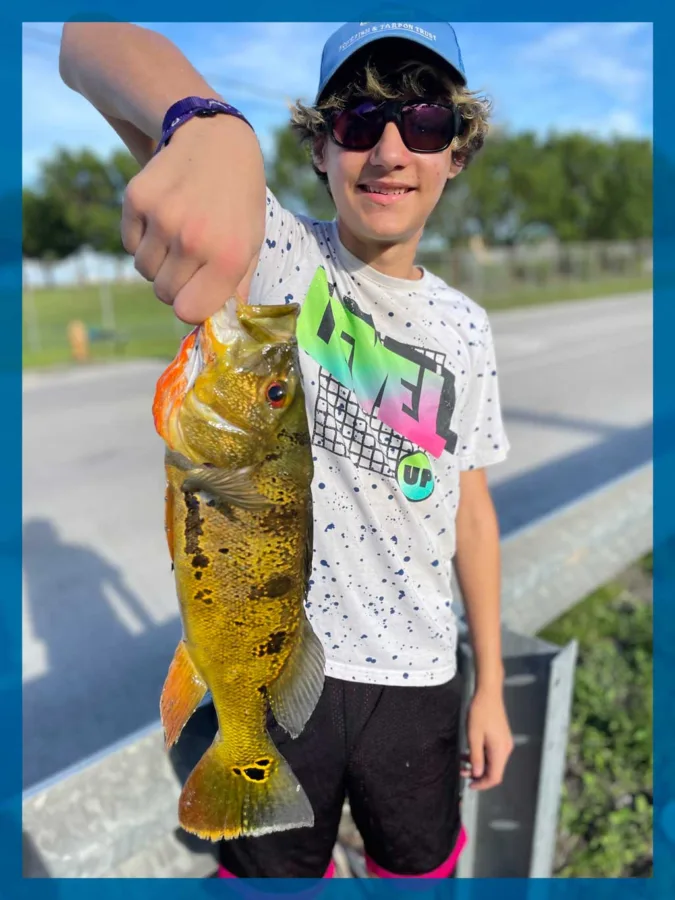 Jerry Gibson caught this peacock bass in a roadside ditch near Miami, Florida. Peacock bass took off in southern Florida but flunked out in Texas.
(Photo: Chester Moore)
Then there was the corvina, or more precisely, the orangemouth corvina. These salt-loving Pacific Coast bruisers were dropped into Braunig Lake back in the mid-80s-about 750,000 of them. The idea was thrilling: a freshwater fish that fights like a speckled trout on steroids. Unfortunately, TPWD dropped the concept.
The Nile perch, one of the largest freshwater fish on Earth and a heavyweight in the African Great Lakes, also got a shot at Texas waters. Between 1978 and 1984, about 80,000 were stocked in Braunig and Coleto Creek lakes. Though they have a fearsome reputation in their native range they never quite took off in Texas.
 ADVERTISEMENT
Let’s not forget the tiger musky, a frankenfish hybrid of the northern pike and muskellunge, famed for its ferocity. TPWD stocked them in several lakes in the late 1970s, including Copper Breaks State Park and Lake Nocona. Similarly, pure muskellunge were introduced into Amistad and Inks Lake. Like their hybrid cousins, they didn’t stick around long.
And yet, through it all, the state kept swinging. Case in point: walleye. These golden-eyed favorites of northern anglers have been stocked heavily in Texas reservoirs, especially up north. In 2016 alone, more than 3.2 million fry were introduced in lakes like Meredith and Wheeler Branch, with another million-plus the year before.
Oh and back in the 70s they were stocked in Sam Rayburn reservoir but like the musky experiment it didn’t work.
More Than Fish Tales
Texas has also led the charge in restoring and protecting big game animals, especially on private lands. Through landowner partnerships and innovative conservation models, species once headed for oblivion have made stunning comebacks. Scimitar-horned oryx and addax have found safe havens in Texas, far from their native ranges.
This brings us to one of the boldest ideas to come out of Texas conservation circles yet: rhinos.
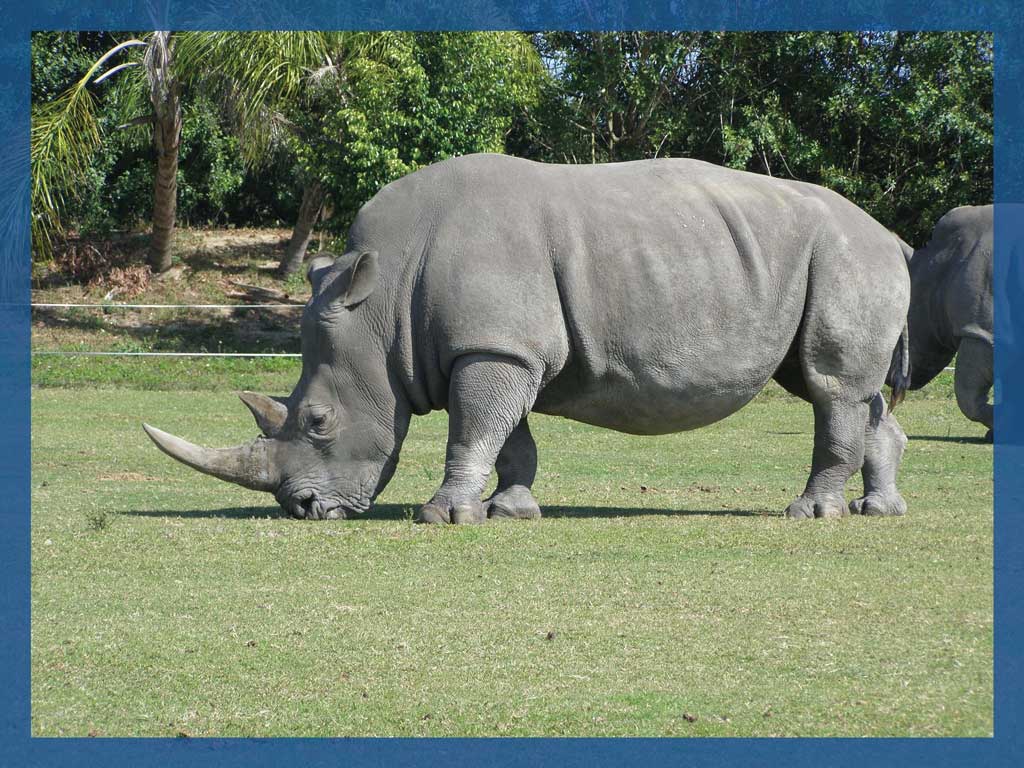 Texas has a growing number of rhinos in private hands that are being used for wildlife tourism in Fredericksburg and other places like the Barksdale area. Could Texas become a safe haven for orphaned baby rhinos?
(Photo: From Public Domain Files)
With poaching decimating rhino populations overseas, driven by black-market demand for their horn that fetches up to $60,000 a pound, some conservationists have floated the idea of bringing orphaned baby rhinos to Texas. The thinking goes like this: the state’s vast, privately owned ranches already serve as sanctuaries for dozens of non-native species. Why not rhinos?
The hope is that Texas could serve as a long-term safety net for rhinos, far from poachers and protected by highly managed, secure ranch lands. A handful of landowners and organizations have expressed interest, and the Exotic Wildlife Association has even endorsed the idea.
But while the passion is real, and some of the pieces are slowly falling into place, nothing is set in stone. Legal hurdles, international regulations, funding challenges, and logistical puzzles remain. The dream of rhinos roaming a piece of the Hill Country hasn’t been realized yet—but the fact that people are even considering it shows just how imaginative Texas conservation can be.
Stocking wildlife, whether it’s wild turkeys in East Texas or peacock bass takes guts, patience, and sometimes a willingness to laugh at your own wild ideas. Not everything has worked, but that’s the beauty of Texas: it’s a place where trying big, bold things isn’t just tolerated.
It’s the way we do things.
Because in Texas, we believe in second chances for species, for habitats, and for those who dare to dream big.
Whether it’s rebuilding a gobbling turkey population, dreaming up a new fishery, or imagining rhinos grazing in the Edwards Plateau, we’re not afraid to dream big and act bigger.
Here, conservation isn’t just about preserving the past. It’s about boldly shaping the future.
—story by CHESTER MOORE
DIGITAL BONUS VIDEO: Flounder Stocking
