
In the warm, salt-laced currents of the Gulf of Mexico, a surprising predator slinks silently among rocks and reefs—the moray eel. Though typically associated with tropical coral environments, several species of moray eels make their home in Texas coastal waters. They’re elusive, nocturnal, and startlingly powerful for their size, appearing occasionally in jetties, offshore rigs, and artificial reefs.
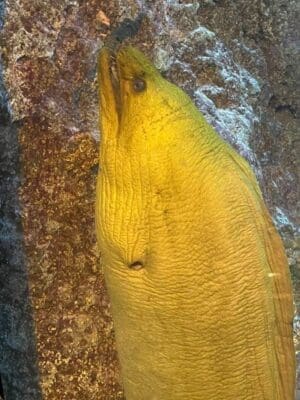
Moray eels are rarely seen by the casual beachgoer, but divers and fishermen familiar with the jetties off Galveston, Port Aransas, and South Padre Island sometimes catch a glimpse of these creatures nestled between rocks or darting from a hole during night dives. Their long, snake-like bodies—often green, brown, or mottled—blend in perfectly with their surroundings. They prefer enclosed spaces, often wedging themselves into rock piles, shipwrecks, or beneath underwater debris, where they wait to ambush prey.
While they may look fearsome, moray eels are typically not aggressive unless provoked or surprised. They hunt by smell, not sight, relying on an acute olfactory system to track down crustaceans, fish, and squid. Once prey is located, they strike with incredible speed and use a unique second set of jaws—called pharyngeal jaws—to drag the catch down their throat. This distinctive feeding mechanism is one reason morays are such efficient predators.
In Texas waters, several species have been officially recorded, including the green moray, spotted moray, blackedged moray, and blacktail moray. Each has its own coloration and size range, but all share the same sinuous movement and solitary habits. The green moray, in particular, is one of the largest and more frequently encountered species in the Gulf, sometimes reaching lengths of over seven feet.
The Texas Parks and Wildlife Department (TPWD) maintains state saltwater fishing records, and morays make occasional appearances in those logs. These are typically caught offshore, either by anglers deep-dropping near rigs or by divers using spearfishing gear. Their appearances on the record list help confirm their presence in Texas’s marine ecosystem, though sightings remain relatively rare compared to more common Gulf species like red snapper or speckled trout.
-
Blackedged Moray
-
Length: 3 ft 1 in | Weight: 39 lb
-
Date & Location: May 30, 1999 – Gulf of America
-
Angler: Ronnie Vaughn, caught via rod and reel
-
Source: TPWD saltwater “Other Methods” records NHPBS+6Texas Parks & Wildlife Department+6Texas Parks & Wildlife Department+6
-
-
Blacktail Moray
-
Length: 2 ft 5 in | Weight: 36 lb
-
Date & Location: March 24, 1998 – Gulf of America
-
Angler: George Flores, caught via rod and reel
-
Source: TPWD saltwater records Texas Parks & Wildlife Department+2Texas Parks & Wildlife Department+2Texas Parks & Wildlife Department+2
-
-
Green Moray
-
Length: 7 ft 7 in | Weight: 48 lb
-
Date & Location: August 1, 1998 – Gulf of America
-
Angler: George Flores, caught via rod and reel
-
Source: TPWD saltwater records Texas Parks & Wildlife Departmentthebermudian.com+7Texas Parks & Wildlife Department+7Texas Parks & Wildlife Department+7
-
-
Spotted Moray
-
Length: 8 ft 6 in | Weight: 50 lb
-
Date & Location: March 5, 1994 – Gulf of America
-
Angler: Louis Kusey III, caught via rod and reel
-
While moray eels might not be top of mind when thinking of Texas sea life, they are a fascinating and little-known part of the state’s marine diversity. From underwater observers to state record holders, these serpentine hunters embody the hidden complexity of the Gulf ecosystem—secretive, specialized, and perfectly adapted to life among the rocks.