

‘Plugging’ with the Master
LISTEN: (5 min, 56 sec)
RUDY GRIGAR, THE SELF-PROCLAIMED “Plugger,” was an original and true to his light-tackle game. He used long whippy two-handed rods and levelwind reels and chunked lures for speckled trout and redfish. Period.
Live bait or “fresh dead” was never allowed. And, almost exclusively, he waded, usually in the bays, occasionally in the summer surf. His boats, big center consoles, were just conveyances to run long fetches of open water to reach prime wading shorelines.
I fished with Grigar off-and-on for at least 20 years, from Galveston and Port O’Connor to Louisiana’s Chandeleur Islands, and never saw him deviate from that classic school of Gulf Coast plugging.
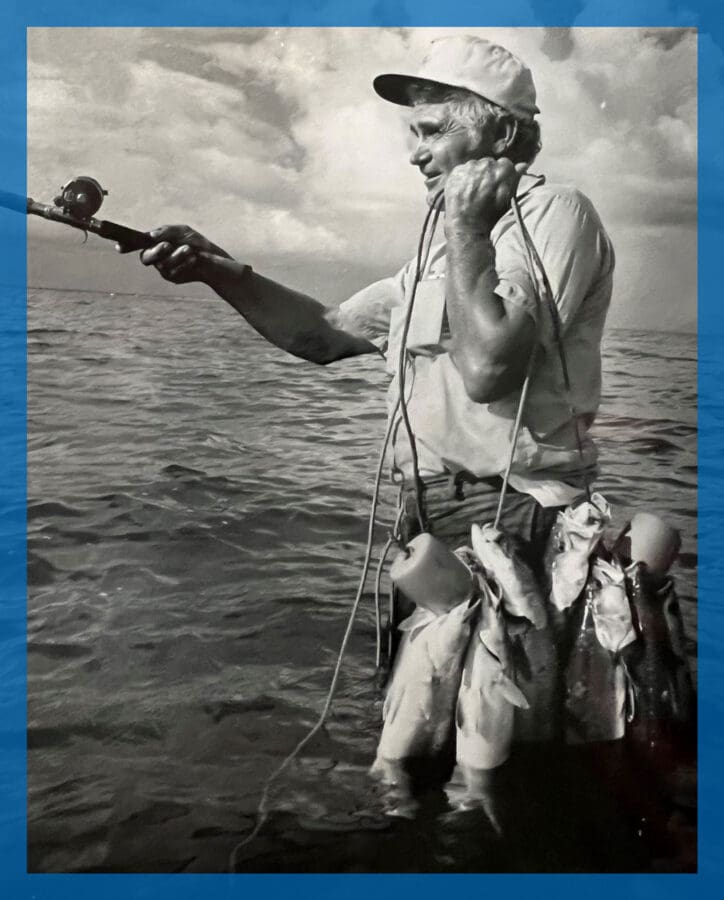 Rudy Grigar, the original “Plugger”
(Photo: Joe Doggett)
Our first session was most memorable. I joined the Houston Chronicle newspaper as a full-time outdoor writer in the summer of 1972, and the following spring Houston-based Grigar invited me on an overnight trip for speckled trout in lower West Galveston Bay.
I was thrilled. I had previously caught specks while “free shrimping” with live shrimp at the Galveston Jetties, and under popping corks in the bays, even a few on spoons and plugs in the green surf, but never in the company of a pro-class plugger.
Grigar had a small, weathered bay house on Mud Cut on the south side of sprawling San Luis Pass. That night we feasted on blue crabs he caught from a pair of chicken wire traps on the sagging wooden dock.
I awoke at dawn, on fire with the Trout Fever. Muggy wind was light from the southeast and scattered clouds bloomed across the open Gulf, ideal conditions. I was dismayed to find him futzing around, in no hurry to go anywhere.
“Relax,” Grigar said, “we need to let the incoming tide get going.”
 ADVERTISEMENT
We pushed his Boston Whaler from the dock an hour later and ran about 15 minutes, across the big pass to a nondescript open-water spot on the Galveston side of the main channel. The bow nudged onto the edge of a knee-deep sandbar, and he told me to drop the anchor. “Not loud, don’t chunk it, just slip the chain.”
Grigar presented me with one of his hand-tweaked plugs. It was a venerable 52M Series MirrOlure, but the metal line-tie eye had been removed from the top of the head and screwed straight into the nose to track shallow (several years later, the L&S Bait Company in Florida finally listened to the Texas pluggers and introduced the nose-rigged 51 Series still popular today).
The plug had a white back and a white belly with silver “Mirro” sides, but Grigar had spray painted the entire back with bright chartreuse (pink was the new hot color back then and few anglers had seen chartreuse patterns). I can’t say he coined the concept; maybe he picked it up from another plugger, but it was the first one I saw.
We rolled from the boat and waded on hard sand across the shallow bar. The “green to the beach” incoming tide was flowing richly across the flat, bringing nervous pods of riffling finger mullet.
Grigar pointed with his rod tip. “Watch for those mullet and put your casts just ahead. Fast retrieve, keep it moving. And remember to shuffle—stingrays.”
Minutes later I turned to an abrupt splash and saw my partner standing under a bent seven-foot rod, hooked up on a fine speckled trout.
A wad of the small mullet drifted past 50 or 60 feet away, and I flicked a soft sidearm cast across the breeze. The MirrOlure plopped down, and the close mullet flurried from the commotion. Several jive-talking reel cranks later a long silver and spotted flash rushed broadside to intercept. The line came tight, and I was fast to a gorgeous four-pound trout.
That was the first time I saw a game fish strike a lure in shallow water. I still remember the thrilling image in vivid detail. Several times, once the sun got higher, predatory trout were visible ghosting across the white sand.
Grigar and I fished for about two hours, until the tide played out and the baitfish parade stopped. The flat was now thigh deep. He strung a dozen or so specks, and I had about half that number. All were solid fish, and all were taken on the mullet-imitation plugs in shallow water. I had previously enjoyed days of more fish on live bait from boats, but nothing equaled the one-on-one experience of stalking with lures.
It was a lesson in quality versus quantity. More than that, it showed that wading shallow with light tackle can make even average fish exceptional. There is absolutely nothing wrong with slinging a free shrimp or working a popping cork, but I was awed by the purist game that the pluggers played on the Texas tides. I knew I wanted to join the salty ranks.
Shallow-running scooters were being built for a select few in South Texas, but that first session predated the armada of tricked-out Florida bonefish skiffs and poling platforms along the Gulf Coast.
And in the early ‘70s nobody knew what a graphite rod blank or a soft plastic “tail” was (both started showing in big numbers two or three years later). Fly fishing was virtually absent on the bay complexes north of the Laguna Madre, and many of today’s standard-issue accessories and accoutrements for bay fishing did not exist.
The original pluggers in faded khakis and canvas sneakers chunked “hard” plugs and spoons with long fiberglass rods and Ambassadeur “red reels” and made it work with a simple but elegant stance, the genesis of the game we play today.
And as a rookie I was fortunate to wade through a sparkling green tide in the wake of a master.
Email Joe Doggett at ContactUs@fishgame.com
