
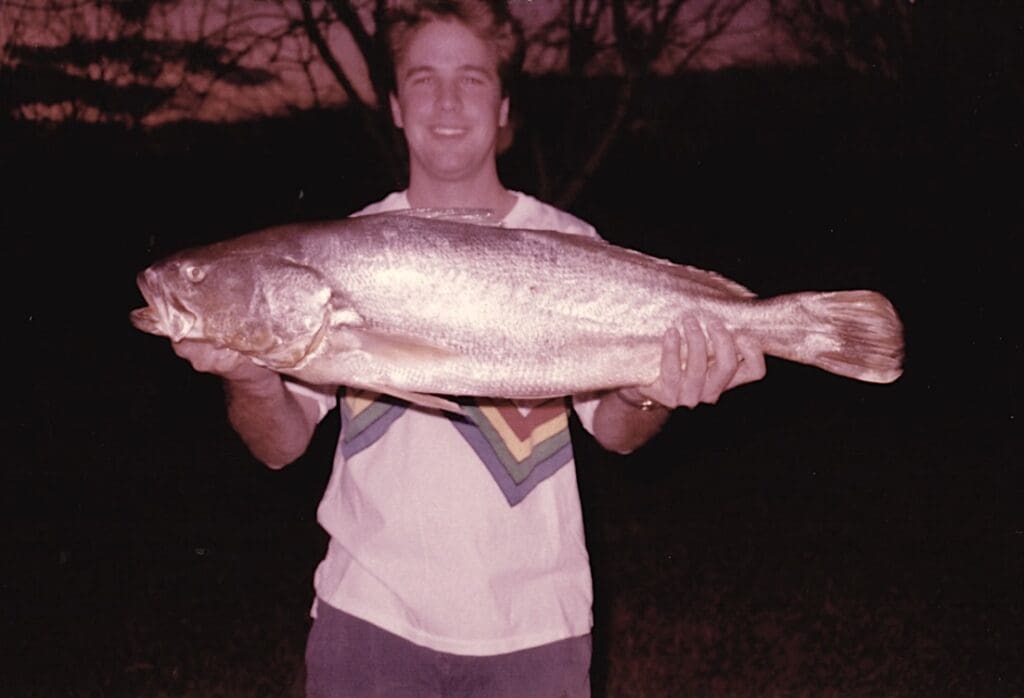
In the mid-1980s, Texas Parks and Wildlife Department (TPWD) undertook one of its most unique stocking experiments.
In the mid 1980s, officials released thousands of orangemouth corvina (Cynoscion xanthulus) into Calaveras and Braunig Lakes—two San Antonio power plant cooling reservoirs. The intent was to create a new, exotic sport fishery alongside the already-thriving red drum stockings that thrived there.
These fish are a speckled trout look alike but they get much larger.
The corvina took hold quickly. Sleek, silver predators with oversized mouths, they found the warm, bait-rich waters ideal. Anglers who fished at night near the spillways began to notice fierce strikes and powerful runs from a fish that, at the time, few Texans had ever seen before.
And on top of that TPWD released many corvina/speckled trout hybrids.
What happened over the next few years was fascinating. The fish thrived and some impressive records were caught including Earl Tenpenny’s state record orangemouth corvina catch of 16.31 pounds on Calaveras.
Richard Alejandre caught Braunig’s water body record corvina in 1990 and it weighed 14.50 pounds.
The speckled trout/corvina catches were even more impressive.
The lake record for Calaveras weighed 14.60 pounds and was caught by Harold Sinclair. The lake record for Braunig is also the state record and it weighed 20.80 pounds and it was caught in 1992 by Phillip Mann.
That’s more than four pounds larger than the state record speckled trout!
A Family Memory from the Early Days
For David Callaway’s family, the corvina era is remembered vividly.
“This is my father, Kelly Callaway, with a corvina, in the mid to early ’80s. We caught several in front of the spillway at night. This one was 4 inches longer than the inside of a standard 48-quart ice chest. The picture is deceiving—this was a massive fish. And here’s the connection: it was caught where his grandmother once owned dry land that was later taken by eminent domain to create the lake.”
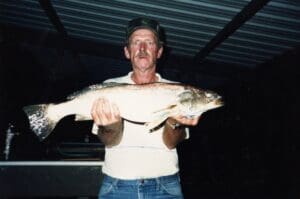
That fish, and others like it, symbolized not just a unique angling opportunity but also a personal tie between family history and the newly created lake.
The Next Generation at Calaveras
By the early 1990s, Sean Hoffman who now directs communication at the Texas Wildlife Association enjoyed this unique fishery.
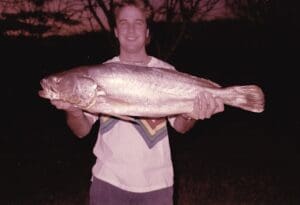
“Judging from the photos, I caught mine in the early ’90s at Calaveras Lake, one of San Antonio’s two powerplant cooling reservoirs. Back then we’d night fish from the bank, but only after cast-netting bluegill and shad. We’d rig them Carolina-style, wade out to waist- or chest-deep water, and cast as far as our Ambassadeurs would allow. The rods sat in holders on the bank, and if we were lucky, one would double over—but more times than not, they didn’t.”
Redfish were the main target in those years, but the corvina left their mark.
Why They Disappeared
By the late 1990s, the corvina program faded. Eventually, no more corvina were stocked, and today their presence in Texas waters is only a memory. There were some concerns that corvina and their hybrids could be transplanted to the coast by anglers and cause problems with native speckled trout.
But for families like the Callaways, those years produced stories that live on. .
Early in my career I wrote an article entitled “Has the Age of the Super Trout Arrived?” pondering at the time new genetic research and the idea of doing to specks what TPWD was doing with Florida largemouth bass.
I didn’t realize it had already happened and faded away into the memories of those who caught these fish that no longer exist in Texas waters.
Chester Moore