
How Crappie Anglers Use Forward Facing Sonar to Fish More Efficiently
Feature Article by MATT WILLIAMS
LISTEN: (9 min, 13 sec)
IT’S NO SECRET that forward-facing sonar is all the rage these days in freshwater fishing. From tournament circles to recreational arenas, many anglers are using the technology to find and catch crappie, big bass, and even catfish with more efficiency than ever before.
For those unfamiliar with FFS, it’s a really cool (and expensive) technology offered by several companies. Humminbird MEGA Live Imaging, Lowrance ActiveTarget and Garmin Panoptix LiveScope are the big three.
The technology functions using a special transducer that captures real-time imagery around the boat and transmits it to the electronics screen for evaluation. It enables trained eyes to spot suspended fish, cover and submerged other targets from a considerable distance.
Anglers can use it to make precise bait presentations to fish, see how they react as a bait moves through the water column, or determine whether fish are present before making a single cast. Some FFS users are so proficient with the tech they are able to specifically target the bigger fish and leave the smaller ones alone.
Around since 2015, the technology has undergone vast improvements since. It’s popularity has really spiked over the last 3-4 years.
“Just about everyone has it now,” said veteran Toledo Bend crappie/bass fishing guide Stephen Johnston of Hemphill. “Some guys have more money tied up in their electronics than their boats are worth.”
Johnston’s Vexus bass boat is fully equipped with premium Humminbird electronics, including the newest MEGA Live 2. He’s also among a budding list of the anglers who thinks popularity of the technology could be having a negative impact on crappie populations in his home lake and others.
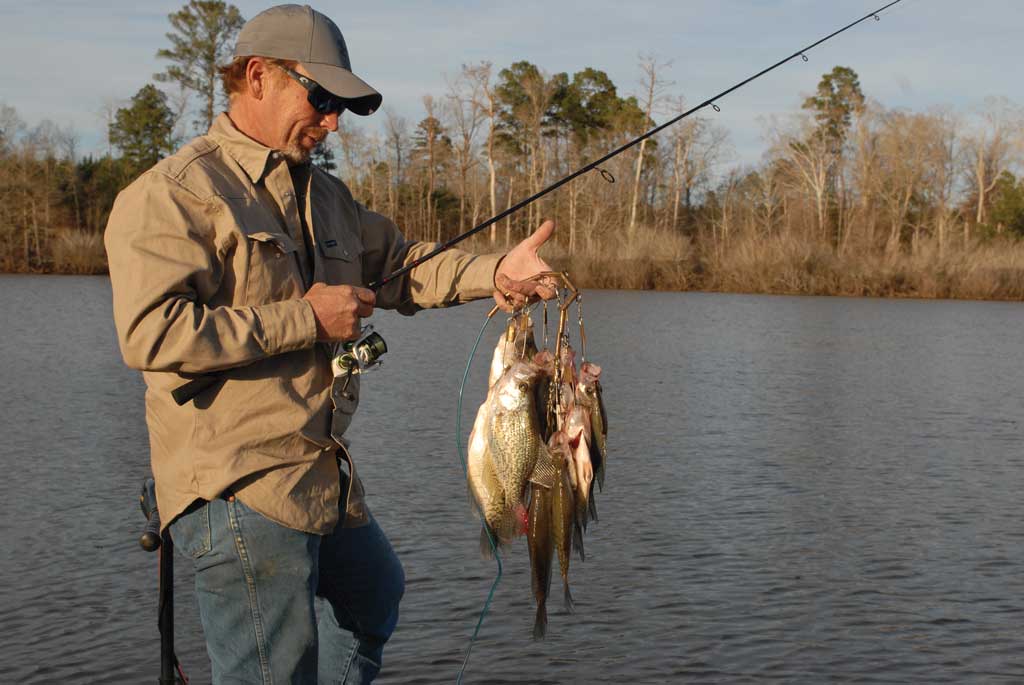 Depending on who you talk to and what lake they fish, FFS technology is either hurting crappie numbers or having little to no affect.
(Photo: MATT WILLIAMS)
A border lake shared with Louisiana, T-Bend is governed by a 25 fish, no-size limit regulation. The Texas statewide reg is 25 fish, 10 inches.
Johnston thinks FFS has made anglers so efficient at catching the brush-loving fish that numbers have declined despite the fact some scientists believe the fish are so prolific they can’t be fished down. He’s seen the dip in numbers at T-Bend occur over the last two years. He said some anglers have even figured out ways to use it to pluck fish out of the shallows while they are spawning.
“I’m not saying technology is a bad thing, but something is going on,” Johnston said. “I rebrushed 42 brush piles the first week of June in 22-30 feet of water where I have been catching fish for years. I took a trip in August and fished seven piles and never caught a single crappie of any size. They just weren’t there.”
 ADVERTISEMENT
He added that old natural laydowns that historically held large schools are no longer holding the numbers they once did consistently. “People used to think crappie were like fleas on a little dirty dog — that you could never catch enough to hurt them. But I’m not so sure about that any more. They just can’t hide any more.”
Texas Parks and Wildlife biologist Jake Norman of Tyler has fielded questions from anglers about the potential of negative impact FFS might have on crappie populations more than once. His stance is that large reservoirs managed for 10 inches are in no danger of being over fished.
Norman says anglers would need to harvest over 80 percent of all legal crappie in a reservoir, regardless of growth rate, before there would be a meaningful decline in population abundance.
“It is essentially impossible for harvest rates to reach anywhere near 80 percent, suggesting we cannot ‘fish down’ our crappie in most Texas waterbodies, although it could potentially impact populations of larger fish on a water body that sees a lot of pressure or if you have a year or two with weaker spawns,” he said.
Norman and TPWD fisheries biologist Dan Bennett were heavily involved in a 2022-23 study carried out on eight lakes — Tawakoni, Fork, Pines, Palestine, Sam Rayburn, Richland Chambers, Ray Hubbard and Oak Creek. The purpose of the angler creel study was to learn the difference in catch and harvest rates between live sonar users and non-users.
Norman said 1,200 anglers were interviewed during the study. About 57 percent of them were using FSS. He said FFS users accounted for 64 percent of harvested fish.
Bennett said the study showed the average number of crappie harvested per day by a live sonar user was lower than you might think — about 7-8 fish.
“The main finding is that crappie populations are not at risk of collapse due to FFS,” Bennett said. “There is a relatively small percentage of crappie anglers that harvest 10 or more crappie. You’re not going to see a large number of anglers, or the crappie population, impacted by lowering the bag limit.”
To date, the only state to adjust crappie limits due to FFS is Mississippi. In 2023, the Mississippi Commission on Wildlife, Fisheries and Parks cut daily limits at four of the state’s more popular trophy crappie lakes — Grenada, Enid, Sardis and Arkabutla Lake. All are well known for producing big crappie.
Limits were slashed from 15 crappie to 10 over 12 inches per angler per day, and no more than 25 crappie per boat, per day.
Biologists told the Clarion Ledger newspaper the changes were implemented after a three-year study showed forward-facing sonar usage among anglers on three of the lakes — Sardis, Enid and Grenada — jumped from 20 percent to 70 percent over the course of the study period. Mississippi biologist Keith Meals also told the paper that study results showed anglers who were using FFS were catching 2-3 times more fish than non-users, and the main goal behind the more restrictive limit is to try to maintain a quality fishery in size.
Gary Paris is another veteran Texas fishing guide who thinks FFS may be having a negative impact on his home lake, Lake Fork. This is especially true of larger fish, 1 1/2 pounds and up. Paris says he would love to see some sort regulation implemented to protect larger fish from over harvest.
“There’s more harvested now than there used to be so I don’t know how it couldn’t be hurting them,” he said. It’s really difficult to catch the fish out of the schools. They’re beat up. There’s less of them. You can go to a lot of the big timber spots and not see a lot of big fish like you should. When FFS first came out we saw how many there were. Now they’re gone. They aren’t there. There’s still a lot of 10 inch fish, but that’s not what people come to Lake Fork for, especially those folks from up north.”
Interestingly, Sam Rayburn guide Blake Ostreich and Lake Palestine guide William Oliver have altogether different opinions. The two guides — both FFS aces — say crappie populations on their home lakes appear to be in great shape with plenty of fish in the water that have simply adjusted to fishing pressure. Ostreich spends most of his time at the lake’s upper reaches.
“I’ve never seen so many fish in my life,” Ostreich said. “I don’t think it’s hurting them one bit. I do think it could hurt them in smaller lakes, but in lakes like Rayburn there is just too much water with abundant bait and cover I don’t think you ever hurt them. They’re prolific spawners and they grow fast.”
Ostreich also runs occasional trips on nearby lakes Nacogdoches (2,200 acres) and Murvaul (3,400 acres). He said the fish do appear to behave differently on those lakes than they did when FFS first came on the scene.
“There’s still tons of fish at Nacogdoches, but I do feel like they act differently than they used to,” he said. “I feel like they are more pressured. Even on Rayburn, if you fish the same stuff every day, they get educated. They may have been doing that for years, we just couldn’t see them before FFS. Sometimes you wonder where they went but they always show back up.”
Oliver said crappie populations on Lake Palestine appear to be in a down cycle right now, but believes it is linked more to poor spawning conditions the past couple of years than anything else.
“The only thing that has changed on Palestine is the same thing that has changed over and over for the last 30 years of my life, said Oliver. “Crappie are cyclical in nature. As humans, we can’t put enough pressure on crappie in a 27,000 acre reservoir to affect the pop by one percent. It doesn’t matter how many people have FFS. I have seen it change as far the fish becoming more conditioned to being fished for, but as far as the population goes, I don’t think (FFS) has anything to do with it.”
—story by MATT WILLIAMS
DIGITAL BONUS: Mr. Crappie
