
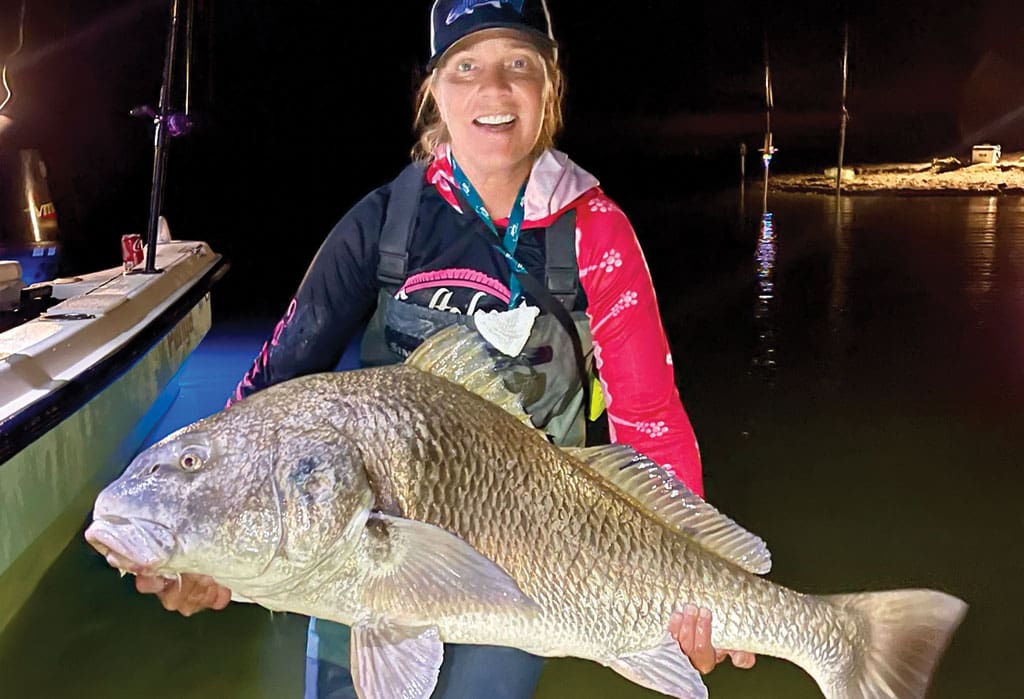
Few fish on the Texas coast are more overlooked than big black drum. They don’t draw crowds like oversized redfish or flashy pelagics, but the anglers who know them understand just how impressive these fish can be. Black drum pushing 40, 50, even 70 pounds are among the strongest and most stubborn fighters in shallow coastal water. Thick-bodied, slow-moving, and built for brute force, they spend their lives where current, structure, and crustaceans come together—along jetties, in the surf, and across the bays.
For anglers willing to slow down, fish heavy, and trust their tackle, black drum offer some of the most memorable battles in saltwater.
If there’s a place synonymous with trophy black drum, it’s the Texas jetties. These rock walls funnel tidal flow, stack bait, and create prime feeding lanes for drum rooting along the bottom. Big black drum here are usually caught tight to the rocks, often in surprisingly shallow water. They cruise slowly, noses down, vacuuming crabs, shrimp, and mollusks off the bottom.
Success starts with proper gear: stout rods, 30–50 lb braid, and a heavy fluorocarbon leader. Drum don’t run like kingfish, but once hooked, they dig in and use their mass to full advantage. Fresh dead shrimp, cracked blue crab, or whole crab halves are go-to baits. Rig them on a Carolina or fish-finder setup with enough weight to hold bottom in the current.
Many bites are subtle—just a heavy thump or a slow pull. Swing too early and you’ll miss them; wait until the rod loads. Jetty drum fishing is best during strong tidal movement, especially around passes connecting the Gulf to the bays. Late winter through early spring often produces the largest fish, though giants can be caught year-round.
The Texas surf is underrated black drum water, but it shouldn’t be. When conditions line up, the beachfront can produce drum that rival jetty fish in size. Big drum cruise the first and second guts, especially near sandbars, cuts, and areas where waves expose shell or hard bottom. Calm to moderate surf with moving water is ideal. On rough days, drum may slide in close, sometimes feeding in water barely deep enough to cover their backs.
Long rods help here—12 to 14 feet—to reach beyond the breakers. Heavy sinkers keep baits pinned in the current. Fresh shrimp remains the top producer, but cracked crab shines when targeting larger fish and avoiding smaller bait thieves. One advantage of surf fishing for drum is space. There’s no structure to wrap you up, so fights are more straightforward—though no less exhausting. When a big drum turns sideways in the surf and starts using wave energy, it feels like trying to drag a wet couch across the beach.
While most anglers associate trophy drum with the Gulf, Texas bays quietly hold massive fish, especially in deeper channels, ship lanes, and along shell pads. In the bays, black drum often school by size. Find one big fish and there are usually more nearby. Winter is prime time, when drum congregate in deeper water and feed heavily.
Look for muddy bottoms adjacent to shell or drop-offs where crabs are plentiful. Boat anglers do well drifting with the current, while wade fishermen can target drum along channel edges during strong tidal flow. Patience is key. Drum aren’t speed feeders—they’re methodical, deliberate, and sometimes maddeningly slow. Light winds and stable weather help tremendously. When the bay lays down and the water clears, drum can be spotted pushing mud or tailing like oversized redfish.
Large black drum are incredibly resilient fish, but they deserve respect. Many trophy-class drum are breeding-age spawners, and releasing them ensures the future of the fishery. Use circle hooks when possible, fight fish efficiently, and keep them in the water during photos. A quick release goes a long way with a fish that may be decades old—some black drum are estimated to live over 50 years.
Fishing for giant black drum isn’t flashy. There are no screaming drags or blistering runs. Instead, it’s a slow, powerful tug-of-war that tests gear, patience, and back muscles. But when that broad, gray-black slab finally rolls at the surface, you’ll understand why so many Texas anglers quietly obsess over them.
From jetty rocks to rolling surf to quiet bay channels, black drum remain one of Texas biggest and accessible saltwater trophies.