
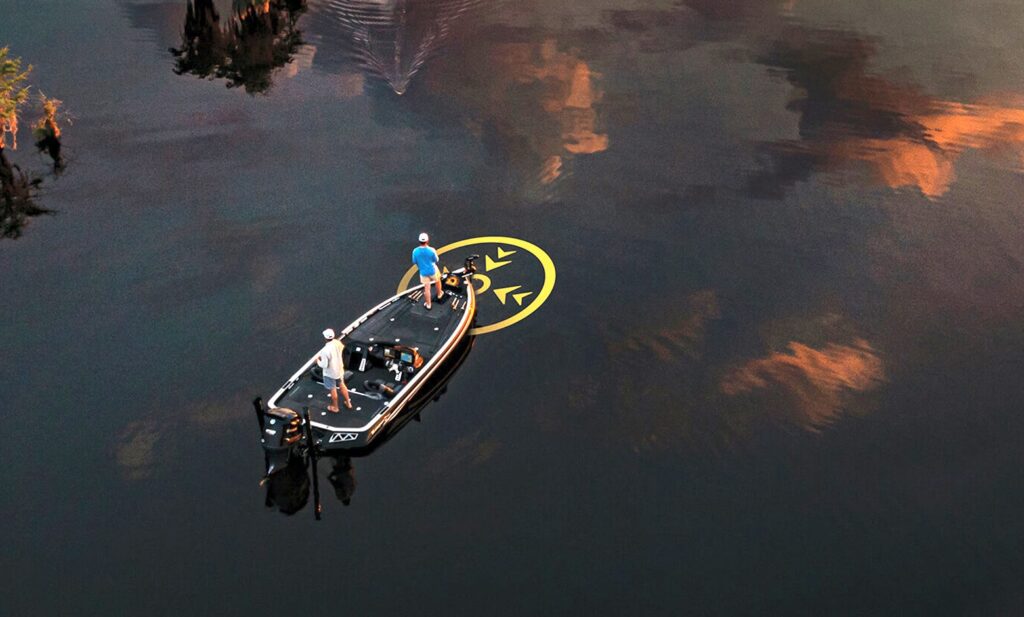
Late winter and early spring are about intercepting bass during seasonal movement. Water temperatures are climbing, bait is shifting, and big prespawn females are positioning along migration routes. Success during this window isn’t just about lure choice but also about boat positioning. A trolling motor like the Minn Kota Terrova, equipped with Advanced GPS Navigation, allows you to control your approach, your angles, and your efficiency in changing conditions.
Late Winter: Holding on Deep Structure
In late winter, bass typically group on steep breaks, channel swings, bluff ends, and deep grass edges near spawning areas. They’re conserving energy and often holding tight to specific depth zones.
Use Spot-Lock® strategically here. Instead of hovering directly over fish, position slightly upwind or upcurrent of the break and engage Spot-Lock to hold your casting distance. This keeps the boat from drifting across the structure and disturbing fish with hull shadow or noise.

Once locked in, use the Jog function to move your position in small increments. This allows you to thoroughly cover a wintering area without lifting the trolling motor or restarting your drift. Make repeated casts at slightly different angles to ensure your bait falls naturally down the breakline.
Transition Period: Working Staging Banks
As temperatures push into the upper 40s and low 50s, bass begin sliding toward secondary points and staging banks. These fish are not spawning yet, but they’re moving with purpose.
Instead of manually steering an entire stretch, use AutoPilot™ to maintain a steady heading down a bank or along a contour line. This keeps your casting angle consistent, especially in crosswinds. A consistent angle helps maintain proper bait depth when fishing jerkbaits, crankbaits, or swimbaits along rock and gravel transitions.
Wind is common during late winter and early spring. Rather than fighting it with constant pedal adjustments, let the motor hold your heading while you focus on retrieve cadence and depth control.
Early Prespawn Flats: Controlled Drift
When bass begin pushing onto flats near spawning pockets, they often relate to subtle depth changes, grass edges, or isolated cover. Boat movement needs to feel natural.
Drift Mode can be useful here. It manages boat speed and direction to match wind or current, helping you maintain a controlled drift across productive water. Instead of overcorrecting and creating unnatural boat movement, you can maintain a steady presentation path.
Approach windblown flats from the downwind side when possible. Allow the boat to drift naturally while casting ahead of your movement. This keeps your bait approaching bass the same direction forage would.
As bass move into shallower staging areas, stealth becomes critical. Sudden throttle changes can push fish tighter to cover or off a flat entirely.
Use steady, low-speed adjustments rather than quick bursts. Smooth power delivery helps reduce noise and vibration. When working docks, laydowns, or emerging grass, begin slowing your approach before you enter the target zone. Early adjustments are quieter than last-second corrections.
Efficiency During Long Prespawn Days
Cold water and long runs between areas can tax batteries. Digital Maximizer™ technology helps extend run time by delivering only the power needed at any given speed. This is especially helpful during late winter, when cold temperatures naturally reduce battery performance.
Plan your drifts and bank runs before starting down them. Fewer unnecessary corrections mean more efficient coverage and more time with your bait in productive water.
Putting It Together
Late winter and early spring bass fishing is about intercepting fish as they transition from winter structure to spawning areas. Position upwind of deep breaks and use Spot-Lock to hold casting distance. Use AutoPilot to maintain clean lines down staging banks. Let Drift Mode assist in covering prespawn flats naturally. Approach shallow water slowly and deliberately.
When you focus on positioning first and casting second, you spend more time presenting your bait effectively. During the prespawn window — when some of the heaviest bass of the year are moving — precise boat control often makes the difference between simply fishing… and consistently targeting trophy-class fish.