

I can still see it as clearly as if it happened yesterday.
I was only about 23 years old, sitting in a shoot-through ground blind on the King Ranch with Keith Warren who was filming our turkey hunt for his television program when the brush in front of us seemed to change shape. It wasn’t sudden movement, not the flash of a whitetail tail or the nervous bob of a javelina. It was something heavier and slower, almost unreal, like the landscape itself was parting.
At first, all I noticed was the color—a slate-gray hide, almost blue in the morning light, sliding between the mesquite trunks. Then the full animal stepped out, and there was no mistaking what it was.
A nilgai bull.
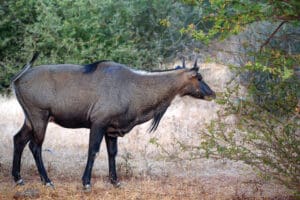
And when I say bull, I mean a creature that looked like it belonged on another continent, or maybe in another century, more than it did in South Texas. He was massive through the shoulders, thick-necked, built like a wild ox, with that prehistoric profile that makes nilgai so different from anything else walking the Texas brush.

He wasn’t supposed to be part of this hunt. We were there for turkeys. Keith was calling softly, the air was full of springtime expectation, and somewhere out in the flats a Rio Grande gobbler had answered not long before. But suddenly none of that mattered. This bull walked into the opening at maybe 20 yards, close enough that I could see the ripple of muscle under his hide, close enough that my pulse felt louder than anything outside the blind.
He stopped broadside, completely calm and completely unaware. For a few seconds, the world shrank down to that animal standing there, filling the sendero like a living monument. I remember slowly turning my head toward Keith, almost afraid to speak, and whispering, “Can we shoot them?”
Keith didn’t hesitate. “No.”
That was it—plain and final.
But I’m going to tell you the truth. At 23 years old, with a nilgai bull of a lifetime standing right there, i wanted to have a little fun. I eased my bow up and drew back anyway, not because I was going to break the rules or ruin the hunt (which I would never do), but because I needed to feel it. I came to full draw and settled my pin right behind his shoulder, right on the vitals.
I knew this might be my only chance to get this close to a trophy nilgai bull with a bow and I just wanted to know that I could have taken him.
I held there for a heartbeat longer than I probably should have, then slowly let the bow down, almost like doing that would somehow ease the ache of having to watch him walk away. The bull stood there a few more seconds, silent and immense, then turned and disappeared back into the thornscrub as smoothly as he had appeared, leaving nothing behind but crushed grass and the kind of memory that stays with you forever.
That was my first real encounter with a nilgai in South Texas, and it gave me huge respect for them. I’ve bowhunted in their lair since but never got close enough to draw back.
Nilgai are one of the most fascinating big game animals we have in Texas, and honestly one of the most unique anywhere in North America. They aren’t native, of course. They come from India, where they are the largest Asian antelope species in the world, animals of open plains and scrub country that have shared landscapes with tigers and leopards for centuries.They were introduced to Texas nearly a century ago, turned loose on big South Texas ranches (beginning with the King) in the early days of exotic game management, and somehow they carved out a permanent foothold in that coastal zone.”
I can still see him as clearly as if it happened yesterday. I was only about 23 years old, sitting in a shoot-through ground blind on the King Ranch with Keith Warren, filming one of his turkey hunts for television, when the brush in front of us seemed to change shape. It wasn’t sudden movement, not the flash of a whitetail tail or the nervous bob of a javelina. It was something heavier and slower, almost unreal, like the landscape itself was parting.
At first, all I noticed was the color—a slate-gray hide, almost blue in the morning light, sliding between the mesquite trunks. Then the full animal stepped out, and there was no mistaking what it was.
A nilgai bull.
And when I say bull, I mean a creature that looked like it belonged on another continent, or maybe in another century, more than it did in South Texas. He was massive through the shoulders, thick-necked, built like a wild ox, with that prehistoric profile that makes nilgai so different from anything else walking the Texas brush.
He wasn’t supposed to be part of this hunt. We were there for turkeys. Keith was calling softly, the air was full of springtime expectation, and somewhere out in the flats a Rio Grande gobbler had answered not long before. But suddenly none of that mattered. This bull walked into the opening at maybe 20 yards, close enough that I could see the ripple of muscle under his hide, close enough that my pulse felt louder than anything outside the blind.
He stopped broadside, completely calm and completely unaware. For a few seconds, the world shrank down to that animal standing there, filling the sendero like a living monument. I remember slowly turning my head toward Keith, almost afraid to speak, and whispering, “Can we shoot them?”
Keith didn’t hesitate. “No.”
That was it—plain and final.
But I’m going to tell you the truth. At 23 years old, with a nilgai bull of a lifetime standing right there, instinct took over. I eased my bow up and drew back anyway, not because I was going to break the rules or ruin the hunt, but because I needed to feel it. I came to full draw and settled my pin right behind his shoulder, right on the vitals, and in that moment I knew without any doubt that I could have taken him.
I held there for a heartbeat longer than I probably should have, then slowly let the bow down, almost like doing that would somehow ease the ache of having to watch him walk away. The bull stood there a few more seconds, silent and immense, then turned and disappeared back into the thornscrub as smoothly as he had appeared, leaving nothing behind but crushed grass and the kind of memory that stays with you forever.
That was my first real encounter with a nilgai in South Texas, and it was enough to hook me for life.
Nilgai are one of the most fascinating big game animals we have in Texas, and honestly one of the most unique anywhere in North America. They aren’t native, of course. They come from India, where they are the largest Asian antelope species in the world, animals of open plains and scrub country that have shared landscapes with tigers and leopards for centuries. Somehow, decades ago, they ended up here, brought to Texas as exotic game, and like so many introductions in this state, they found a place that fit them almost perfectly.
What makes nilgai different from other exotics is that they never really spread everywhere. Axis deer have expanded across the Hill Country and beyond, blackbuck can be found in scattered pockets, but nilgai remain tied to a very specific part of the map—South Texas’ coastal zone. Kenedy County, Willacy, Cameron, and the legendary ranchlands that run down toward the Laguna Madre are the heart of nilgai country.
It’s a region of thornscrub, coastal prairie, and wide-open horizons where the wind always seems to carry salt in it, and the brush can be so thick that even something as big as a nilgai can vanish like smoke. That’s part of what makes them so special. People hear the word “antelope” and imagine something light and delicate, but nilgai are not delicate. A mature bull can weigh 600 pounds or more, and they carry themselves with a kind of quiet power that demands respect.
Hunting nilgai is not like hunting deer. They are wary, intelligent, and incredibly resilient. They live in country that is already unforgiving, and when pressured they can cover ground faster than seems possible for an animal that size. A wounded nilgai can disappear into the nastiest brush imaginable, and if you don’t respect them, you will learn quickly why South Texas hunters speak about them with a different tone.
That’s why weapon choice matters so much. Most experienced nilgai hunters lean toward serious rifle calibers. This is not the place for marginal rounds or questionable bullets. A .30-06 or something like a .300 Winchester Magnum are common choices, because you want penetration and a clean ethical kill on an animal built the way they are.
Bowhunting them can be done, and it has been done successfully, but it requires discipline, heavy arrows, stout broadheads, and the patience to wait for exactly the right angle. Their vitals sit slightly more forward than a whitetail’s, and the margin for error is small.
But when everything comes together, the reward is tremendous, and I’m not just talking about the hunt itself.
Nilgai meat, in my opinion, is the finest wild meat you can eat. I don’t say that lightly. Axis deer is famous for table fare, and I love axis, but if you gave me the choice between the two, nilgai wins every time. The meat is lean, rich, and clean tasting, almost like the best grass-fed beef you can imagine, with just enough wild character to remind you where it came from. Backstrap from a nilgai bull is something truly special.
Nilgai are also a reminder of how strange and wild Texas can be, because where else can you sit in a ground blind on one of the most historic ranches in America listening to turkeys gobble, and then watch an animal from India step out of the thornscrub like it belongs there?
In many ways, nilgai have become part of the South Texas landscape, woven into the identity of that coastal ranch country. But they are still vulnerable to the extremes of that land. The freeze of February 2021 was a stark reminder of that. Nilgai are built for heat and warm winters, and when that brutal cold settled over the coastal plain, many of them died, especially younger animals or those caught without shelter.
And yet, nilgai persist.
They are still out there, slipping through mesquite and huisache, standing like statues at last light, watching from the edges of senderos with that calm, almost prehistoric presence.
That morning on the King Ranch, I didn’t get to take that bull. But I took something else with me—a memory, a fascination, and the certainty that nilgai were not just another exotic on a game list, but one of the most unique animals roaming anywhere in the United States.
Sometimes the hunt isn’t about the shot. Sometimes it’s about the moment an animal steps out of the brush and changes the way you see the wild world forever. And somewhere out there, in that coastal South Texas country where the wind smells like salt and mesquite smoke, another big nilgai bull is standing in the shadows.
Next time, the answer might be yes.
What makes nilgai different from other exotics is that they never really spread everywhere. Axis deer have expanded across the Hill Country and beyond, blackbuck can be found in scattered pockets, but nilgai remain tied to a very specific part of the map—South Texas’ coastal zone. Kenedy County, Willacy, Cameron, and the legendary ranchlands that run down toward the Laguna Madre are the heart of nilgai country.
It’s a region of thornscrub, coastal prairie, and wide-open horizons where the wind always seems to carry salt in it, and the brush can be so thick that even something as big as a nilgai can vanish like smoke. That’s part of what makes them so special. People hear the word “antelope” and imagine something light and delicate, but nilgai are not delicate. A mature bull can weigh 600 pounds or more, and they carry themselves with a kind of quiet power that demands respect.
Hunting nilgai is not like hunting deer. They are wary, intelligent, and incredibly resilient. They live in country that is already unforgiving, and when pressured they can cover ground faster than seems possible for an animal that size. A wounded nilgai can disappear into the nastiest brush imaginable, and if you don’t respect them, you will learn quickly why South Texas hunters speak about them with a different tone.
That’s why weapon choice matters so much. Most experienced nilgai hunters lean toward serious rifle calibers. This is not the place for marginal rounds or questionable bullets. A .30-06, a .308 with premium ammunition, or something like a .300 Winchester Magnum are common choices, because you want penetration and a clean ethical kill on an animal built the way they are.
Bowhunting them can be done, and it has been done successfully, but it requires discipline, heavy arrows, stout broadheads, and the patience to wait for exactly the right angle. Their vitals sit slightly more forward than a whitetail’s, and the margin for error is small.
But when everything comes together, the reward is tremendous, and I’m not just talking about the hunt itself.
Nilgai meat, in my opinion, is the finest wild meat you can eat. I don’t say that lightly. Axis deer is famous for table fare, and I love axis, but if you gave me the choice between the two, nilgai wins every time. The meat is lean, rich, and clean tasting, almost like the best grass-fed beef you can imagine, with just enough wild character to remind you where it came from. Backstrap from a nilgai bull is something truly special.
Nilgai are also a reminder of how strange and wild Texas can be, because where else can you sit in a ground blind on one of the most historic ranches in America listening to turkeys gobble, and then watch an animal from India step out of the thornscrub like it belongs there?
In many ways, nilgai have become part of the South Texas landscape, woven into the identity of that coastal ranch country. But they are still vulnerable to the extremes of that land. The freeze of February 2021 was a stark reminder of that. Nilgai are built for heat and warm winters, and when that brutal cold settled over the coastal plain, many of them died, especially younger animals or those caught without shelter.
And yet, nilgai persist.
They are still out there, slipping through mesquite and huisache, standing like statues at last light, watching from the edges of senderos with that calm, almost prehistoric presence.
That morning on the King Ranch, I didn’t get to take that bull. But I took something else with me—a memory, a fascination, and the certainty that nilgai were not just another exotic on a game list, but one of the most unique animals roaming anywhere in the United States.
Sometimes the hunt isn’t about the shot. Sometimes it’s about the moment an animal steps out of the brush and changes the way you see the wild world forever. And somewhere out there, in that coastal South Texas country where the wind smells like salt and mesquite smoke, another big nilgai bull is standing in the shadows.
Next time, the answer might be yes.
Chester Moore