
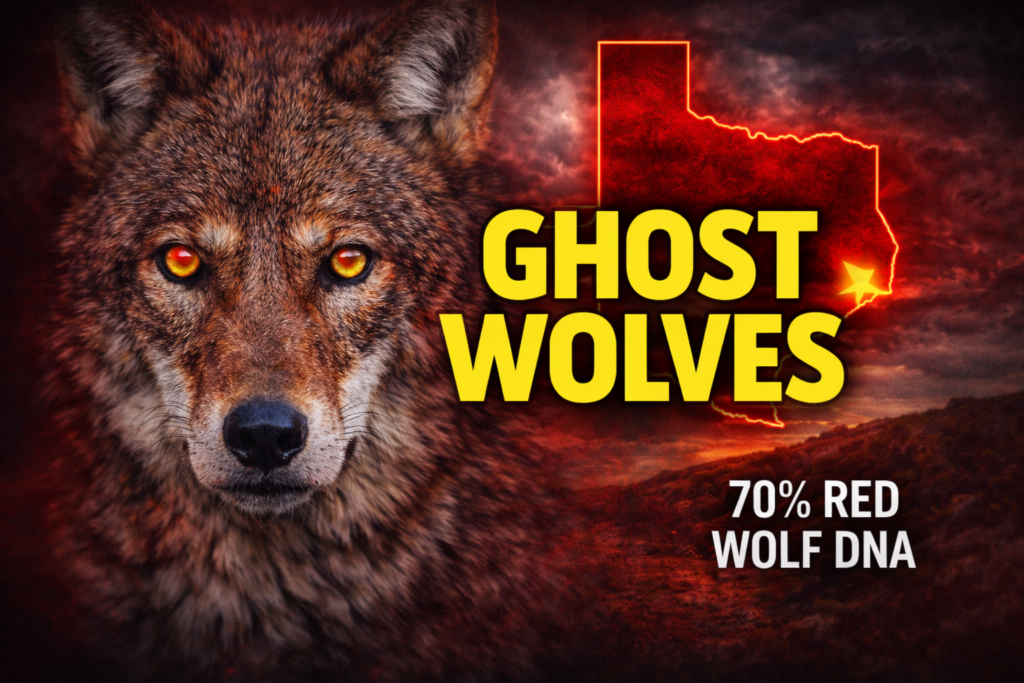
On a humid stretch of prairie behind the subdivisions and beach houses of Galveston Island, something unexpected moves through the cordgrass at dusk.
Locals call them coyotes. Officially, that’s what they are.
But genetically, many of these canids are something far more complicated.
Recent testing has revealed that some of the island’s coyotes carry astonishing levels of red wolf ancestry — in a few cases, as much as 70 percent. That’s a startling number when you consider that the Red Wolf is one of the most endangered mammals in North America, with only a small, managed population remaining in the wild.
To the untrained eye, a Galveston coyote looks like any other Gulf Coast song dog: lean, long-legged, wary. But hidden in its DNA is the genetic echo of a predator that once roamed from Texas to the Carolinas. Some researchers have started calling them the “ghost wolves” of the Gulf Coast — living remnants of a species many believed was functionally lost outside a tightly controlled recovery zone.
So what does that mean for conservation?
In this story — and in my accompanying YouTube video — we sit down with Matt James of Colossal Biosciences, the Dallas-based biotech firm known for high-profile wolf cloning and de-extinction projects. Colossal has made headlines for its ambitious work with endangered canids and other lost species, pushing the boundaries of what modern genetics can accomplish.
Our conversation tackles the questions that make wildlife managers uneasy and geneticists lean forward:
If these Galveston coyotes carry so much red wolf DNA, could they become a lifeline for red wolf recovery?
Could advanced reproductive technologies — even cloning — help restore lost genetic diversity to a bottlenecked population?
Along the Gulf Coast, the ghost of the red wolf may not be gone after all.
It may just be wearing a different name.
Chester Moore