
There’s a number that still hangs over Texas bass fishing.
18.18 pounds.
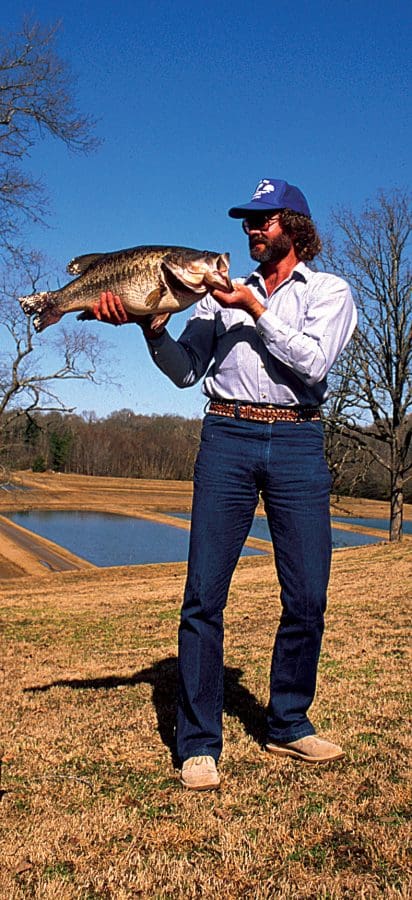
That fish, caught in 1992 from Lake Fork by Barry St. Clair, didn’t just set a record—it set a standard that everything since has been measured against. More than thirty years later, it still sits at the top.
But if you look closely at the numbers, you can see something familiar taking shape again. Not a guarantee, not a repeat—but a pattern that echoes what happened once before.

(Photo: TPWD)
To understand it, you have to go back to when Lake Fork first caught fire.
From 1986 through the early 1990s, Fork produced what is still the most concentrated run of giant bass in Texas history. The record book lays it out clearly:
- 17.67 (1986)
- 17.29 (1988)
- 17.64 (1989)
- 17.63 (1990)
- 17.08 (1991)
- 18.18 (1992)
Six bass over 17 pounds in a six-year window, all from the same lake. That’s not a coincidence. That’s a system producing fish at the upper edge of what’s possible.
And just beneath those were more fish pressing up toward that same ceiling:
- 16.89 (1993)
- 16.54 (1991)
- 16.63 (1999)
It wasn’t just that Fork produced the biggest bass. It produced depth at the very top end.
Then the surge passed.
After 1991, Lake Fork never produced another 17-pound bass, even as it continued to dominate the record book just below that mark. The lake kept producing giants, but not the kind that lived at the very top of the list.
And that distinction matters.
Because Lake Fork never stopped being great. It still hasn’t. It remains the benchmark for trophy bass production in Texas, consistently producing heavyweight fish and a steady stream of ShareLunker-class entries year after year. The lake didn’t fade—it stabilized.
For a long time, though, nothing else challenged that upper tier either.
From 1991 until 2022, Texas went more than three decades without another bass over 17 pounds entering the record book.
There were big fish:
- 16.80 (Sam Rayburn, 1997)
- 16.17 (Caddo, 2010)
- 16.07 (Caddo, 2011)
But the ceiling held.
Then came February 24, 2022.
A 17.06-pound bass from Lake O.H. Ivie broke that drought. It became the first bass over 17 pounds in Texas since 1991.
And like Fork decades earlier, it didn’t stand alone.
In a short span, Ivie began stacking fish in that upper range:
- 16.40 (2021)
- 17.06 (2022)
- 16.10 (2022)
- 16.65 (2023)
- 16.39 (2025)
Five Top 20 fish in just a few years, all from one lake.
That’s the part that matters.
Because historically, that’s how these things start—not with one fish, but with several pushing into the same narrow band.
There are similarities between the two lakes, but also differences.
Lake Fork’s rise came during a narrow window when everything lined up—new habitat, abundant forage, and bass that had never been pressured. It produced a short, intense burst of historic fish.
Lake O.H. Ivie is developing in a different era. Today’s fisheries are shaped by decades of management and a better understanding of how to grow trophy bass. The fish being caught now are part of a system that has been refined over time.
Even so, the numbers still tell a familiar story.
Ivie has produced multiple fish in the mid-16-pound range and one just over 17. What it hasn’t shown yet is the kind of clustering in the high 17s that Fork produced before the record fell.
That gap—roughly a pound—is small on paper, but it’s the difference between exceptional and historic.
Lake Fork showed what was possible and proved it again and again. It built the foundation for trophy bass fishing in Texas and still produces giants at a level no other lake consistently matches.
And this is not to downgrade other lakes.
While Lake Conroe, for example, has never produced the kind of concentrated runs of 16- and 17-pound bass seen at places like Lake Fork or Lake O.H. Ivie, it has quietly built a reputation as one of Texas’ most reliable big-bass fisheries. Year after year, Conroe continues to produce ShareLunker-class fish over 13 pounds, showing a level of consistency that many lakes never achieve.
That steady production is backed by proven top-end potential, highlighted by a 15.93-pound largemouth, which ranks as the No. 24 bass in Texas history. It may not dominate the record book, but Conroe has proven it can grow truly exceptional fish—and do it on a regular basis. Other lakes like the aforementioned Sam Rayburn as well as Toledo Bend fall into the same category.
Texas bass fishing has been in a great place for decades and all indications show that trend will continue, although a new state record might just remain elusive.