
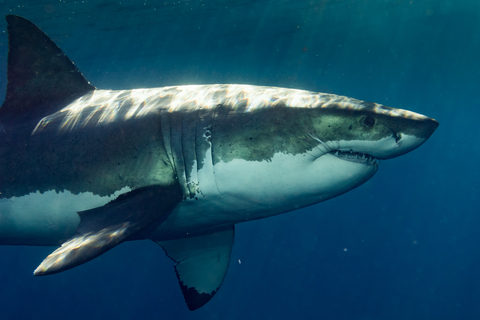
A viral social media graphic claims two tagged great white sharks—“Kara” and “Alyssa”—are moving toward the Texas coast. It’s spreading fast, and at first glance, it looks believable. There’s a map, named sharks, and specific locations along the Gulf.
But when you check the actual tracking data, the story completely falls apart.
The image shows a Texas Gulf Coast map with markers near Galveston, Houston, and Corpus Christi. It suggests both sharks are approaching the area. The problem is simple—it’s mixing real sharks with the wrong ocean.
“Kara” is a real tagged great white shark, but she is not anywhere near the Gulf of Mexico. She’s a Pacific animal.

She was tagged on October 20, 2025, off California by the Marine Conservation Science Institute and is tracked through the Expedition White Shark app. Kara is a 16-foot female, and her movement history is exactly what you would expect from a Pacific white shark. She has stayed along the West Coast and moved as far north as the Pacific Northwest.
As of April 11, Kara’s most recent location is off Northern California near Eureka.
“Alyssa” is also real—and even larger.
She was tagged on December 11, 2025, by the same research team and is also tracked through the Expedition White Shark app. At around 18 feet, she’s one of the bigger white sharks currently being followed.
As of April 11, Alyssa is far offshore of San Francisco, still firmly in the Pacific.
That’s the key detail the viral post leaves out.
For either of these sharks to be approaching Texas, they would have to travel from the Pacific Ocean, cross an entire continent, and enter the Gulf of Mexico. There is no scientific record of a Pacific-tagged great white ever doing that.
Great white sharks are not global wanderers. They belong to distinct regional populations and follow predictable migration routes. Pacific sharks stay in the Pacific. Atlantic sharks are the ones occasionally seen in the Gulf. You can read more in our guide to great white sharks in the Gulf of Mexico.
To read the full story click here.
Chester Moore