
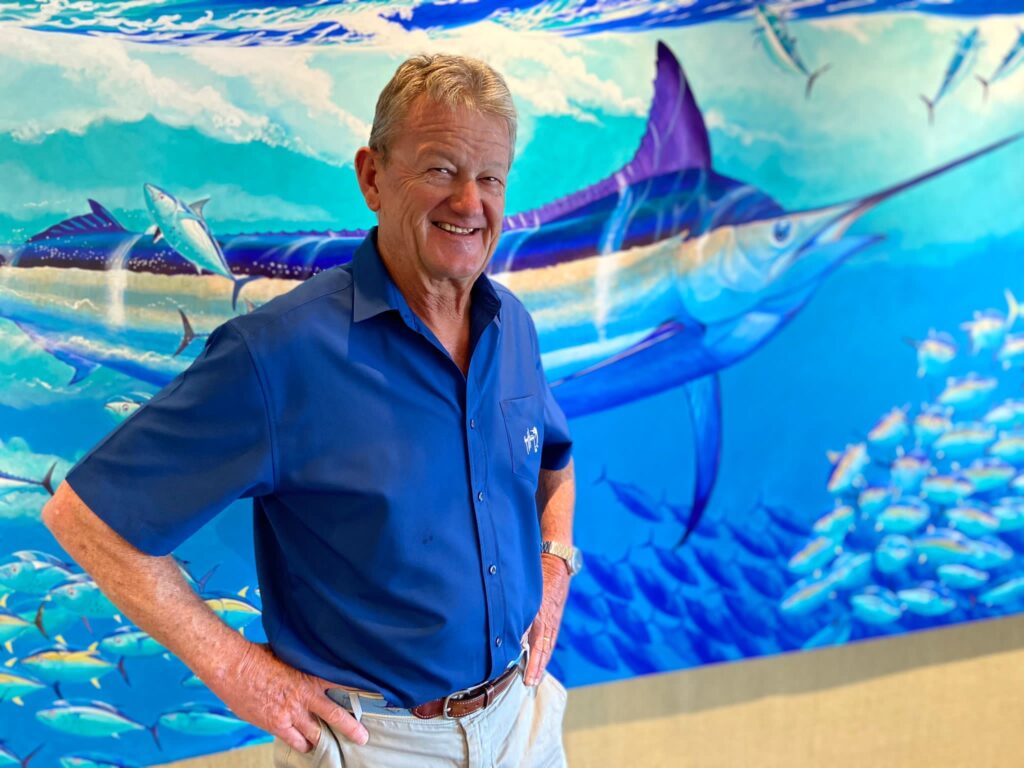
There’s one name in the saltwater world that just about everybody recognizes.
You see it on the back of a truck at the ramp, on a sun-faded T-shirt at a bait stand, or stretched across a mural in an airport, and you already know what it stands for.
Guy Harvey is that name.
For 40 years, Dr. Guy Harvey has built something that goes way beyond art. He’s created a connection point between anglers, everyday folks, and the ocean itself. Now, with the release of the documentary “Guy Harvey,” that story finally gets told in full.
I had the chance to sit down with Harvey and talk about the film, his career, and where things are headed. What stood out right away wasn’t just how long he’s been doing this but how deliberate the whole path has been.
The timing of the documentary lines up with the 40th anniversary of the brand, which started back in 1986. The project came together about 18 months ago, with the goal of telling the whole story—artist, scientist, businessman, conservationist and how those pieces have always been tied together.
It didn’t start easy.
Before the shirts and licensing deals, Harvey was teaching and doing research at the university level in Jamaica. At the same time, he was trying to build a business in Florida. For about two and a half years, he lived in both worlds—teaching during the week, then traveling for shows, exhibitions, and meetings to get the brand off the ground.
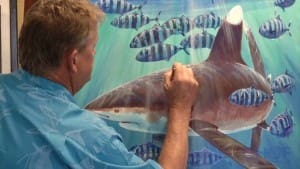
For a long stretch, he didn’t take a salary from the business, living instead off selling his artwork and putting everything else back into growing the brand.
Eventually, it took hold. The brand expanded, licensing caught on, and he was able to reconnect with the science side by founding the Guy Harvey Research Institute in 1999. From there, things grew into something bigger—using the reach of the artwork to support real research and conservation work around the world.
That connection between art and science runs all the way through the documentary.
Harvey’s work has never just been about painting fish. It’s about getting people to notice them, ask questions, and understand what’s at stake. Whether it’s a mural in a major airport or a T-shirt on a kid, the idea is to spark that first bit of curiosity.
One of my favorite parts of the conversation wasn’t about shark dives or tagging studies—it was something I told him. A few months back, I walked into my church youth group and saw a kid wearing a Guy Harvey shirt. I asked him about it, and he said he’d looked the guy up and learned what a blue marlin was. That’s when it hits you—this reaches people in a real way. It’s not just art hanging on a wall or printed on a shirt. It’s getting kids curious about the ocean who might never have thought about it otherwise.
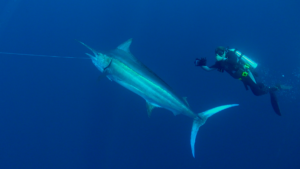
The film also spends time on the science side of things, which is where a lot of the real work happens. As Harvey put it, the rules that govern fishing, diving, and marine use are built on research. In many cases, his foundation and research partners are part of producing that data.
And there are still plenty of challenges out there.
Mahi-mahi are one example he pointed to. They’re one of the most commonly targeted offshore fish, and both recreational and commercial pressure are taking a toll. Size limits in many places don’t give them enough time to reproduce before harvest, which is a growing concern.
There are bigger unknowns, too. Black marlin in the Eastern Pacific remain largely a mystery. Despite years of research, there’s still very little data on where they spawn or where juveniles spend their early life stages. That lack of information makes conservation and management much more difficult.
Those are the kinds of gaps the foundation is working to close through partnerships with universities and research institutions around the world.
The documentary balances those realities with time on the water—shark dives, offshore expeditions, and firsthand encounters that have shaped Harvey’s perspective over the years.
Early screenings have drawn strong crowds. The premiere at the Fort Lauderdale International Film Festival sold out well ahead of time, and the Cayman Islands showing filled multiple theaters in a single night.
Looking ahead, Harvey is starting to shift his focus. Leadership of the foundation is moving to the next generation, with his daughter Jessica taking on a larger role as CEO, particularly in expanding marine science education. Texas is one of the places being looked at for that growth.
On the business side, his son Alex oversees marketing and licensing for the brand, helping guide it forward.
That shift allows Harvey to spend more time doing what he started with—painting, fishing, and diving.
The documentary doesn’t try to turn him into something he’s not. It shows the long road, the risks, and the work that’s still ahead.
More than anything, it shows how far one idea can travel.
Sometimes it starts with a painting.
Sometimes it starts with a fish on a shirt.
And sometimes, it starts with a kid who didn’t know what a blue marlin was—until a guy named Harvey put one in front of him on a shirt hanging in a sporting goods store.
Chester Moore