
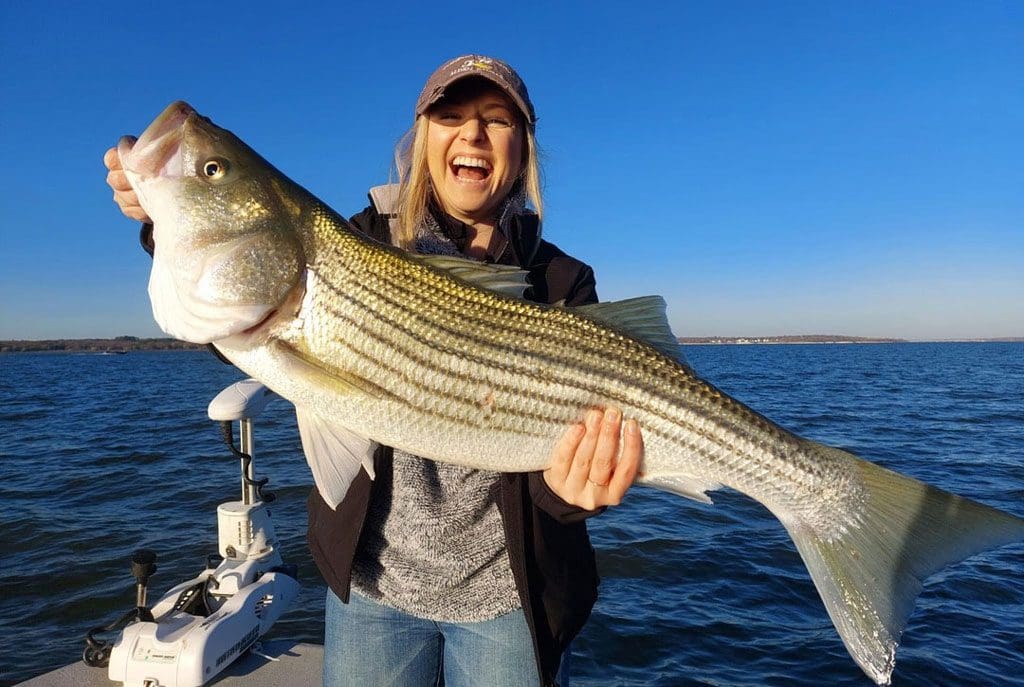
Summer striper fishing on Texas lakes is mostly about understanding conditions and adjusting to them. The heat changes where fish can live, and if you ignore that, you’ll struggle no matter how good your gear is.
Across lakes like Lake Texoma, Lake Whitney, and Lake Tawakoni, the same core principles apply. Water temperature, oxygen levels, and bait movement control everything.
On Texoma, the early morning bite is the most predictable part of the day. Stripers will often push shad to the surface, and when that happens, it’s obvious—gulls working, fish breaking, and bait scattering. Topwaters can work during that window, but it usually doesn’t last long.
(Photo: Bill Carey, Striper Express)
After the sun gets up, the fish move deeper and settle along the thermocline. In summer, that’s typically somewhere between 10 and 30 feet. Fishing below that level is usually a waste of time because oxygen drops off quickly.
Live shad is the most consistent approach here, especially when fished vertically over fish you mark on electronics. Trolling can also work, but depth control matters more than lure choice. Staying in that upper, oxygen-rich layer is the priority.
Whitney fishes similarly but can be less obvious. The fish tend to stay more scattered, so covering water and watching for signs becomes more important. Birds are a reliable indicator—if they’re actively feeding, there’s a good chance stripers are pushing bait underneath.
The thermocline on Whitney is often a little deeper, usually around 20 to 25 feet. Again, staying above it is key. Anglers who pay attention to that tend to do better consistently.
Live bait works well, but Whitney is also a good lake for artificials. Jigging spoons and swimbaits are effective when fish are suspended and feeding on shad schools.
Tawakoni is a bit different because of how much wind influences the bite. Wind pushes plankton, which draws bait, and that brings in stripers. Fishing windblown areas—points, flats, or humps—can make a big difference.
This lake often sets up well for casting when fish are active. When stripers are feeding near the surface, swimbaits and jigs can be productive, and the action can stay consistent longer than on some other lakes.
Across all three lakes, the main factors don’t change. You need to locate bait first. Stripers won’t be far from it. You also need to stay above the thermocline and pay attention to what’s happening around you—especially bird activity and what your electronics are showing.
There’s no single technique that works all day in summer. Early morning might favor topwater, mid-morning shifts to live bait or trolling, and the rest of the day depends on how the fish position themselves.
If you stay focused on those basics and adjust as conditions change, you’ll stay on fish more consistently.