
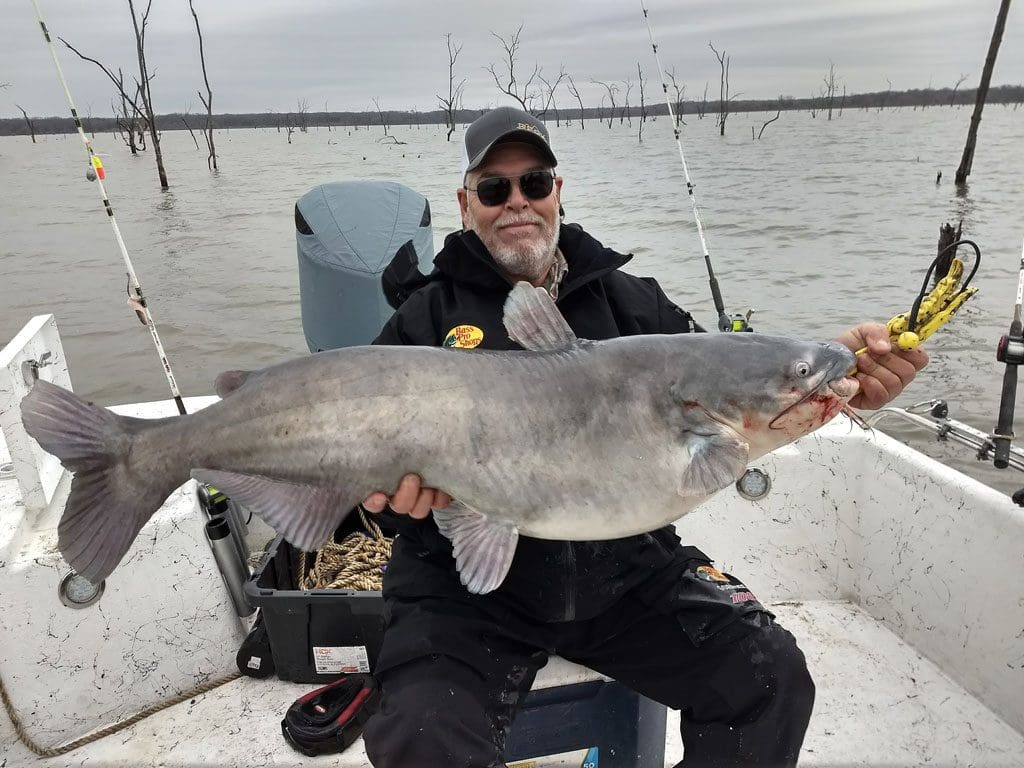
There is something different about a truly giant catfish.
Big largemouth bass get the spotlight. Trophy trout earn magazine covers. But anglers who have tangled with a massive blue or flathead catfish understand there is another level of freshwater power swimming through Texas reservoirs.
These fish are heavy, unpredictable, and unbelievably strong. And across Texas, reservoirs from Texoma and Tawakoni to Livingston, Conroe, and Falcon continue producing catfish large enough to humble even experienced anglers.
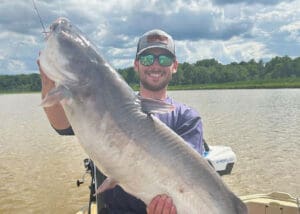
The interesting thing is that giant catfish are rarely random.
Much like bass or offshore species, big catfish position around very specific structure, current flow, bait concentrations, and seasonal patterns. The anglers who consistently catch trophy fish are usually the ones who understand how these giants use a reservoir.
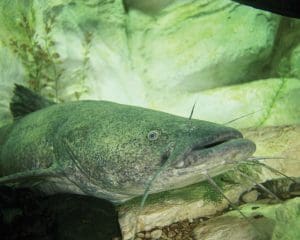
During much of the year, giant blue catfish relate heavily to river channels, submerged creek bends, ledges, humps, and large flats near deep water. Flatheads often favor heavier cover such as standing timber, brush piles, rock structure, and submerged debris where they can ambush prey.
But the common thread is food.
Big catfish are constantly tracking forage. In many Texas reservoirs that means shad. Threadfin and gizzard shad schools become magnets for trophy blues, especially during cooler months when large fish group up around bait-rich structure.
That has completely changed the way many anglers approach catfishing.
Instead of anchoring randomly and soaking bait for hours, modern trophy catfish anglers spend enormous amounts of time graphing structure and searching for bait concentrations. Electronics have transformed catfishing into a highly technical pursuit where understanding underwater terrain matters just as much as bait selection.
Join fishing legends Mark Zona, Ed Zyak, Kevin VanDam and Bryan Thrift as we unveil our two groundbreaking products: XPLORE Fish Finders and MEGA Live 2 Forward-Facing Sonar.
Systems like the Humminbird XPLORE, combined with LakeMaster mapping and side imaging technology, allow anglers to break down massive reservoirs with incredible precision. Creek channels, submerged roadbeds, ledges, timber lines, shell beds, and subtle bottom transitions all become easier to identify. Instead of blindly fishing open water, anglers can focus on the exact structural features that consistently hold giant fish.
Often, the catfish are not sitting directly on structure but nearby, using depth changes and current movement to intercept forage.
Bait selection is another major piece of the puzzle when targeting giant Texas catfish. Fresh-cut shad remains the standard for trophy blue catfish across much of the state, especially on reservoirs loaded with threadfin and gizzard shad. Many serious anglers spend time cast-netting fresh bait before they ever make a fishing run because the quality and freshness of bait can make a dramatic difference.
Flathead anglers often take a different approach, relying heavily on live bait such as sunfish or perch presented around timber, creek bends, and heavy structure where these fish ambush prey. Big flatheads are predators first, and lively bait placed in the right location can trigger violent strikes from fish that may ignore cut bait entirely.
Presentation also matters. Some anglers anchor directly over productive structure, while others drift expansive flats and channel edges using controlled drift techniques to cover more water. The key is matching bait placement to where fish are positioned in relation to structure, current, and forage movement.
Wind can also become a major factor.
Strong wind pushing into a main-lake flat often concentrates baitfish, and giant blues frequently follow. Some of the best trophy catfish action occurs when drifting large flats adjacent to creek channels where shad schools are heavily concentrated.
Other anglers focus heavily on current.
On lakes influenced by river flow or dam generation, giant catfish often position in predictable feeding areas where moving water funnels bait directly to them. Channel swings, underwater points, depressions, and current seams can all become feeding stations for truly massive fish.
And while giant catfish are certainly powerful predators, they are also creatures of efficiency.
Large fish prefer locations where they can conserve energy while waiting for forage to move past them. That is why subtle structural features can make such a huge difference. A small ledge, isolated stump row, rock pile, or depression along a channel edge may hold multiple trophy fish if conditions are right.
Many serious catfish anglers now spend as much time idling and studying sonar as they do actively fishing. Once they identify the right combination of bait, depth, and structure, they begin repeating that pattern across multiple areas of the reservoir.
That approach often separates average catfish trips from truly unforgettable ones.
There is also something deeply Texas about trophy catfishing.
It is a blend of patience, preparation, heavy tackle, and pure anticipation. Long drifts across open water, the steady hum of sonar over submerged structure, and the sudden violent pull of a giant fish creates an experience unlike any other in freshwater fishing.
And when a truly massive blue catfish finally surfaces beside the boat, rolling in muddy water with a broad tail and giant head, it feels less like catching a fish and more like connecting with something ancient.
Texas reservoirs continue to offer some of the best trophy catfish opportunities in the country. For anglers willing to study structure, understand bait movement, and spend time learning patterns instead of simply waiting for luck, the next bite could come from the biggest freshwater fish of their lives.