
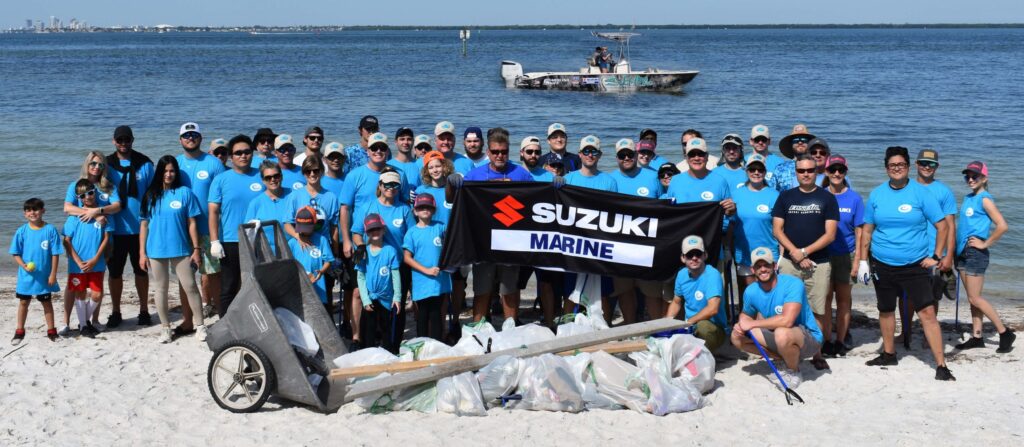
For generations, anglers have depended on healthy coastal ecosystems to provide world-class fishing opportunities. From the marshes of Sabine Lake to the seagrass flats of the Lower Laguna Madre, clean water is the foundation of productive fisheries. That reality is why environmental stewardship has become an increasingly important focus throughout the marine industry.
Suzuki Marine has taken a proactive role through its SUZUKI CLEAN OCEAN PROJECT. The initiative grew from the company’s global “Clean-Up the World Campaign,” which began in 2010. Since then, more than 17,000 participants have joined cleanup efforts around the world. Today, the project continues those cleanup efforts while placing an even greater emphasis on addressing marine plastic pollution and promoting long-term environmental responsibility.
The project reflects Suzuki’s commitment to environmental stewardship through three primary efforts: continuing worldwide cleanup campaigns, reducing plastic packaging, and helping collect marine microplastics through innovative technologies. It is all part of a broader effort to protect the marine environments that anglers and boaters depend upon.
For Texas anglers, the issue is far from theoretical.

Plastic pollution remains one of the most visible and persistent threats facing coastal ecosystems. Unlike organic materials, plastics do not readily decompose. Instead, they break down into smaller and smaller pieces known as microplastics, which can remain in the environment for years.
Along the Texas coast, plastic waste impacts fish and wildlife in several ways. Sea turtles, coastal birds, marine mammals, fish, and invertebrates can become entangled in debris or ingest plastic. Floating plastic bags can resemble prey items for sea turtles, while discarded fishing line poses a particular danger to birds and other wildlife around jetties, marshes, shorelines, and boat ramps.
Researchers have also documented microplastics in Texas coastal waters and estuarine environments. That means the same habitats that support speckled trout, redfish, flounder, shrimp, and forage species are part of the larger plastic pollution issue facing coastal ecosystems.
The challenge can seem overwhelming. After all, one angler picking up a few pieces of trash may not appear to make much difference in a system as large as the Texas coast.
But conservation success has always been built on individual actions multiplied thousands of times.
That is where the SUZUKI CLEAN OCEAN PROJECT offers an important lesson. While large-scale cleanup events are valuable, the project also emphasizes personal responsibility and everyday actions that help keep plastics from entering the marine environment in the first place.
Texas anglers are uniquely positioned to make a difference because we spend more time observing coastal habitats than almost anyone else. We see the discarded line tangled in marsh grass. We notice plastic bottles trapped in shoreline vegetation. We encounter bait containers, food wrappers, and other debris that can eventually break down into smaller pieces and persist in the environment.
Fortunately, helping is easier than many people realize.
One of the most effective steps anglers can take is to adopt a simple rule: leave every location cleaner than they found it. Whether fishing a boat ramp, marsh shoreline, jetty, or beachfront, taking a few minutes to collect litter can produce meaningful results over time.
Reducing personal plastic use is another practical solution. Refillable water bottles, reusable food containers, and durable storage systems can dramatically reduce the amount of disposable waste brought onto the water. Less plastic on the boat means less plastic that can accidentally enter the environment.
Proper disposal of fishing line is equally important. Monofilament can persist in the environment for many years and presents an entanglement risk to birds, sea turtles, and marine mammals. Collecting used line and disposing of it properly should be as automatic as putting away a rod at the end of the day.
Three Ways Texas Anglers Can Help
Pick Up More Than You Brought
- Carry a small trash bag on every trip.
- Remove discarded fishing line, plastic bottles, and bait containers when you encounter them.
- Leave every shoreline, marsh, or boat launch cleaner than you found it.
Reduce Single-Use Plastics
- Use refillable water bottles.
- Pack food in reusable containers.
- Secure trash and packaging on board to prevent accidental loss.
Participate in Cleanup Efforts
- Join organized beach and shoreline cleanups.
- Encourage fishing clubs and tournaments to include conservation projects.
- Introduce young anglers to stewardship by making cleanup part of every fishing trip.
These actions may seem small, but collectively they can make a substantial difference. Imagine the impact if every Texas coastal angler removed just a handful of trash items during each outing.
The future of our fisheries depends on more than regulations, stocking programs, and habitat restoration projects. It also depends on everyday decisions made by the people who use and enjoy these resources.
The Texas coast supports some of the finest fishing opportunities in America. It provides habitat for speckled trout, redfish, flounder, tarpon, sharks, sea turtles, migratory birds, and countless other species. Protecting those resources requires a commitment from all of us.
The SUZUKI CLEAN OCEAN PROJECT demonstrates how businesses, communities, and individual anglers can work toward a common goal. Cleaner water means healthier habitats. Healthier habitats support stronger fisheries.
And stronger fisheries help ensure that future generations will experience the same thrill of watching a tailing redfish in a marsh pond, feeling the strike of a speckled trout on a reef, or seeing a child catch their first fish along the Texas coast.
Every piece of trash removed matters. Every piece of plastic kept out of the water matters.
And every angler has an opportunity to be part of the solution.