
Offshore brush piles have long been among the most productive places to catch bass, crappie and other game fish. They provide shade, concentrate baitfish and offer ambush points that predators use throughout much of the year. The challenge has never been understanding why fish use brush. The challenge has been fishing it efficiently.
Anyone who has spent much time targeting submerged brush knows the frustration. You idle over the pile, mark a waypoint and ease back with the trolling motor. Then comes the guessing game. Is the pile ten feet off the bow or fifteen? Are you casting across the center of it or dragging your lure down one side? Is your bait actually reaching the sweet spot where the fish are holding?
Those small details often determine whether you get bit.
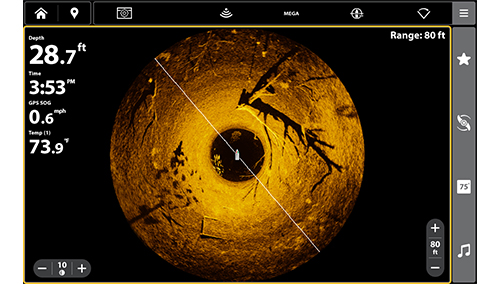
That’s why Humminbird MEGA 360 Imaging has become such a valuable tool for offshore anglers. Rather than simply marking the location of a brush pile, the technology gives anglers a real-time view of the structure surrounding the boat. Instead of guessing where the cover sits in relation to the bow, anglers can line up casts with confidence and spend more time presenting their lure where fish are actually positioned.
That kind of efficiency paid off in a big way for Humminbird pro Buddy Gross during the Bassmaster Elite Series tournament on Lake Eufaula. Gross built his winning pattern around offshore brush, moving rapidly from one piece of cover to another instead of spending long periods trying to force inactive fish to bite.
“The Humminbird 360 was key,” Gross said. “Every time I’d pull up I’d figure out the perfect cast to hit the brush as effectively as I could. If I didn’t get bit in 3-4 casts I was leaving. I wanted to hit the ones that were actually firing.”
That statement says a lot about modern offshore fishing.
The goal isn’t simply finding brush piles anymore. Thanks to Side Imaging and quality mapping, many anglers have dozens—even hundreds—of productive locations marked on their electronics. The difference comes in how effectively those piles are fished once the trolling motor goes down.
A brush pile isn’t just a brush pile. Bass often position on one side instead of the other depending on sunlight, current, wind direction and the location of nearby baitfish. Sometimes they’re tucked deep inside the limbs. Other days they’re suspended just off the down-current edge. If your lure never comes through that strike zone, you’ll likely assume the pile is empty when, in reality, the fish were simply never shown the bait.
Humminbird MEGA 360 Imaging helps eliminate much of that uncertainty. By showing the relationship between the boat, the brush and surrounding structure, anglers can make subtle boat-position adjustments without constantly moving over the cover or making repeated blind casts.
That also means less disturbance. Every unnecessary pass over a brush pile with the trolling motor has the potential to alert fish. Positioning the boat correctly from the start allows anglers to make their best presentations while keeping the cover relatively undisturbed.
Another lesson from Gross’s approach is knowing when to leave.
Too many anglers become emotionally attached to a brush pile because it produced fish in the past. They keep casting, changing lures and experimenting with retrieves, hoping something will happen. The best offshore fishermen understand that active fish usually reveal themselves quickly. If a brush pile doesn’t produce after several quality presentations, it’s often more productive to move to the next one than to continue fishing memories instead of conditions.
That philosophy works just as well for crappie anglers. Brush piles have become magnets for slab crappie on many Texas reservoirs, especially during the summer. Knowing exactly where the brush sits allows anglers to present jigs or live minnows more accurately and spend less time snagging limbs that aren’t holding fish.
None of this means electronics replace fishing knowledge. Anglers still have to understand seasonal movements, forage, weather patterns and fish behavior. A screen can’t tell you whether bass want a deep-diving crankbait, a football jig or a soft swimbait. It simply helps ensure those lures are presented where they have the greatest chance of being eaten.
In many ways, that’s the greatest strength of Humminbird MEGA 360 Imaging. It doesn’t replace instinct or experience. It builds on them. It allows anglers to fish brush piles with greater precision, greater efficiency and greater confidence.
And in offshore fishing, where a cast that’s three feet off target can mean the difference between a tournament-winning bass and no bite at all, that precision can make every cast count.