
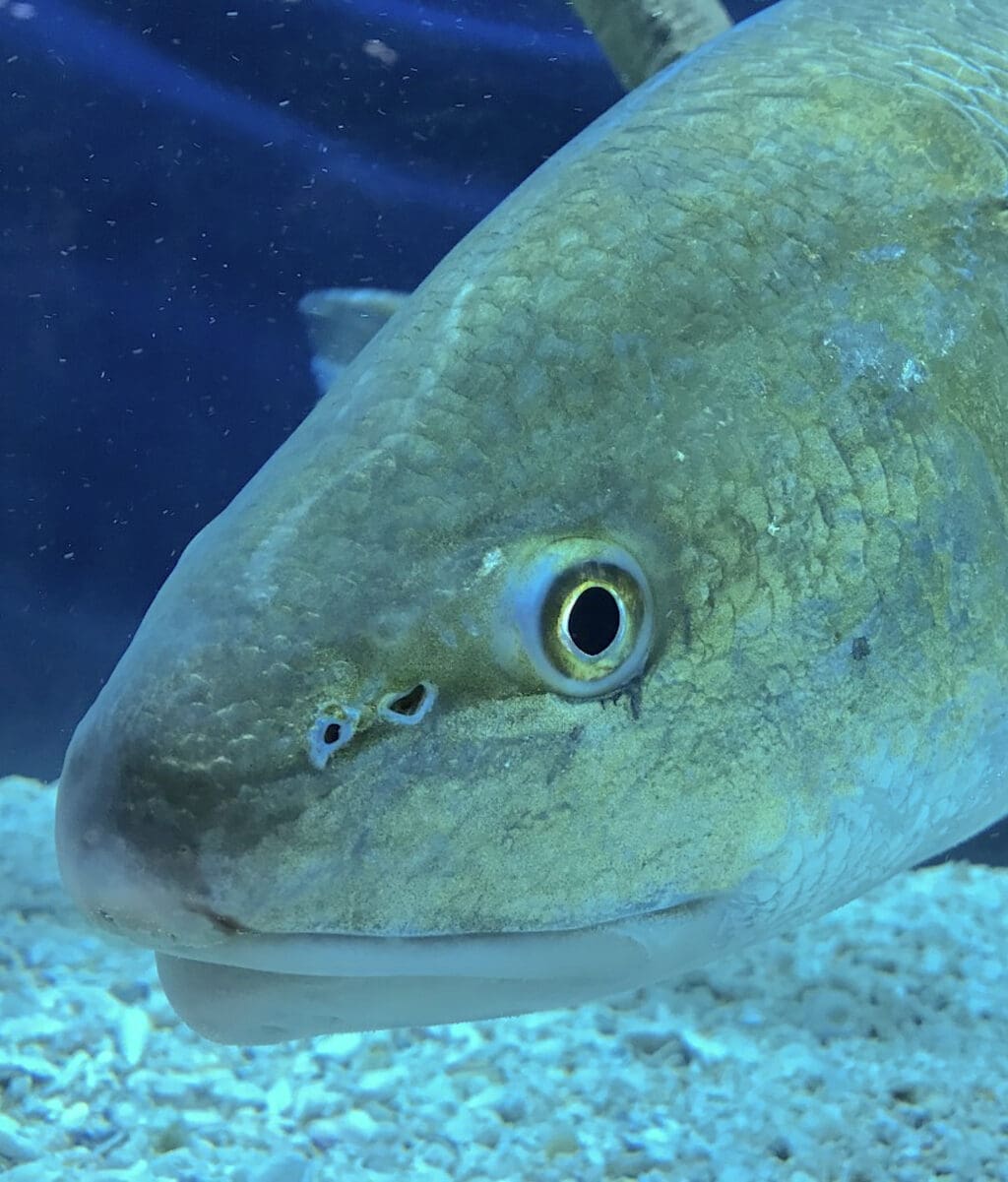
Somewhere along the Texas coast, there could be a redfish swimming right now that weighs more than 60 pounds.
That is not wishful thinking.
Texas has produced some truly enormous red drum, and the fish sitting at the top of the record book has held that position for more than a quarter century.
On Jan. 30, 2000, Artie Longron caught a 59.50-pound red drum from Gulf waters. According to the Texas Parks and Wildlife Department (TPWD), the fish measured 54.25 inches and remains the Texas rod-and-reel weight record for the species.

A 40-pound redfish is a monster. A 50-pounder is the kind of fish most Texas anglers will never encounter. Longron’s fish was knocking on the door of 60 pounds.
But could something bigger be out there?
There is compelling evidence that it could.
One of the strongest arguments is already sitting in the TPWD record book.
On Aug. 14, 2011, Wendy Covey caught and released an astonishing 60.5-inch red drum from Baffin Bay in the Upper Laguna Madre. Covey caught the fish on a croaker, and TPWD recognizes it as the Texas catch-and-release state record for red drum.
Consider that measurement alongside Longron’s standing weight record.
Longron’s 59.5-pound fish measured 54.25 inches.
Covey’s redfish was 6.25 inches longer.
That doesn’t mean Covey’s fish weighed more. Length and weight don’t have a perfect relationship in redfish. Girth and overall body condition make a huge difference, and without a certified weight there is no way to know exactly what the Baffin Bay giant weighed.
But a verified 60.5-inch Texas redfish changes the conversation.
Texas doesn’t have to prove it can produce a redfish longer than the standing weight-record fish.
It already has.
The biological potential is certainly there as well. TPWD reports that adult red drum can live more than 40 years, reach five feet in length and exceed 80 pounds. Mature reds spend considerably more time in Gulf waters than younger fish, which helps explain why the biggest bulls are so often encountered around passes, jetties, beachfronts and open Gulf waters.
And Texas doesn’t even hold the Gulf Coast state record.
Next door in Louisiana, David Weber caught a 61-pound redfish in June 1992. That fish remains Louisiana’s state record.
Think about how close that is.
Only 1.5 pounds separates Louisiana’s record from Longron’s Texas giant.
For anglers interested in the possibility of a Texas record breaker, there is a tremendous amount of coastline to consider.
The Sabine area has long been known for monster bull reds. The passes, beachfront and nearshore waters of the upper coast give anglers access to mature fish moving between the estuaries and Gulf. The same can be said for the Galveston area, where the beachfront, passes and jetties regularly produce heavyweight redfish.
But I wouldn’t put all my money on the upper coast.
South Texas has incredible potential.
The Laguna Madre, Baffin Bay, Port Mansfield and waters stretching toward the Mexican border have produced some incredible redfish. Covey’s 60.5-inch Baffin Bay fish is proof enough that truly extraordinary reds occur in those waters.
And then there is the Gulf itself.
Once redfish mature, their world becomes much larger than the shallow flats where most Texas anglers encounter them. Somewhere offshore could be an old female red that has avoided nets, sharks, dolphins, hooks, hurricanes and everything else the Gulf has thrown at her for decades.
Texas regulations allow an angler to retain an oversized redfish using the appropriate red drum tag, so a legitimate record attempt remains possible. At the same time, catch-and-release fishing for giant bulls has become increasingly popular, meaning the largest redfish caught in Texas during any given year might never see a certified scale.
That’s something worth thinking about.
The Texas weight record has survived since 2000.
Yet 11 years after Longron caught his 54.25-inch record fish, Wendy Covey caught and released a Texas redfish measuring more than six inches longer.
So could the 59.5-pound Texas record fall?
Absolutely.
Somewhere between Sabine and the Mexican border—or somewhere beyond the beachfront in Gulf waters—the fish capable of doing it may already be swimming.
It just has to meet the right angler.
Chester Moore