
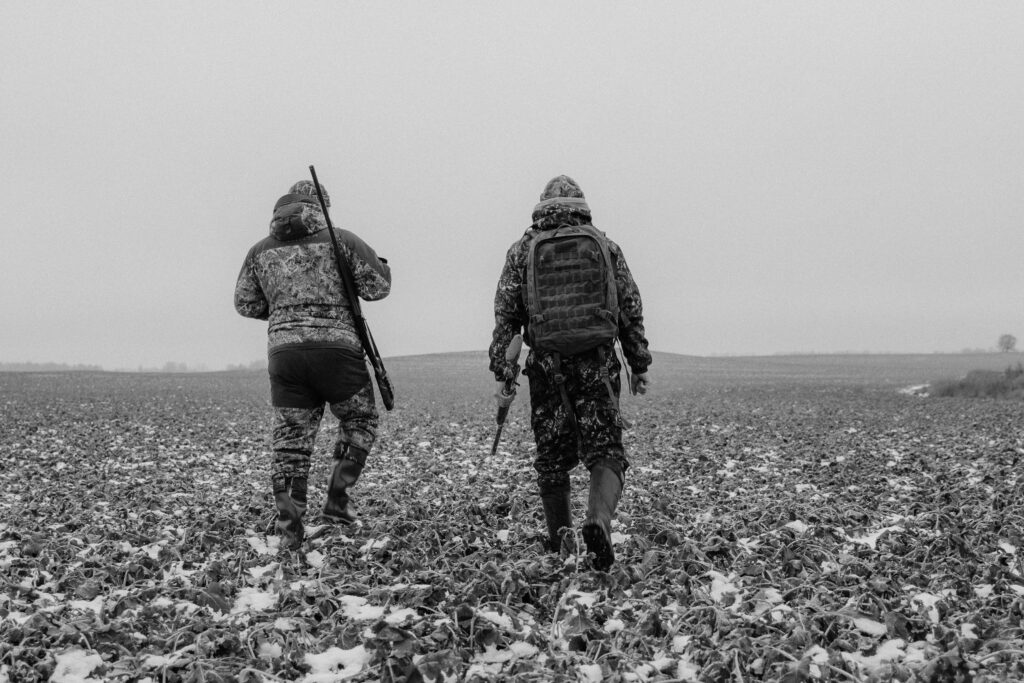
HAVE YOU EVER WONDERED why your rifle that groups small as can be at the range, groups large as can be in the field?
It’s the same story every season. Hunter sweats bullets at the shooting bench all summer long. Punches one dirty hole at 100 yards, and heads home feeling like the hard part is over. Then comes opening morning… and now that shot must be made kneeling down a steep hillside with a heart that won’t calm down.
The bench never prepared anyone for that moment.
The good news?
Closing that gap comes fast by simply practicing from where you actually are out on the field. It doesn’t cost anything except some time and a healthy dose of humility.
What’s covered below:
- Why the Bench Builds False Confidence
- What the Numbers Say About Field Shots
- The Four Positions Worth Practising
- Building a Preseason Practice Routine
The Bench Builds False Confidence.
Here’s the thing about a shooting bench…
Eliminates nearly every factor that makes field shooting challenging. The rifle is placed on sandbags. Elbows are resting on a table. Nothing shakes, nothing vibrates and nothing moves.
That can actually be helpful for two things: verifying zero and determining what ammunition a particular firearm prefers.
But once a shooter steps off that bench, the hands assume the task those sandbags were providing. Now grip angle, palm position and wrist alignment will dictate whether that trigger press is clean or sloppy. This is where an ergonomic rifle grip becomes crucial. It’s also why chassis builders like XLR Industries put so much engineering into grip geometry and hand placement. A near-vertical, well-designed grip allows the trigger finger to stay straight and the wrist to stay relaxed when shooting kneeling and sitting positions, where shooting with a poor grip angle forces the shooter to fight the rifle.
Grip ergonomics barely register when a rifle is lying on bags.
They matter enormously when a body is holding it up.
What the Numbers Say About Field Shots
Field shooting isn’t a hyper-niche thing that competitive geeks do. It’s how nearly every hunting shot in the world gets made.
Big game hunting remains massively popular. In 2022 there were 14.4 million hunters age 16+ in the US alone. That includes 11.5 million big-game hunters pursuing deer, elk, bear, and more.
Not one of them carries a bench into the timber.
And here’s the part that should make every hunter sit up…
An analysis of field records submitted by UK deer stalkers showed that only 4% of deer shot at were missed. Misses and wounded animals were attributed to identifiable causes only: uncomfortable shooting position, inadequate time to steady, shooting freehand or supported by elbows and an absolute lack of shot practice.
Read that list one more time.
Sitting is funny. Bad sling technique. These are practice issues, not gun issues. Marksman accuracy off the bench won’t solve either.
The ammunition time is here, too. About 46.2 million people went plinking in that same national poll. Lots of shooters are getting their trigger time. Just not standing up.
The Four Positions Worth Practising
Each position has stability versus speed of deployment traded off against each other. Positions that are more stable take longer to deploy. Positions which deploy quickly tend to sway.
Learn all four and there is always an option available.
Prone
Steadiest position possible without going prone. Legs spread out, body horizontal with rifle supported by pack or bipod.
Best gun for longer range open country shooting. Downside is that it dies more often than many people realize from grass, brush and rough terrain.
Sitting
The most useful all-round hunting position, and the one most shooters neglect.
Sit use builds up fast, it works great in thick grassy areas, and locks you in stone hard as soon as you add shooting sticks or a pack. Place your elbows on your knees, not your kneecaps.
Kneeling
It’s the “don’t have time for anything else” hold. Faster than sitting and more stable than standing, it allows practicality between the two for close, quick shots when fighting in heavy cover.
Practice dropping into it in under three seconds.
Standing
Dead last for stability… but sometimes the only option available.
Standing over crossed shooting sticks with heavy brush or waist-high grass is the shot. If you hunt anywhere that resembles that description, practice it every week. It highlights a poor grip and lazy fundamentals more than any other shot.
Building a Preseason Practice Routine
Ok. Now for the fun stuff. Preseason practice should NOT resemble a normal range day.
Begin with a truthful benchmark. Place an 8-inch paper plate at a reasonable distance. Now… take your position and shoot it cold. One shot. No warm-up. That first, cold shot will be your only shot that replicates a hunt.
Then build the routine around these rules:
- Shoot from positions, not the bench, for at least 80% of your rounds
- Wear the actual hunting clothes, boots and pack you’ll be using
- Add a timer, because hurried shots are where things go wrong
- Practise on uneven ground, hillsides and around trees
- Use the same shooting sticks, bipod or pack you plan to hunt with
Dry fire deserves a mention here as well.
It’s free, can be done at home, and magnifies every anticipation, flinch and grip issue in a shooter’s foundation. Ten minutes of dry practice a couple nights a week will improve field accuracy better than another box of ammo dumped on the bench.
Support Gear That Actually Earns Its Weight
Positions get better with support. That’s not cheating, it’s smart hunting.
Shooting sticks, a heavy pack, a bipod or draped jacket over a log will all help transform an unstable position into one that is stable. The rifle even matters. Length of stock, height of cheek weld and an ergonomic rifle grip designed for the shooter’s hand size are all factors in how repeatable that position will be when it matters.
But don’t overthink the gear.
Someone that practices once a week sitting and kneeling a bad ammo rifle will shoot better than someone who only benches with a FULL KIT. Skills before gadgets.
Getting Ready Before Opening Day
Preseason practice isn’t meant to prove that your rifle shoots small groups. It’s meant to prove you do.
The bench answers a question nobody asks in the field.
To sum it all up:
- Use the bench only for zeroing and load testing
- Spend the rest of your practice in prone, sitting, kneeling and standing
- Build every position around comfort, support and an ergonomic rifle grip
- Track your cold-bore hits on an 8-inch plate at honest ranges
- Mimic gear, clothing and terrain as closely as possible to the hunt you are going on
Get up on that between now and game day, and that funky sidehill shot is just another repetition. That’s why you practice.