
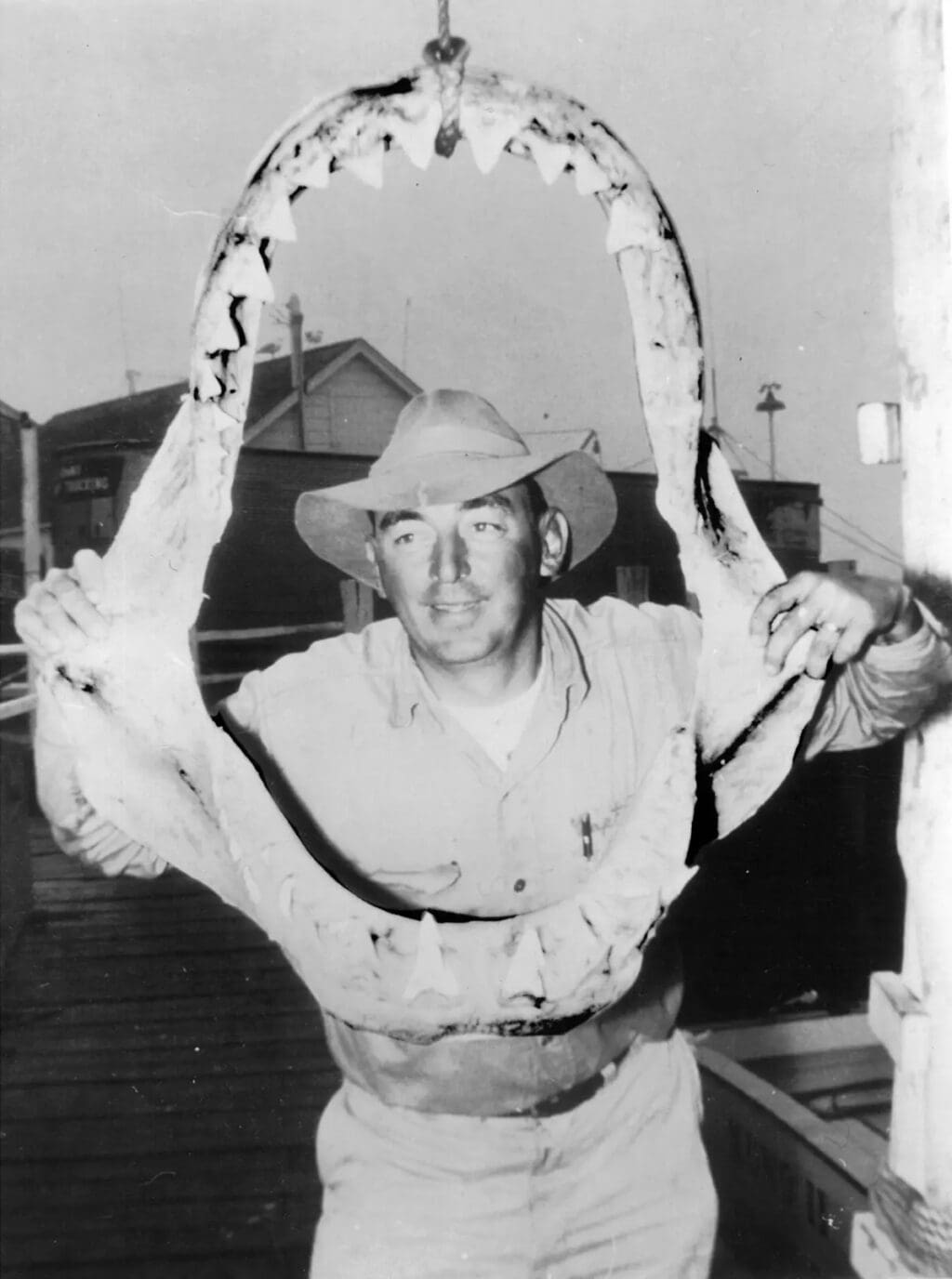
Frank Mundus knew a thing or two about catching big fish.
The legendary Montauk charter captain became famous for catching enormous sharks and is often associated with the inspiration behind Quint in Jaws. But later in his life, Mundus became a strong advocate for shark conservation, tagging and releasing sharks instead of simply bringing them back to the dock.
One of the tools he promoted was the circle hook.
On Mundus’ website, which remains online years after his 2008 death, he addressed the problem of sharks being gut-hooked during tagging operations.
“In order for a shark or any other fish to send back statistics after you plant a tag into him, he has to survive the tagging process,” Mundus wrote.
His solution was straightforward: hook the fish in the jaw rather than deep inside its digestive tract.
“A good way to ensure hooking a shark in the jaw is by using the right hook,” he wrote. “One of the best hooks to use is the Mustad circle hook.”
You can read Mundus’ original article, “Tag, You’re It!”, on his website here: Frank Mundus — Tag, You’re It!.
Decades later, the basic principle Mundus promoted remains important for anglers pursuing some of the biggest fish in Gulf waters.
Circle hooks are designed differently from traditional J-hooks. The point curves inward toward the shank. When a fish takes a bait and moves away, the hook can slide from deeper inside the mouth and catch in the jaw or corner of the mouth.
That’s especially important when the plan is to release the fish.
NOAA Fisheries recommends circle hooks for shark fishing because they increase the likelihood of hooking sharks in the jaw instead of the gut. That reduces the potential for internal injuries and can also make releasing the shark easier and safer.
But sharks aren’t the only big Gulf fish where circle hooks make sense.
Bull redfish are another prime example. Many of the giant reds encountered around passes, jetties, beachfronts and nearshore waters will be released. Tarpon are another fish where anglers should be thinking about the condition of the fish when it swims away, not simply getting it to the boat.
Circle hooks can be particularly effective when fishing natural baits for these species.
Anglers also need to understand that fishing a circle hook is different from fishing a traditional J-hook. Resist the temptation to make a dramatic hookset. Allow the fish to move away, come tight and let the hook do what it was designed to do.
The hook is only part of responsible big-fish angling. Use tackle heavy enough to avoid unnecessarily long fights, minimize handling and get the fish back into the water as quickly as possible. NOAA Fisheries includes circle hooks among the gear choices that can improve catch-and-release survival.
Mundus learned through decades of shark fishing that catching a fish wasn’t the end of the story.
If you’re going to release it, how you catch it matters too.
For bull reds, sharks, tarpon and other Gulf giants, sometimes conservation really does come full circle.
Chester Moore