

There are two species of catfish commonly caught in coastal waters of Texas: the gafftop and sea catfish, more commonly known as hardhead. These fish certainly do not run in the same crowd as tarpon and speckled trout, but they do have a dedicated cult following and a few positive attributes.
Before we get deep into the fish themselves there are some bait choices-including some unusual ones you might want to give a shot. Some of them (the bottom half) are cheaper than buying shrimp so we might we would include if you really want to try to catch some salt catfish or just take the kids out for something that will tug on the line.
Unusual (but highly effective) bait choices worth trying:
- Squid strips (extra tough cuts): A step above the typical “throw-on-a-chunk” approach. Cut squid into long, thin strips so they flutter in the current and mimic wounded bait. The real advantage is durability as squid will stay on the hook through repeated bites, often outfishing softer baits simply because it’s still there after everything else gets stolen.
- Cut mullet or menhaden (thin, active strips): Instead of big chunks, go with narrow, tapered strips that move naturally in the water. This adds action and can trigger more aggressive strikes, especially from gafftops cruising mid-column. Fresh-cut pieces release a strong oil trail that travels well in moving water.
- “Combo baits” (layered scent approach): This is where things get interesting. Pair a base bait like shrimp with a tougher “keeper” like squid or a strip of bacon. The shrimp provides immediate scent, while the tougher piece keeps the hook from getting picked clean. It’s a simple trick that can dramatically increase your hookup ratio when hardheads are pecking everything to death.
- Chicken gizzards (tough and long-lasting): A favorite among anglers who want something that stays put. Cut them into bite-sized chunks and thread them firmly onto the hook—they’re rubbery enough to withstand repeated nibbles. They don’t disperse scent as fast as softer baits, but they shine when bait thieves are thick and you need something that will still be there after a few pecks.
- Hot dog chunks: Cheap, easy, and surprisingly productive. Cut into 1–2 inch sections and fish them on a kahle or circle hook. They hold up better than softer baits and still put out enough scent to draw strikes. Some anglers even let them sit in the sun a bit to “ripen.”
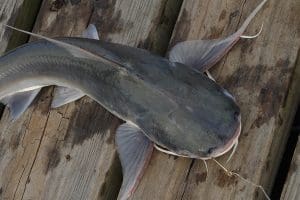
Gafftops have extra-long dorsal fins that look like a sail on a boat, hence the name gafftopsail. They also have long, stringy whiskers. The fish average 2.5 pounds, but can get as big as 15 pounds. They have actually become fairly popular along the coast in no small part due to the CCA Star Tournament offering amazing prizes (boat) for adults and scholarships for kids for catching the biggest during the summer-long event.
For anyone who has never caught a gafftop,be mindful of the slime. These fish have more slime on them than any other fish in the sea. You will actually see it coming up your line when fighting a big one.
Gafftops make hard, determined runs, rubbing against the line and depositing the telltale slime. The stuff then oozes along the line toward the spool like an alien visitor from a 1950s science fiction movie.
These fish are so slimy they play havoc with coastal anglers looking for more desirable species. Feeding game fish like speckled trout and redfish create oil slicks on the water when feeding on baitfish like menhaden. A fresh slick is a sure sign of fish feeding activity unless gafftops are in the area. They often create oil slicks as well and will feed in schools. A big school of gafftops can create a slick big enough to make any angler worth his salt do a double take.
Gafftops usually hang out around fish passes, jetties, and offshore oil platforms, although they can travel far beyond the reach of saltwater.
Gafftops are like their freshwater cousins in that they are suckers for chum and will hit just about any kind of bait. They will even hit soft plastic shrimp imitations designed to catch game species.
Hardheads are a different story altogether.
Hardhead Catfish
Few fish are more maligned and dreaded than the hardhead. Part of the reason is that hardhead fins contain a powerful toxin that causes severe pain, and might even send a person to the hospital. Hardheads do not seek out people to stick, but when removed them from the hook, often flop around and sometimes fin the angler.
I can attest the pain is tremendous. In 1999, a small shark bit me on the leg and a hardhead stuck me a month later. I am not exaggerating when I say the pain from the hardhead encounter was at least five times worse than the small shark bite I received the same year.
Hardheads are smaller than gafftops and do not get much bigger than three pounds. The average hardhead is in the neighborhood of 10 ounces.
Very few anglers actively pursue hardheads, although coastal creel surveys show they are the most commonly caught species in many areas. That is because they are highly abundant along beachfronts and in bay systems where fishing pressure is high, and will hit just about any kind of bait. Shrimp is a favorite, although they gladly accept donations of squid, cut bait, and crab.
I say accept donations because they are skilled bait thieves, which is just fine with many anglers; rebaiting a hook is far better than removing a hardhead.
An interesting note about saltwater cats is that people do not always call them by their common name. In fact, many anglers call them things that are not suitable to print in this publication. Some of the less extreme names for gafftops are slimer, slimy boy, blob fish, slime machine, Mr. Long Whiskers, and ooze fish.
Hardheads are dubbed tourist trout, stinger, thieving cat, #%&*, and other obscenities.
I used to keep all of the big gafftops I caught but there is a consumption warning for Sabine Lake that warns against more than three eight-ounce meals a month. They have pretty white meat that tastes similar to blue catfish, but since you have to get past the slime and there is a possible health threat I skip these days.
The flesh of hardhead is not as good as gafftop, but it is not half bad. Catching a big enough fish to bother cleaning is usually the hardest part. I have eaten hardhead fried, and smoked like salmon. The smoked was better, although it was not quite as good as salmon, to put it nicely.
Chester Moore