
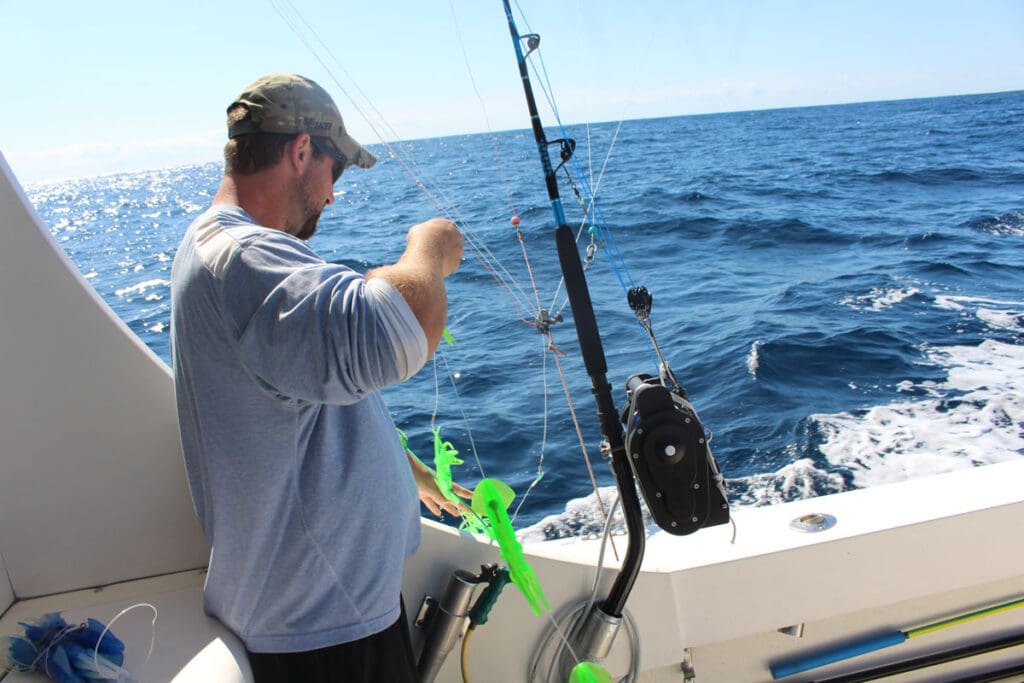
Daisy chains are popular lures for offshore anglers, but few people realize that how you run them will have a huge effect on just how many fish they bring in to the boat. In fact, most people just clip them on the end of a line and send them back without a second thought. That’s a shame, because daisy chains could be doing a whole lot more for you. Conside these three factors the next time you set your spread, and your chances for success will go way, way up.
- Set your chains at a distance where the first lure or two dips in and out of the water. If the first one spends more time in the air than the water, it’s a good thing – those dipping lures drive tuna wild. Every boat and rig is a bit different, but the short rigger is often a great placement to get some dipping going since it elevates the line a bit and gets it out from the whitewash. On boats that don’t have outriggers or a way to get some elevation on the line, your best bet is to get a daisy chain with a mini-bird at the front. You won’t get any dipping but the splashing and commotion the bird creates has a similar effect.
- Run a shirted ballyhoo alongside the daisy chain or ever so slightly in front of it, more or less paralell to dipping lures or the bird. If the daisy chain is on a short rigger, this will usually be in the position of a flat-line or boat rod. Choose a skirt color that’s similar to, but slightly different than, the color of the lures in the chain. A bright lime skirted ballyhoo run near a dark green chain (or vise-versa) would be a good example.
- Watch the chains for billfish, and if one comes up to a daisy chain, pull the chain away as you drop back a naked ballyhoo. Sure, sometimes a billfish will eat the hook-bait on a chain. But often they’ll wack at the chain over and over again without eating. If you start pulling that chain away they get hot – and when you send the ballyhoo back in its place they get hungry.