
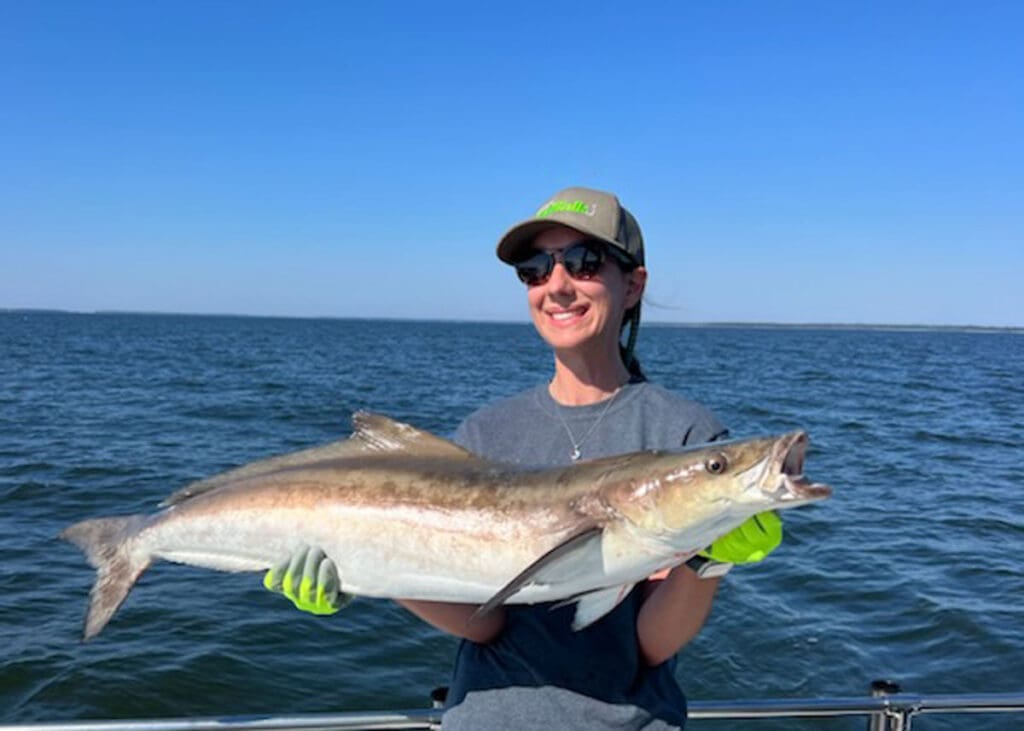
If you’ve spent much time sight fishing for cobia you’ve probably had a few days when you could see and cast to fish after fish, yet none would show an interest in attacking the bait. Are the fish simply not feeding? Is the tide all wrong? Did a full moon allow them to feed all night long? There are a million plausible explanations as to why this happens sometimes. And yet, does it really matter? The bottom line is that we want to catch fish, and that means figuring out how to trigger an attack. Sometimes, thinking outside the box can make it happen.
I do a fair amount of fishing in Virginia when the season opens there, and while that may be a long way off from Texas, last June’s experience does apply. There were cobia just about everywhere, and we were seeing 10 to 25 per day. Out of those fish maybe one or two could be tempted into striking. Maybe.
In Virginia, the standard technique that’s worked as long as there have been cobia and as long as there have been eels has been to cast a live eel to the fish. If the fish isn’t spooked by a splash-down that’s too close and if the eel is close enough to see, the fish generally zooms in and snaps it right up. For whatever reason nature conjured up, last season they simply stopped doing so. Maybe it was the tides, maybe it was the moon, or maybe someone sent an email to all the cobia warning them of the danger. Whatever. The net effect was the same: bites were few and far between. We tried casting jigs and bucktails (the second most common way of catching them in these waters) to no avail. Eventually, someone tried tying on a six-inch jerkbait. He tossed it out, started retrieving, and… WHAMMO! For the next several days, probably half the fish we spotted chomped on a hook. And that hook was always attached to a six-inch jerkbait.
I have no clue whatsoever as to why this was the case, why the fish ignored eels and jigs yet pounced on the jerkbaits. But the lesson here applies to trying to catch cobia in Texas, too. In fact, it applies to all sorts of fisheries across the board: when the usual technique isn’t working, try something completely different. Something you’ve never tried before, or never heard of anyone trying. Because sometimes fish act just plain weird. Throw them a curveball, and the results can be rewarding.