
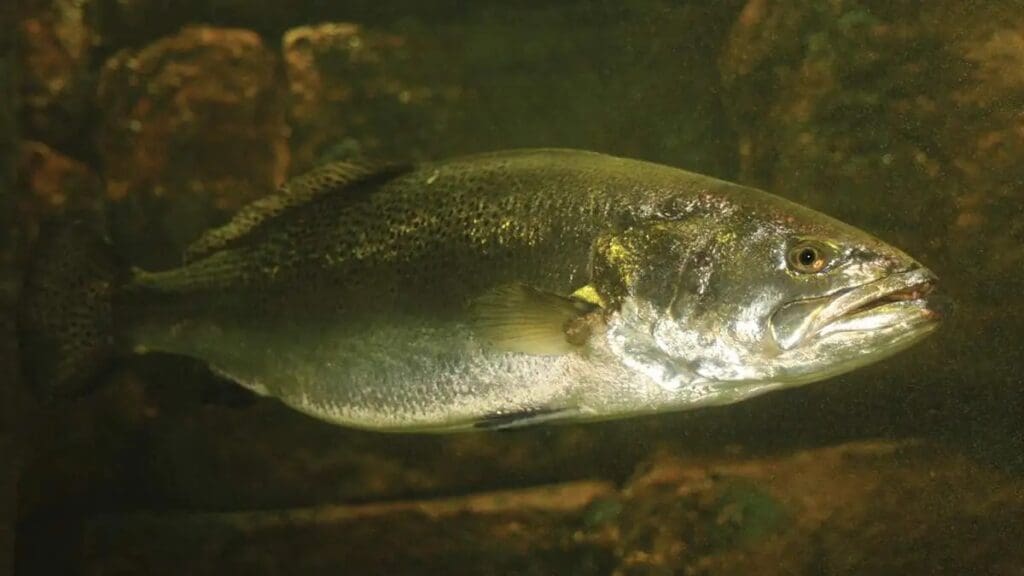
Carl “Bud” Rowland’s speckled trout from 2002 has stood as the Texas state record trout for 23 years.
Caught on fly in the Lower Laguna Madre, the 37-inch behemoth weighed in at a jaw-dropping 16 pounds. But as we move further into 2025, anglers across the Texas coast are left to wonder: Will the record ever be broken? And if so—where?
To answer that, it’s worth examining the history of record-class trout in Texas and the statistical trends (or lack thereof) surrounding them.
Before Rowland’s giant, the record was held by Jim Wallace, who caught a 13-pound, 11-ounce trout in 1996 out of Baffin Bay. That fish toppled a long-standing record held by Mike Blackwood, whose 13-9 catch in 1975 held for 21 years. Interestingly, Wallace’s fish only reigned for six years before Rowland’s Lower Laguna legend hit the books—but since then? Crickets.
And it’s not just the state record that has held firm. Across the Texas coast, every major bay system has produced giants, but the peak years are scattered:
- Sabine Lake: 12 pounds (Kelly Rising, March 28, 1999)
- Galveston Bay: 12,11 pounds (R.J. Spencer, March 19, 2007)
- Corpus Christi Bay: 12 pounds (Filip Spencer, March 18, 2014)
- Matagorda Bay: 10.90 pounds (Mark Idoux, Jan. 20, 1999)
- Gulf of Mexico: 13.13 pounds (Lanny Myers, May 25, 1969)
There’s no clear pattern here—no decade of dominance, no “hot spot” that regularly churns out monsters. Unlike Lake Fork’s big bass bonanza in the late ‘80s and early ‘90s, trophy speckled trout in Texas seem to be one-off wonders, lightning strikes that no one can quite predict.
Even environmental impacts like freeze kills don’t seem to fully explain the gaps. Wallace’s 1996 catch came just seven years after the devastating 1989 freeze, and was likely a survivor of that event—proof that trophy trout can endure and grow under the right circumstances.
But what about the world record?
That mark—17 pounds, 7 ounces—was set in 1995 in Fort Pierce, Florida, and has withstood the test of time. Florida, with its superior trout genetics and warmer waters, arguably provides a better environment for growth. Angler pressure is also more evenly distributed across other species like tarpon, snook, and pompano, giving trout a bit more room to thrive.
Listen to this episode of Higher Calling Wildlife® to learn about big trout in the Gulf.
So, could Texas produce a world record trout? It’s certainly within the realm of possibility—but unlikely under current conditions.
The better question might be: Where is the best shot at a new state record coming from?
Given the evidence, the answer almost certainly lies on the Lower Coast. Rowland’s 16-pounder came from Lower Laguna Madre, and the broad, shallow, hyper-saline waters of this bay system are ideal for producing big trout. The region has lower angling pressure relative to more populous areas like Galveston or Corpus, and warmer winters help fish survive year after year.
That said, Baffin Bay can’t be ruled out. It produced Wallace’s record trout in 1996 and a flurry of 11–12 pounders that same year, signaling that, under the right circumstances, it can compete with any water in the state.
Galveston Bay and Corpus Christi have shown they can kick out 12-pounders, but those catches are often separated by nearly a decade. And while Sabine Lake and Matagorda have entries in the record books, they haven’t produced anything close to 13+ pounds in decades.
So what bay system has the best shot? Lower Laguna Madre remains the frontrunner, with Baffin Bay not far behind. But the big question remains: Will a new Texas record ever be caught—or have we already seen the peak?
It might not be in a bay system at all. Could it be in the Gulf of Mexico with someone catching a record in the surf or at teh short rigs on the Upper Coast?
Only time (and tides) will tell.
What are your thoughts?