
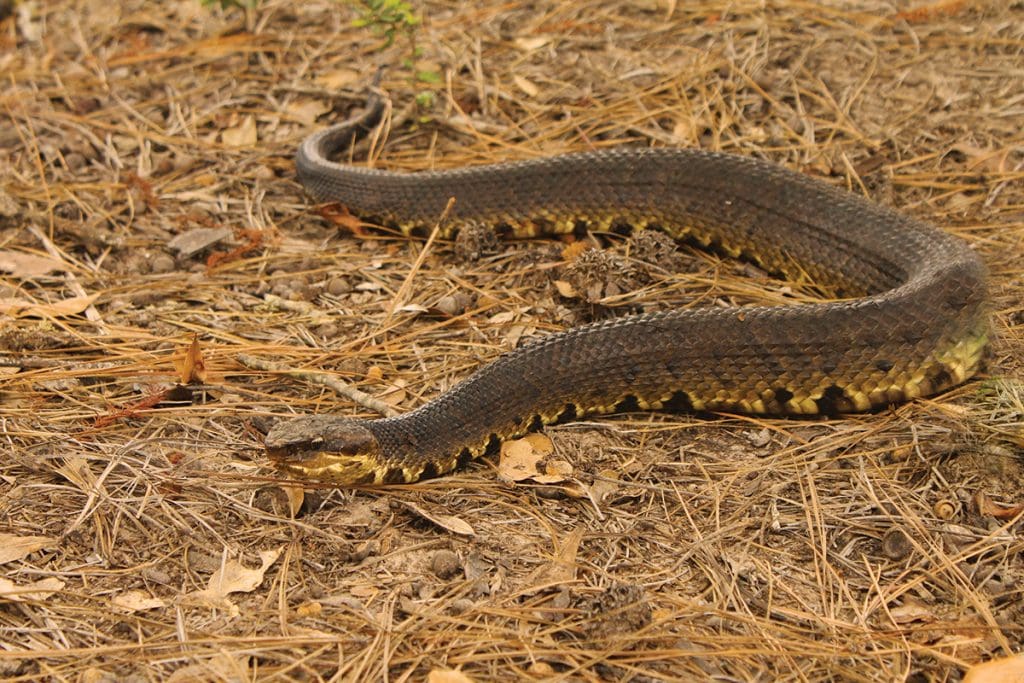
Few snakes spark more debate around Texas fishing holes and bayous than the cottonmouth, also known as the water moccasin (Agkistrodon piscivorus). Found across much of the eastern half of the state, this heavy-bodied pit viper is one of North America’s few venomous semi-aquatic snakes, and its reputation precedes it.
Identification
The cottonmouth earns its name from the startling white interior of its mouth, displayed when the snake feels threatened. Adults can reach three to four feet in length, with thick, muscular bodies colored in dark brown, olive, or black. Younger snakes often show striking crossbands that fade as they age.
Habitat and Behavior
True to its nickname, the water moccasin thrives in swamps, marshes, lakeshores, and slow-moving creeks. Unlike most snakes that flee at the first sign of disturbance, cottonmouths are notorious for standing their ground. When confronted, they may coil, gape, and vibrate their tails—a clear warning to back away.
Despite this reputation, they are not prone to chase humans. More often, they rely on intimidation displays to discourage would-be predators.
Venom and Danger
Cottonmouths are venomous, capable of delivering a hemotoxic bite that can cause tissue damage, swelling, and intense pain. While bites are rarely fatal with modern medical care, they are serious medical emergencies. For anglers, hunters, and hikers, the key is awareness: watch your step near water’s edge, wear boots, and never handle a snake you cannot identify.
Myth Versus Reality
Stories of “aggressive moccasins” are common around campfires, but the truth is more complicated. Like most wild animals, individual behavior varies. I’ve had different kinds of run-ins with cottonmouths.
-
On one occasion, a cottonmouth stood its ground with remarkable aggression, gaping and striking repeatedly.
-
Another time, while easing along a trail at night, I stepped directly on one. To my surprise (and delight!), the snake never struck, merely easing into the brush as if uninterested in conflict.
These moments serve as a reminder that cottonmouths are not mindless aggressors, but complex creatures reacting to their environment. Respect, caution, and a little distance go a long way when sharing Texas waters with these formidable neighbors.
Chester Moore