

| TL;DR
· LiTime’s ArgoSeeker comes in two sizes: the A1 (24V, 700W, 60 lb thrust, 13.45 lbs) and the A2 (48V, 2,000W, 120 lb thrust, 16.53 lbs). · A 2,000W rating converts to about 2.7 horsepower (1 hp is roughly 746 W). The “5HP” on the A2 is an equivalence claim about low-speed push, not a gas-engine power figure. · Runtime is battery watt-hours divided by watts. A 2,560Wh 24V battery would run the A1 flat out for roughly 3.7 hours before losses, and longer at part throttle. · In Texas, a boat pushed by any motor, trolling motors included, must be registered. Electric outboards themselves are exempt from titling and from the outboard motor tax. Short version: the motor is the simple part. The battery sets your range, and at the time of writing LiTime lists the ArgoSeeker as coming soon, with no price. |
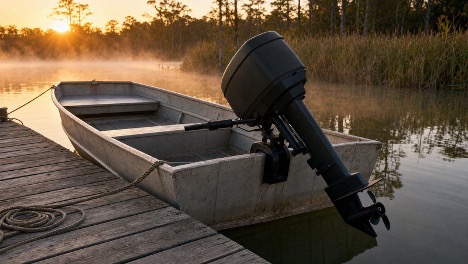
No pull cord. No choke, no fuel line to prime, no exhaust drifting back over the cooler.
LiTime’s ArgoSeeker runs on direct current from a 24V or 48V lithium iron phosphate (LiFePO4) battery. A controller takes orders from a wireless remote and meters that current into a brushless motor, and the motor spins the prop. The A1 is rated at 700 watts and the A2 at 2,000. How hard it pushes and how long it lasts both come back to those numbers and the battery behind them.
Two sizes, one layout
LiTime lists its ArgoSeeker electric outboard motor in two versions built on the same idea: a brushless motor on a 28.22-inch shaft, a clamp that grips the transom without drilling the hull, and a remote in place of a tiller. You can’t buy one yet. The product page says “coming soon” and promises priority air shipping to the first 10 orders, but at the time of writing (September 2026) it shows no price and no launch date.
| Spec | A1 | A2 |
| Battery voltage | 24V | 48V |
| Rated power | 700W | 2,000W |
| Rated thrust and LiTime’s gas equivalent | 60 lb, “2HP” | 120 lb, “5HP” |
| Weight | 13.45 lbs | 16.53 lbs |
| Shaft length | 28.22 in | 28.22 in |
| Boat length (LiTime’s guidance) | 8.2 to 13.1 ft (2.5 to 4.0 m) | 9.8 to 16.4 ft (3 to 5 m) |
| Boat weight (LiTime’s guidance) | Up to about 770 lb (350 kg) fully loaded | Up to about 1,540 lb (700 kg) |
| Hulls LiTime names | Kayaks, canoes, small inflatables | Dinghies, aluminum boats, small fishing boats |
| Weed-cutting blade | Not listed | Built into the propeller |
The A1 is a paddle-craft motor. The A2 is aimed at the aluminum boats a lot of Texas anglers fish from.
Following the power from battery to prop
Four parts sit in a line, and the energy moves through them in order.
It starts at the battery. LiTime says the motor “integrates a dedicated LiTime battery system with a secure waterproof connection.” The rule you can’t bend is voltage: 24V for the A1, 48V for the A2.
Next comes the controller, and you never touch it directly. The 2.4 GHz remote gives stepless speed adjustment (no fixed notches, just a smooth range), cruise control and an emergency stop button, and it handles steering too. LiTime’s own description is that the control system “translates remote commands into coordinated motor output and steering response.”
Then the motor. In a brushless motor the permanent magnets ride on the spinning rotor and the copper windings stay put. The controller energizes those windings in sequence, so the magnetic field rotates and the magnets chase it around. There are no carbon brushes dragging on a commutator to wear out, which is what makes LiTime’s “maintenance-free” claim believable for the motor itself. An electric motor also makes turning force from a standstill, so the prop starts pushing as soon as the controller sends current.
Last, the propeller. The A2 carries what LiTime calls an “integrated weed-cutting blade inside the propeller for improved resistance to weed entanglement.” On grassy Texas lakes that’s the feature worth asking about first. A wad of vegetation wrapped around the hub costs you thrust and battery until you tilt the motor up and pick it clean.
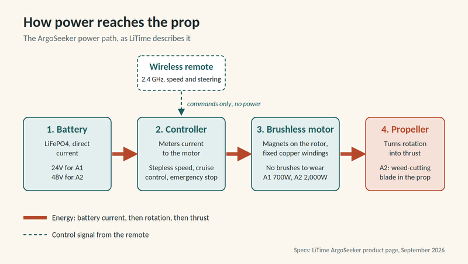
The remote never carries power. It sends commands, and the controller decides how much battery current reaches the motor windings.
Watts, thrust and the “5HP” on the label
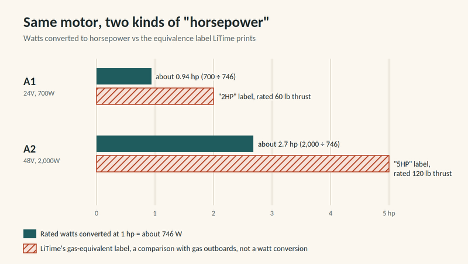
One mechanical horsepower is about 746 watts. The A1’s 700W comes to roughly 0.94 hp (700 ÷ 746), while the A2’s 2,000W comes to roughly 2.7 hp (2,000 ÷ 746). LiTime sells them as “2HP” and “5HP” equivalents anyway. That isn’t a typo. It’s a different kind of number.
Pounds of thrust measure push, the same way trolling motors have always been rated. A gas outboard’s horsepower describes what the engine makes near the top of its rev range. Equivalence ratings compare how hard the two push a boat at low speed, and low-speed push is the job an electric motor is good at.
What the label doesn’t promise is top speed. LiTime publishes none for either model, so don’t assume the A2 will run like a 5HP gas motor wide open.
Runtime is one division
Hours equal battery watt-hours divided by the watts the motor draws. LiTime rates its 24V 100Ah Group 31 TM Smart battery at 2,560Wh ($634.79 at the time of writing). At the A1’s full 700W, that’s 2,560 ÷ 700, or about 3.7 hours. A 48V-class 100Ah LiFePO4 battery at 51.2V nominal holds 5,120Wh, which gives the A2 about 2.6 hours flat out. LiTime sells a 48V battery with that rating but markets it as house power, and the motor page names no pairing, so treat this as arithmetic, not a matched setup.
| Estimated runtime (hours) | A1 on 2,560Wh | A2 on 5,120Wh |
| Full rated power (700W / 2,000W) | 3.7 | 2.6 |
| Half rated power (350W / 1,000W) | 7.3 | 5.1 |
| Quarter rated power (175W / 500W) | 14.6 | 10.2 |
| Full power, stopping at 80% discharge | 2.9 | 2.0 |
These are estimates: nominal battery energy divided by average draw, with no allowance for wiring or controller losses. “Half rated power” means average draw, not half throttle. The last row follows LiTime’s own advice to keep discharge around 80% for best performance.
Nobody runs wide open all day, and draw falls away fast as you ease off. Marine engineers call it the propeller law: the power a prop demands rises roughly with the cube of its speed, so a small throttle cut saves a big share of the watts. When Lenny Rudowtested a small electric outboard on a jon boat for this magazine in 2021, he fished full days, sunrise to sunset, without using half his battery. Different motor, same physics.
Texas paperwork: registered, not titled
Once a motor goes on the boat, Texas treats it as a motorized vessel. The Texas Parks and Wildlife Department’s registration and titling FAQ says all motorized vessels must be registered regardless of length, and it spells out that motorized boats include boats propelled by a trolling motor. So the canoe or kayak that was exempt as a paddle craft needs numbers the day an A1 gets clamped on.
The same FAQ exempts all electric outboard motors from titling, and electric outboards are the only ones exempt from the outboard motor tax. The boat still needs a title. The motor doesn’t.
What to check before you hang one on your transom
- Get a price and find out what’s in the box, including whether a battery ships with the motor or is sold separately.
- Match the battery: 24V for the A1, 48V for the A2, with enough watt-hours for your day plus some margin.
- Weigh the boat the honest way, loaded with people, gear and the battery, and hold that number against LiTime’s limits.
- Measure the transom. LiTime hasn’t published a clamp range, so check thickness and height and make sure the 28.22-inch shaft keeps the prop well under the surface.
- Ask for the missing specs. Runtime, top speed, waterproof rating, reverse and warranty terms aren’t on the page yet.
- Put registration numbers on the hull before the first Texas launch.
An electric outboard is a simple machine: watts go in, push comes out, and the battery keeps score. What LiTime has published explains how the ArgoSeeker works. The numbers still missing will tell you whether it works on your boat, so get them in writing before your name goes on the order list.