

October is a special month for redfish along the Texas coast, and anglers willing to look beyond the traditional shallow flats have a chance to encounter some truly massive fish.
On Oct. 1, 2008, a 39.13-pound redfish measuring 48 inches was caught in the Upper Laguna Madre. The fish is listed in Texas Parks and Wildlife Department records as the water body’s all-tackle record, with Dr. E. Stanton Shoemaker credited with the fly-rod catch.
That is an extraordinary fish by any standard, particularly for an inshore bay system. It also demonstrates something anglers sometimes overlook when targeting redfish: Not every giant red comes from the surf, jetties or open Gulf.

Texas has one of the great redfish conservation success stories in American fisheries management. Decades of protective regulations, commercial netting restrictions, hatchery stocking and careful management helped restore a fishery that had suffered tremendous declines during the 1970s and early 1980s.
Today, Texas anglers benefit from that conservation legacy. Size and bag limits protect much of the spawning population, giving more redfish the opportunity to survive into older, larger age classes. Although most mature redfish eventually move into Gulf waters, some occasionally return to bays, and those fish can provide unforgettable encounters.
The key is knowing where to look.
Deep Shell and Big Reds
One of the most overlooked habitats for oversized redfish is deep shell.
Most anglers associate redfish with shallow oyster reefs, grass flats and marsh shorelines. Those are excellent places to catch reds, but anglers specifically searching for larger fish should investigate oyster reefs and shell-covered bottom adjacent to deeper water.
The best areas often feature substantial changes in bottom depth, particularly where a shell reef drops into a channel or deeper basin.
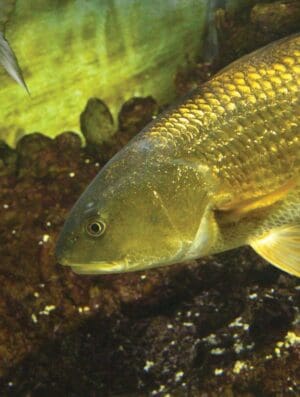
These locations provide feeding opportunities for redfish pursuing crabs, mullet and other forage. Shell also creates irregular bottom contours and current breaks that can concentrate bait.
Rather than fishing directly on top of the shallowest shell, work the deeper edges. Look for subtle breaks where the bottom falls several feet and where tidal movement sweeps food across the structure.
A fresh chunk of mullet presented along the deeper edge of a reef can be an excellent way to intercept a large redfish.
Where Man-Made Canals Meet the Bays
Another location worth investigating is the intersection of deep man-made canals and main bay points.
These areas can be especially productive because they combine several important features: deep water, shallow feeding habitat, current and access to concentrated baitfish.
Consider a canal dredged substantially deeper than the surrounding bay. Where that canal opens into the main bay, the bottom often changes abruptly, creating a drop-off near the mouth.
If a prominent point extends into the bay nearby, the location becomes even more interesting.
During periods of tidal movement, mullet and other forage may concentrate around these intersections. Redfish moving between deeper water and nearby feeding areas can take advantage of those conditions.
Anglers should work both sides of the canal mouth, paying particular attention to the corners where the channel intersects the bay bottom.
These are also excellent locations to fish during changing weather conditions. When strong winds make shallow flats difficult to fish, deeper canals can provide alternative habitat worth exploring.
The important thing is not simply finding a deep canal. It is finding one connected to productive feeding areas.
Channel Edges and Drop-Offs
Ship channels, intracoastal waterways and smaller bay channels offer another opportunity to locate oversized redfish.
The most promising areas are not necessarily the deepest parts of the channels themselves. Instead, focus on the transitions where relatively shallow bay bottom drops toward deeper water.
Points, bends and irregular channel edges can be particularly attractive.
Look for places where moving water crosses a shallow flat and spills into a channel. These locations can concentrate forage, giving large redfish opportunities to feed without traveling far from deeper water.
A depth finder can be invaluable for locating these areas. Even a relatively modest change in depth can be important when combined with shell, current and baitfish activity.
Anglers fishing these locations should remain mindful of commercial vessel traffic and avoid anchoring in navigation channels.
Follow the Mullet
If there is one forage species anglers should pay particular attention to when searching for monster reds, it is mullet.
Large redfish are powerful predators capable of consuming substantial baitfish. Mullet provide a tremendous food source, particularly during fall when concentrations of these fish become increasingly noticeable along the Texas coast.
Schools of mullet moving across bay points, along channel edges or around shell reefs deserve close attention.
But don’t assume the biggest reds will always be crashing bait on the surface.
Sometimes the most productive location is directly beneath or adjacent to a concentration of mullet, especially where the baitfish are holding over a deeper bottom feature.
Fresh cut mullet is one of the best natural baits for large redfish. A substantial chunk fished near the bottom can attract fish that might ignore smaller offerings.
Live mullet also deserve consideration, particularly when anglers can position them naturally along channel edges and other feeding areas.
Crabs are another major food source.
Large redfish feed heavily on crustaceans, and areas with abundant blue crabs can be excellent places to concentrate an oversized-redfish search.
A fresh blue crab presented on the bottom near shell or a channel drop-off is a proven approach. Texas Parks and Wildlife identifies fresh cut mullet, larger live mullet and blue crab among the best natural baits for bull redfish.
Timing the Fall Bite
October offers an interesting combination of seasonal conditions for redfish anglers.
Water temperatures are generally moderating from summer extremes, baitfish are moving through coastal systems and mature redfish are associated with their fall spawning season near Gulf passes.
Not every big redfish will be inside the bays. In fact, many of the largest adults spend most of their lives in Gulf waters.
However, deeper bay structures, particularly those connected to passes and major channels, can provide opportunities to intercept oversized fish.
Tidal movement is especially important.
Rather than selecting fishing locations based entirely on the time of day, pay attention to when water begins moving across productive structures. A shell reef or channel intersection that seems lifeless during slack water can become productive once the tide starts moving.
Strong tidal flow can also make bait presentation difficult, so use enough weight to keep natural baits near the bottom without unnecessarily restricting their movement.
Heavy spinning or conventional tackle, abrasion-resistant leaders and appropriately sized circle hooks are good choices for targeting large redfish around shell and channel structures.
Because oversized reds are valuable spawning fish, handle them carefully, minimize time out of the water and release them promptly when not legally retained. Check current Texas red drum regulations and tagging requirements before fishing.
A Different Kind of Redfish Hunt
There is nothing quite like seeing a school of redfish pushing water across a shallow flat or watching copper-colored tails waving above the grass.
But anglers interested in catching the biggest redfish of their lives should consider a different approach.
Look deeper.
Find the shell reefs that drop into channels. Investigate the mouths of man-made canals where they intersect prominent bay points. Search for underwater ledges and channel bends where tidal movement concentrates mullet and crabs.
The conservation efforts that restored Texas redfish populations have created tremendous opportunities for today’s anglers, and those opportunities extend well beyond catching slot-sized fish on the flats.
That 39.13-pound Laguna Madre redfish is a reminder of just how impressive a Texas bay redfish can become.
And October is an excellent time to go looking for one.
Chester Moore