
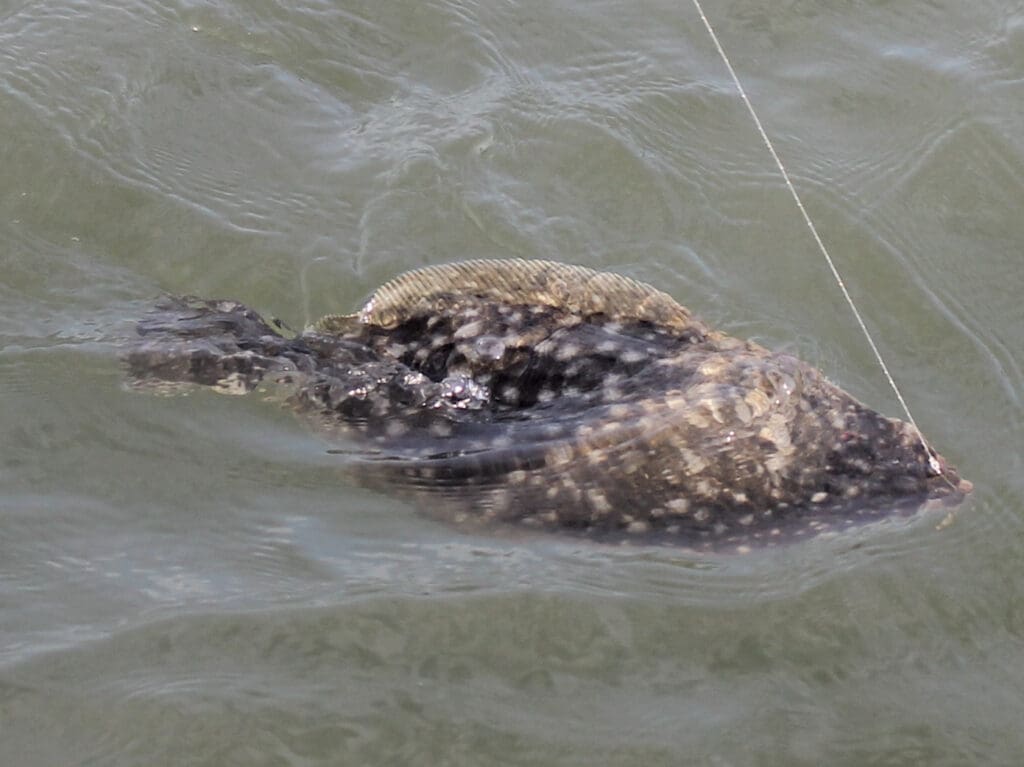
A few years back, after countless hours on the water and more than a little luck, I stumbled onto something unusual—something that felt like the edge of a mystery waiting to be unraveled. It had to do with flounder feeding not along the bottom, as we typically expect, but higher up in the water column.
The pattern seemed to emerge in areas where shallow flats dropped steeply into deeper water. During high tide, I’d look for schools of baitfish—mainly menhaden (shad) or shrimp—tight against the shoreline. That was the key. If you paid close enough attention, you might have seen flounder striking at the surface or even breaching entirely. Most anglers passed right by, never realizing what was happening just beneath (or above) the surface.
Back then, I rigged up with a 7’6” medium-action spinning rod, a dependable saltwater spinning reel, 30-pound braided line in a natural green shade, and a 40-pound fluorocarbon leader about 2.5 feet long. My go-to lure was a 4-inch soft plastic swimming mullet, rigged beneath a stout, long-casting popping cork that made a sound remarkably like a predator striking at the surface.
I positioned myself so I could cast parallel to the shoreline, starting just a few feet off the bank and working my casts out toward the drop-off. A couple of strong pops, then a pause—five to ten seconds. That sound, that pause… it triggered something. The cork I used had a distinct pop that was a dead ringer for a trout smashing bait, and the long casting range made it perfect for reaching those fish that weren’t hugging the bank.
I’ll never forget the moment that really solidified it. I watched my late father hook into a flounder well over 20 inches long after spotting it strike at bait nearly 45 yards out. He cast right to it—and got an immediate reaction strike.
At the time, I typically used lighter corks when targeting flounder—and rarely at that—but this situation was different. These fish were fired up, feeding with an intensity I hadn’t seen before. They weren’t the ambush predators hugging the bottom; they were hunting with purpose, reacting to noise and motion at the surface.
Sometimes the cork would vanish instantly with a hard strike. Other times, it would slowly slip under, like a crab was pulling it down. In those cases, I’d feed a bit of line, and if it started to drift away with a fishon.
Knowing when to set the hook wasn’t always obvious. I found that waiting until I felt the weight of the fish or saw the float stay submerged worked best.
That bite pattern lined up with when shad began bunching along deeper banks, and it stayed consistent for a stretch.
As summer nears and shad begin piling up, it might time to try this again.
Chester Moore